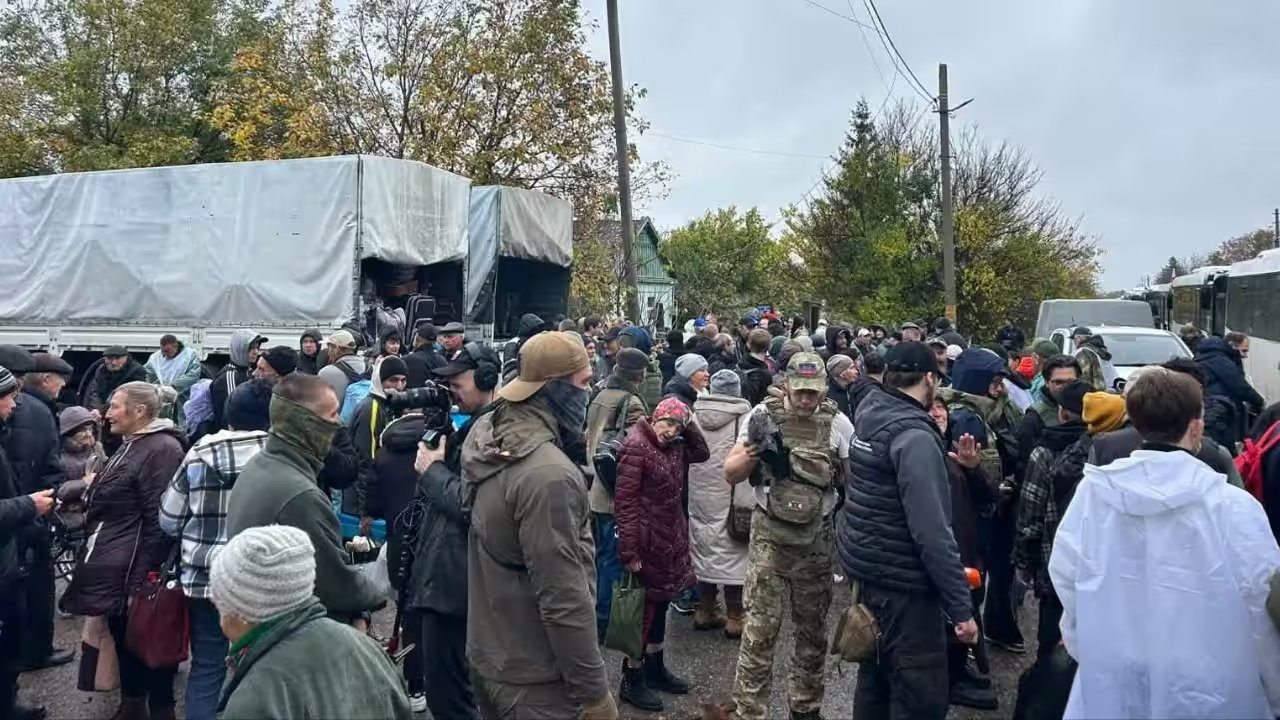
Three planes touched down at Gomel airport in Belarus on Saturday, carrying hundreds of exhausted, starving residents who had been trapped in the Russian-occupied town of Oleshky since the war’s early days. It was the first joint humanitarian evacuation of its kind in four years and eight months of conflict, made possible by a temporary ceasefire that allowed a 25-bus convoy to clear a landmine-strewn road out of the devastated town. The move, brokered personally by US First Lady Melania Trump, marked a stark shift from the grinding stalemate on the Kherson front, where a broader ceasefire has held since Tuesday.
The logistics were precise and tense. Residents wishing to leave were given a four-hour window on Friday to board buses heading to the Russian resort town of Anapa. From there, they were flown to Gomel, where they will cross into Ukraine via a designated border checkpoint. Russian human rights ombudsman Yana Lantratova confirmed the operation proceeded without incident, praising the “high level of organisation” between opposing forces. Ukrainian authorities verified that the evacuees, many of whom had been denied basic necessities for months, were indeed traveling south to rejoin their families.
The diplomatic nuance here is significant. Trump stated that the “safe passageway in and out of Oleshky” was established through mutual agreement between Russian and Ukrainian leaders, positioning the US First Lady as a neutral facilitator rather than a partisan actor. This rare alignment of convenience for both Moscow and Kyiv highlights the humanitarian crisis in occupied territories, where civilians are often used as bargaining chips. The four-hour window was not a gesture of goodwill but a calculated operational necessity to clear the corridor before the ceasefire expired.
The immediate next step involves the physical transfer of these hundreds of individuals into Ukrainian territory, a process that will test the durability of the ceasefire framework. Lantratova and her Ukrainian counterpart have jointly appealed to Trump to institutionalize these missions, requesting that humanitarian operations be conducted regularly under her coordination. Whether this leads to a broader humanitarian corridor or remains a one-off PR victory for the White House remains to be seen, but the precedent of a direct, joint US-brokered evacuation is a new and fragile thread in the war’s tapestry.