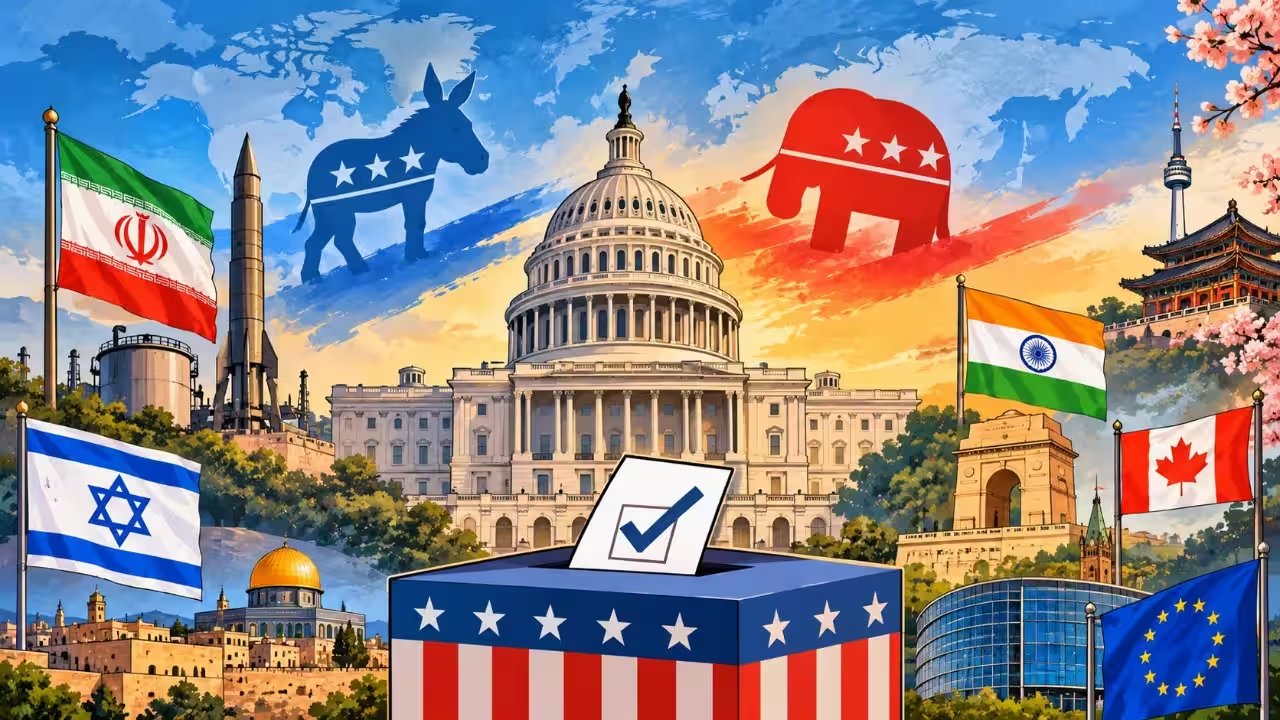
Democrats seized control of both the House and Senate in the US midterm elections, handing Congress to the opposition party and upending President Donald Trump's legislative footing. The shift immediately triggered diplomatic ripples across three critical fronts: Tehran, Jerusalem, and New Delhi. For Trump, the loss represents a significant political setback, yet it may paradoxically push him to pursue quick foreign policy wins to salvage his administration's narrative.
In Tehran, Supreme Leader Mojtaba Khamenei dismissed the electoral shift as irrelevant to US-Iran relations. In a written message published on Wednesday for Iran's annual anti-US commemoration, Khamenei warned that Washington seeks Iran's “unconditional surrender” and that any compromise would invite further military aggression. “If anyone still hopes for a change in behaviour or a shift between political parties and factions in the system of domination, they are gravely mistaken,” he wrote. Khamenei, who has not appeared in public since the war began on February 28, emphasized that US military power is not invincible, citing Iran's actions in the Strait of Hormuz as proof.
In Israel, the Democratic takeover introduces uncertainty over US support. Analysts note that Democratic control of Congress increases scrutiny over the war in Gaza and US military assistance. The 2028 presidential race looms large, with candidates like Zohran Mamdani and Abdul El-Sayed, who are critical of Israel, gaining traction. This could pressure future Democratic nominees to adopt a tougher stance toward Jerusalem, regardless of their personal views.
For India, the shift poses a different challenge. The Global Trade Research Initiative (GTRI) suggests Trump may use executive powers to pressure New Delhi into a quick trade deal, seeking a diplomatic win amidst setbacks in Russia, China, and Iran. The proposed agreement involves greater US access to Indian agricultural and industrial markets, commitments to purchase $500 billion in American goods over five years, and alignment on security policies. Additional tariffs linked to India's Russian oil purchases remain a concern, though a Democratic Congress may offer some legislative scrutiny of Trump's tariff policies.
As Washington adjusts to the new congressional balance, global partners brace for a more cautious and strategically driven US foreign policy. The next few weeks will reveal whether Trump pivots to diplomacy or escalates military postures, particularly in the Middle East, while trade negotiations with India and Canada intensify.