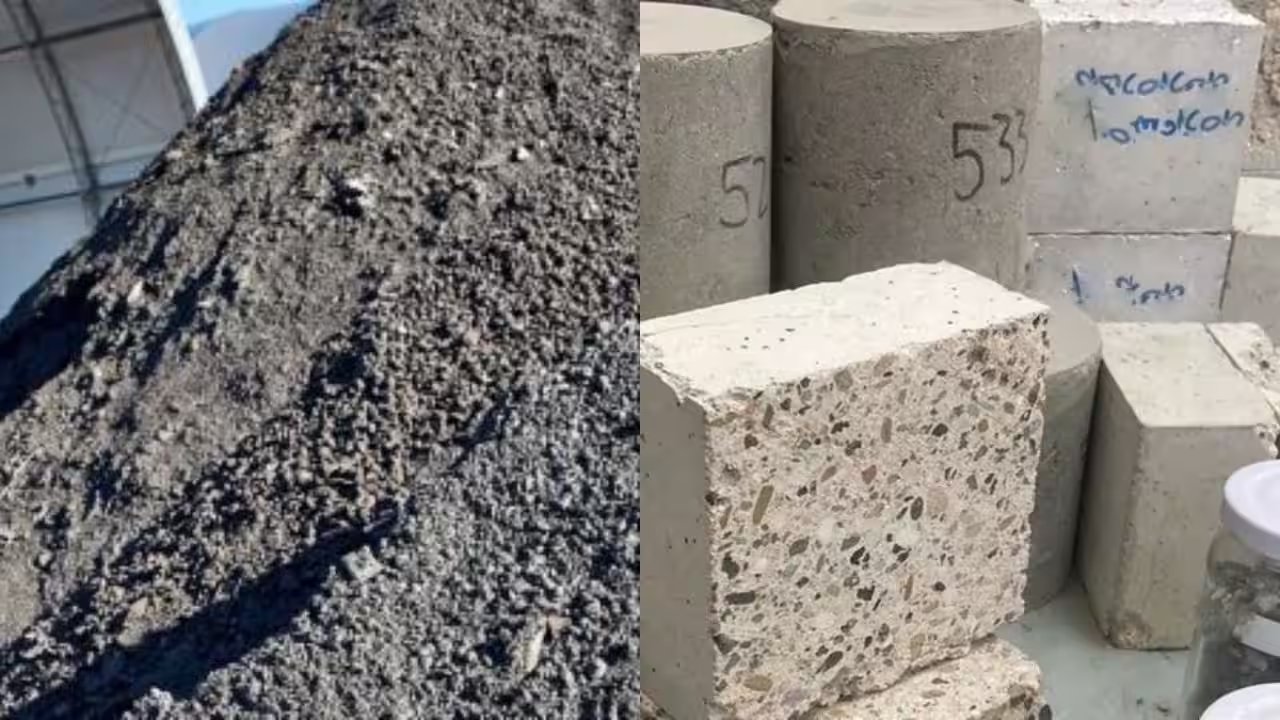
COLOGNE — German incinerators churn through mountains of domestic refuse every year, burning municipal trash down to six million tonnes of dense, mineral-laden bottom ash. Most of it ends up buried or stored under strict environmental controls. Now, a research coalition backed by North Rhine-Westphalia's government is mounting a campaign to turn that hazardous post-combustion liability into carbon-locking aggregate for highways and buildings.
German universities TH Köln and RWTH Aachen have teamed up with regional waste authority Bergischer Abfallwirtschaftsverband (BAV) on the initiative, dubbed KARMA. The project secured more than €1 million from North Rhine-Westphalia's carbon capture and utilisation (CCU) program to run industrial-scale carbonation trials through mid-2028. The goal is simple: trap industrial carbon dioxide inside waste ash minerals, immobilise toxic residues, and curb the construction sector's voracious appetite for freshly quarried aggregate.
Raw bottom ash straight from the furnace cannot touch civil engineering projects. It is toxic. Unprocessed incinerator ash carries elevated levels of heavy metals, soluble salts, dioxins, and furans. Industrial partner refer GmbH first processes the raw material at specialised treatment works, stripping out scrap metals through screening and magnetic sorting before delivering a cleaned mineral residue to the scientists.
Carbonation locks gaseous CO2 into the ash by triggering reactions between the gas and calcium-bearing mineral compounds, converting them into stable carbonates. Once locked inside, the carbon dioxide remains trapped permanently.
To move past test tubes, the team is building an industrial test unit at the Leppe waste disposal centre near Lindlar. The pilot plant will pit two distinct chemical approaches against each other under operating conditions designed to mimic industrial waste facilities:
| Carbonation Process | Operational Mechanism | Technical Trade-Off | Status at Leppe Facility |
|---|---|---|---|
| Wet Carbonation | Ash processed directly in water slurries | Delivers higher CO2 absorption; demands heavy thermal drying energy | Pilot evaluation |
| Low-Moisture Carbonation | Ash exposed to gas under strictly controlled humidity | Low thermal energy footprint; creates dense outer skin limiting CO2 depth | Pilot evaluation |
Either approach forces researchers to confront a difficult engineering bottleneck. Wet systems capture significantly higher volumes of carbon dioxide because moisture accelerates mineral dissolution, but evaporating that water afterward consumes substantial energy. By contrast, running the process with restricted water saves energy, yet builds a chalky mineral armor over each grain that stops carbon dioxide from penetrating the core.
Axel Wellendorf, lead researcher at TH Köln, laid bare the trade-off confronting the engineering team.
In this method a carbonated layer is formed on the surface of the ash. But the layer can get quite dense and keep carbon dioxide from getting deeper into the material. This means less gas is being stored.
Axel Wellendorf, TH Köln Researcher
Engineers must calculate whether the net carbon ledger justifies the drying fuel, or if thin-layer surface carbonation yields sufficient mechanical strength to satisfy highway engineering codes.
The Leppe pilot unit will run trials through June 2028, testing structural integrity, leaching stability, and carbon saturation limits before municipal agencies permit carbonated ash on public highway contracts.