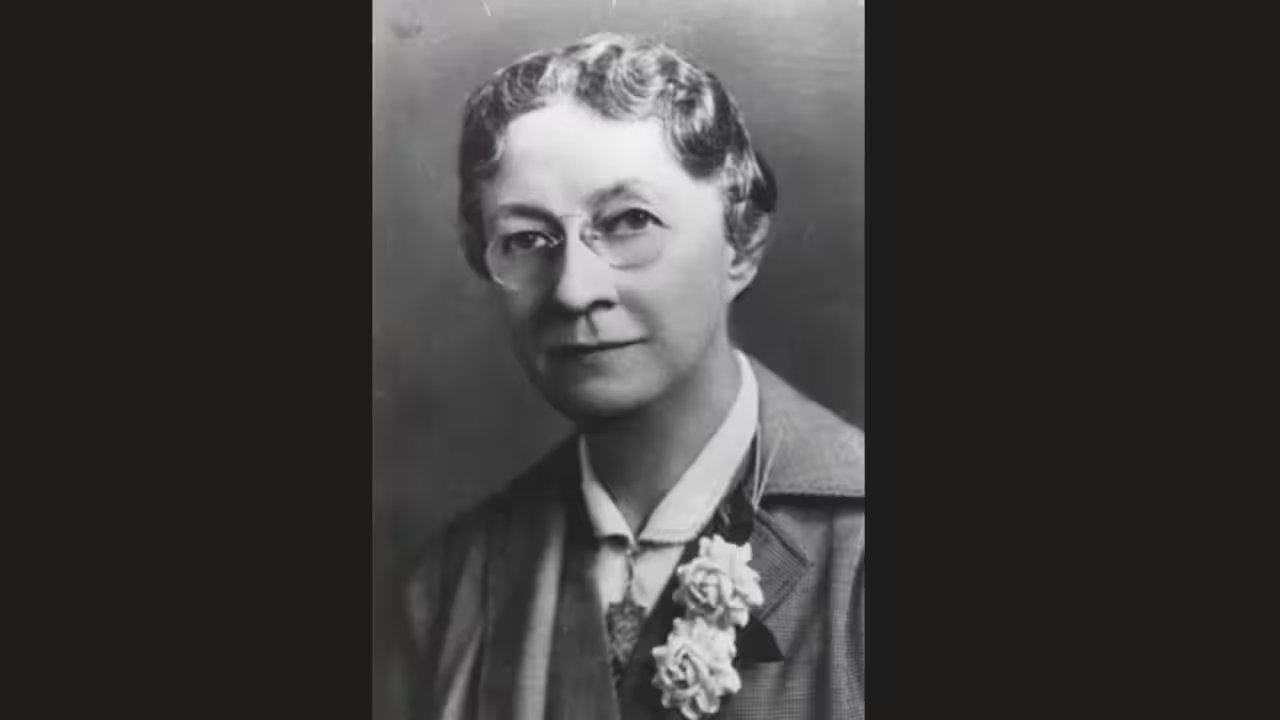
Before federal authorities regulated the purity of commercial perishables, spoiled food routinely sickened American consumers. The science of keeping milk, poultry, and eggs edible during cross-country transport barely existed. Mary Engle Pennington transformed that reality. Working across municipal labs, federal agencies, and rail yards, she turned cold-storage preservation from an ad-hoc commercial gamble into an exact bacteriological science. Her protocols became the backbone of modern food safety standards across the United States.
But her scientific career nearly stalled before it began. When Pennington was 12 years old, she discovered Rand's Medical Chemistry at a local library and became obsessed with laboratory research. She immediately asked the headmistress of her private girls' school to launch a chemistry course. The administrator refused outright. Chemistry, the headmistress insisted, was no subject for girls. Pennington rejected the verdict.
She pushed forward. At age 18, Pennington enrolled at the University of Pennsylvania to study chemistry and biology. The university barred women from earning degrees at the time. Yet her lab performance proved so undeniable that the faculty awarded her a certificate of proficiency in 1892. Three years later, in 1895, the institution granted her a doctorate in chemistry.
Earning the degree did not guarantee a job. Academic and commercial laboratories routinely shut their doors to female scientists. Pennington responded by launching the Philadelphia Clinical Laboratory. There, she conducted bacteriological analyses, focusing on tainted raw milk supplies and ice cream sold to school students. She educated local dairy farmers on basic sanitation, proving that unhygienic milking practices bred lethal bacterial colonies before the product ever reached city carts.
Harvey Wiley, head of the US Department of Agriculture's Bureau of Chemistry, noticed her work. In 1905, Wiley recruited Pennington to investigate refrigeration failures and bacterial decay. The timing was critical. Congress cleared the Pure Food and Drugs Act of 1906, giving federal regulators statutory power to penalise contaminated supplies.
Wiley needed a director for the newly established Food Research Laboratory. He wanted Pennington. Knowing federal hiring boards routinely rejected women, Wiley filed her civil service application under the name "M.E. Pennington." She scored the highest marks in the country. Bureaucrats protested when her gender became public, but Wiley pushed back, citing civil service rules that forbade exclusion on gender grounds. Pennington secured the post in 1906, becoming the first woman to direct an FDA-affiliated laboratory.
Civil service law did not permit her exclusion simply because she was a woman.
Historical records, US Food and Drug Administration
She tackled food spoilage immediately. Pennington demonstrated that perishables could survive long-distance transit only if kept at constant, low temperatures without fluctuation. Her team developed industrial guidelines for processing chicken, handling raw eggs, and pasteurising dairy products. The food industry adopted her bacteriological thresholds as standard practice.
| Career Milestone | Year | Historical & Industrial Impact |
|---|---|---|
| Certificate of Proficiency, UPenn | 1892 | Completed chemistry and biology coursework despite university ban on female degrees |
| PhD in Chemistry | 1895 | Overcame graduate barriers to enter bacteriological research |
| Philadelphia Clinical Laboratory | Post-1895 | Formulated dairy and ice cream safety standards for schoolchildren |
| Chief, Food Research Laboratory | 1906 | Scored highest on civil service exam; first woman to lead the federal bureau lab |
Global conflict brought her biggest logistical challenge. When the United States entered World War I in 1917, Pennington joined the War Food Administration under future President Herbert Hoover. Her assignment focused on stopping food wastage across the national railway network.
She climbed inside boxcars herself. Pennington tested the cooling efficiency, airflow, and ice bunkers across the country's fleet of 40,000 refrigerated railcars. By redesigning floor racks and modifying air circulation patterns, her team eliminated temperature hot spots that caused entire cargo shipments of meat and dairy to rot en route to Atlantic supply ports.
| War Food Administration Assignment | 1917 | Inspected and standardised cooling designs for 40,000 national railcars |