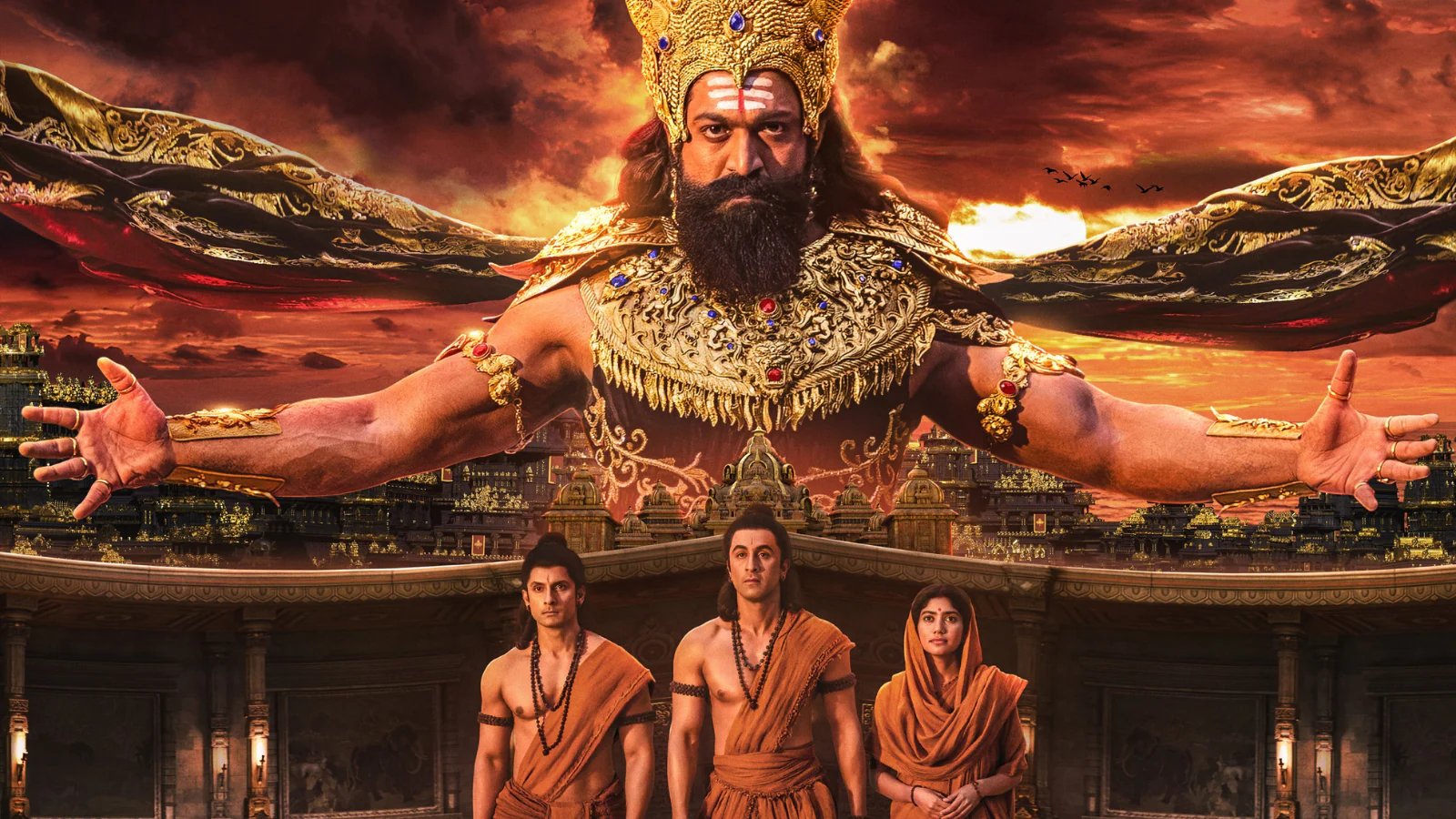
The box office receipts arrived fast. Nitesh Tiwari’s epic screen adaptation of Ramayana blasted past the ₹1,000 crore mark worldwide in eight days, turning its monstrous production bet into an immediate commercial triumph. But beneath the ticket run lies a three-year construction marathon that nearly broke the conventional rules of Mumbai set design.
Partners Subrata Chakraborty and Amit Ray spent 36 months laying the physical bricks and timber for Ayodhya and Lanka. Their goal was straightforward: fool the viewer's eye so thoroughly that digital illusion blends invisibly into physical plaster. In Ayodhya's cavernous throne room, the duo built 70 percent of the space as an operational, practical set, leaving the remaining 30 percent for computer-generated visual extensions.
The illusion worked. Audiences argued over what was built by hand and what was rendered by machine processors.
The good thing is people are confused about what physical sets are and where we used VFX. We wanted viewers to be unable to tell what was set and what was VFX. That is a huge thing for us.
Subrata Chakraborty framed the visual design around psychological contrasts. Ayodhya received cool, muted palettes to project serenity, calm, and regal abundance. Lanka, by contrast, was conceived from scratch as architectural arrogance—a city engineered to look like an unbridled ego. For Janasthan, the creative team looked outside traditional Indian sketches, pulling stone carvings and spatial aesthetics directly from Cambodia alongside Southeast Asian references surrounding Sri Lanka.
| Production Parameter | Verified Detail |
|---|---|
| Global Box Office Run | ₹1,000 crore milestone cleared in 8 days |
| Pre-Production & Build Timeline | 3 years of architectural research and physical construction |
| Ayodhya Throne Room Split | 70% practical build, 30% VFX digital ceiling |
| Architectural Reference Pool | Southeast Asian and Cambodian motifs for Janasthan |
| Direction & Production Core | Nitesh Tiwari (Director), Namit Malhotra (Producer) |
| Production Design Leads | Subrata Chakraborty, Amit Ray, Ramsey Avery |
The world-building began with early concept passes led by Hollywood artist Ramsey Avery, working alongside Tiwari and producer Namit Malhotra. Avery handed over foundational blueprints, but Chakraborty and Ray stepped in to ground those western conceptual sketches with authentic Indian detailing, soil textures, and regional architectural motifs.
The shoot brought relentless mathematical scrutiny. Chakraborty pointed out that any slight misalignment between live cameras and green screens ruins the shot.
We had to work against green screens. We had to understand how to enhance the forest and how it would blend with our design. We didn't know where to put the elements, how to create the texture or how much to slide. It was a mathematical film. If the mathematics was even a little off, the VFX would be off. That's why VFX can look fake. We had to make everything mathematically accurate so that when the VFX was created after our work, it would look real.
With ticket sales holding strong and the ₹1,000 crore barrier breached, the film's technical blueprint now sets the standard for how large-scale Indian mythological cinema balances physical craft against digital scale.