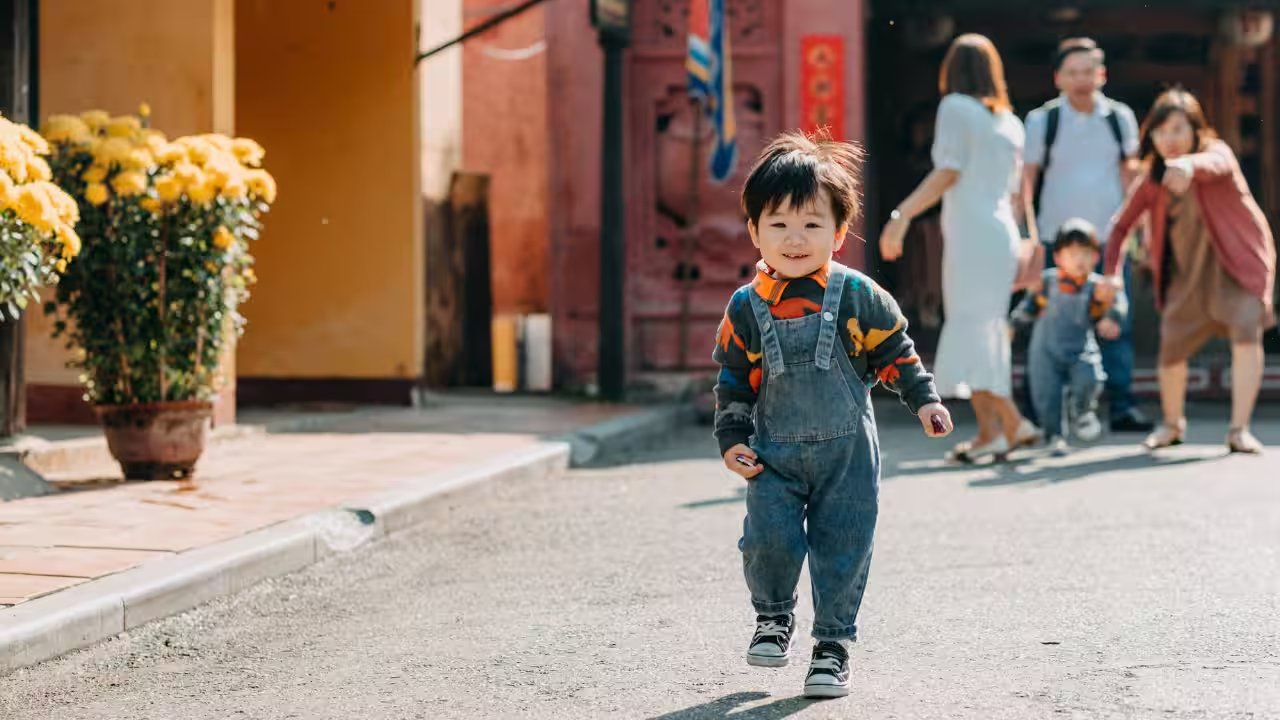
Every parent knows the sudden jolt of panic. You hold a small hand along a crowded path, look down for a second, and your child bolts. They sprint toward a pond, an open gate, or a packed pavement.
Your heart thumps. You shout their name. The natural human reaction is irritation, accompanied by a sinking suspicion that your child has decided to disobey you in broad daylight.
Yet developmental science tells a radically different story.
Toddlers are not miniature adults calculating how to bend household rules. They are new movers testing out brand-new limbs in a world they have never mapped before. Data published by the National Library of Medicine shows that during an hour of free play, an average toddler logs approximately 2,400 steps, travels 700 metres, and crashes to the ground 17 times. That relentless velocity is not malice—it is pure biomechanical practice.
| Developmental Metric | Measured Toddler Frequency (Per Hour of Play) | Primary Source |
|---|---|---|
| Total Steps Taken | ~2,400 steps | National Library of Medicine |
| Distance Covered | ~700 metres | National Library of Medicine |
| Falls Recorded | ~17 falls | National Library of Medicine |
| Gaze Fixed on Destination | ~16% of walking bouts | Eye-Tracking Locomotion Research |
| Two-Year Milestone Achievement | ≥75% of children run | US Centers for Disease Control and Prevention |
Adults run to get somewhere. Toddlers run because running is the objective.
Eye-tracking investigations examining early childhood mobility reveal that toddlers gaze at a targeted destination ahead of time in only 16 percent of their walking bouts. The remaining 84 percent of the time, they move without a fixed end point in mind. Many of these locomotor sequences last just one to three steps before shifting direction entirely.
Even physical environment changes little about this urge. Comparative observational trials tracked 15-month-olds placed inside rooms packed with toys versus completely empty rooms. The children moved just as frequently in bare rooms as they did in spaces filled with playthings. The urge to mobilise does not require external bait.
In her foundational developmental review Learning to Move, researcher Karen Adolph points out that moving infants are essentially "learning to learn." Movement bridges raw sensory perception with real-time motor control. Every surface change—from slick marble to uneven grass—forces the young brain to recalibrate balance on the fly.
Infants are 'learning to learn' as they master locomotion... exploration is what connects perception with motor control." >
Karen Adolph, Developmental Locomotion Researcher
A 2019 study published in Frontiers in Psychology confirmed this link between cognitive curiosity and raw motor activity. Researchers found that an infant's innate curiosity prompts them to engage directly with objects and people on their own initiative. The moment children learn to walk, their gross motor engagement surges dramatically as they actively seek out tactile feedback across their environment.
Public health agencies also treat rapid transit as standard biology. The US Centers for Disease Control and Prevention lists running directly on its two-year developmental milestone checklist. The agency notes that at least 75 percent of children reach this physical milestone by age two.
A child breaking into a sprint across a park is clearing an expected neurological hurdle, not staging a rebellion. Understanding those 2,400 steps an hour helps caregivers swap public embarrassment for watchful, informed supervision as toddlers build their bodies from the ground up.