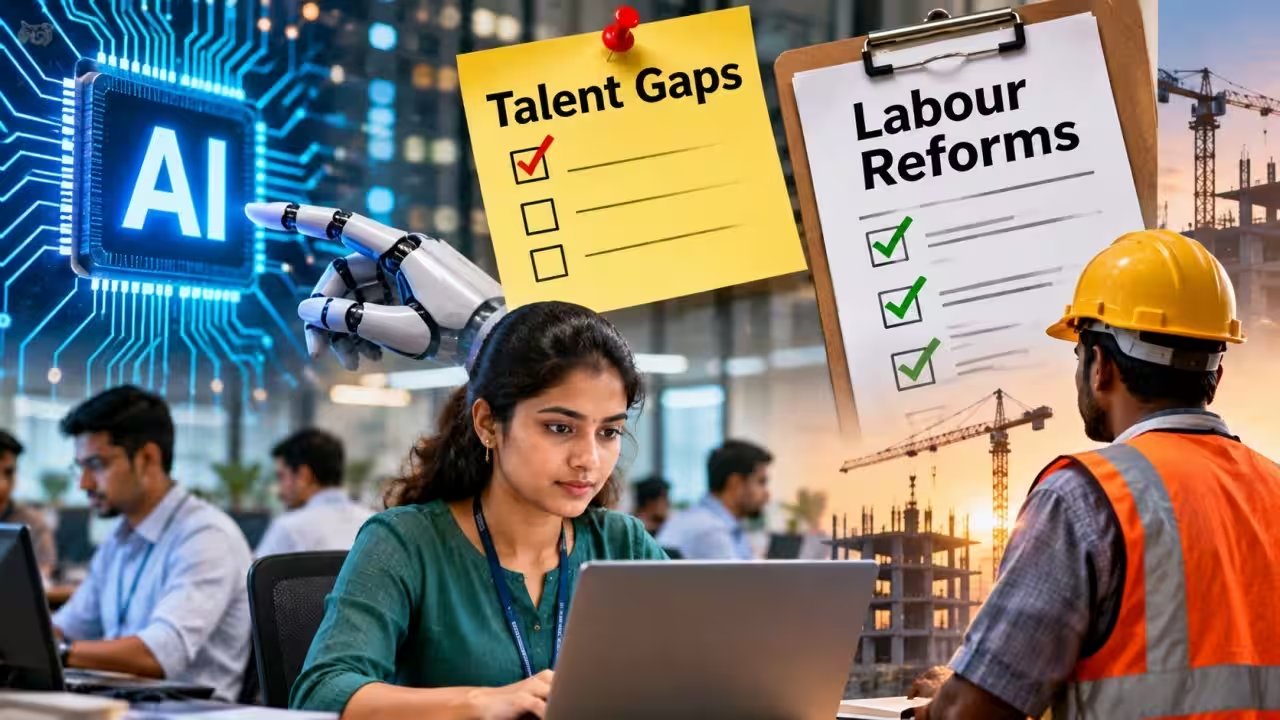
India Inc is stepping up hiring, but finding qualified personnel has turned into an operational bottleneck.
Net Employment Change across corporate payrolls will rise to 5.4% during the second half of fiscal 2026-27, climbing from 4.7% recorded in the preceding six months, according to the latest TeamLease Employment Outlook Report. The survey canvassed 1,239 enterprises spanning 23 industries across 20 cities. Sixty percent of employers plan to expand their headcounts, up from 58% in the prior half-year cycle. Yet the surge in recruitment intentions conceals an acute structural bind: 72% of employers preparing to hire anticipate moderate to severe roadblocks in finding workers equipped to handle modern operational workflows.
Skill shortages are stalling talent pipelines. Recruiters can no longer settle for single-track qualifications.
Artificial intelligence has entered corporate operations at scale, but firms are keeping deployments inside strict perimeters. While 85% of surveyed employers confirm operational use of AI and Generative AI applications, only 13% have embedded these platforms across more than half their staff. Instead, 54% of enterprises limit AI tools to one-quarter or less of their workforce, with the single most common deployment band resting between 11% and 25%.
Rather than dismantling white-collar divisions wholesale, companies are layering automated systems directly over legacy desks. Logistics providers deploy algorithmic routing and automated scheduling. Service networks run diagnostic assistants. Contact centers rely on machine learning for initial query resolution. For workers, the baseline requirement is no longer dodging automation—it is proving they can operate beside it without slowing down production.
The primary barrier to payroll expansion is a severe mismatch between existing labor competencies and technological demands. Digital literacy has emerged as the most sought-after capability in the market, sought by 59% of employers across all operational bands. Customer experience management trails at 51%, while communication proficiencies stand at 48%. Teamwork and adaptability register as non-negotiable baselines for 44% of hiring committees.
Digital capability is no longer reserved for software engineers. Warehouse loaders must log freight across digital inventory networks. Retail cashiers must manage integrated checkout consoles, cloud billing channels, and real-time customer data feeds. Domain competence alone no longer guarantees employment.
| Hiring Parameter & Operational Metric | Survey Baseline (HY2 FY 2026-27) | Prior Period Baseline (HY1 FY 2026-27) |
|---|---|---|
| Net Employment Change Projection | 5.4% | 4.7% |
| Employers Planning Workforce Expansion | 60% | 58% |
| Employers Anticipating Hiring Difficulties | 72% | Not Assessed |
| Firms Utilizing AI or GenAI Systems | 85% | Not Assessed |
| Firms Deploying AI to Under 25% of Staff |
Talent deficits are cutting straight across key operational divisions. Information technology desks suffer the most acute crunch, with 39% of expanding employers reporting severe difficulty in closing open seats. Sales and marketing divisions face a nearly identical squeeze at 38%, as commercial teams struggle to adapt to data-led distribution models. Engineering divisions register a 32% friction rate, while blue-collar recruitment desks report hiring shortfalls of 31%.
"Being skilled will no longer mean simply being proficient in one particular trade or function," noted Balasubramaniam A in the TeamLease analytical assessment. "It will mean having the ability to combine domain knowledge with digital fluency, communication and adaptability."
Market Context: India's macroeconomic demographic advantage provides scale, but raw headcounts do not solve corporate skill deficits. The labor market is responding to three simultaneous structural forces: rapid operational AI rollouts, persistent competency deficits, and the phased implementation of new labor codes. Without immediate corporate investments in continuous internal reskilling, structured vocational coursework, and expanded apprenticeship programs, the gap between open positions and job-ready workers will continue to choke business growth across both digital and physical supply chains through the next fiscal cycle.
| 54% |
| Not Assessed |
| Firms Deploying AI to Over 50% of Staff | 13% | Not Assessed |
| Digital Literacy Priority Rate | 59% | Not Assessed |
| IT Hiring Difficulty Level | 39% | Not Assessed |
| Sales & Marketing Hiring Difficulty Level | 38% | Not Assessed |
| Engineering Hiring Difficulty Level | 32% | Not Assessed |
| Blue-Collar Hiring Difficulty Level | 31% | Not Assessed |