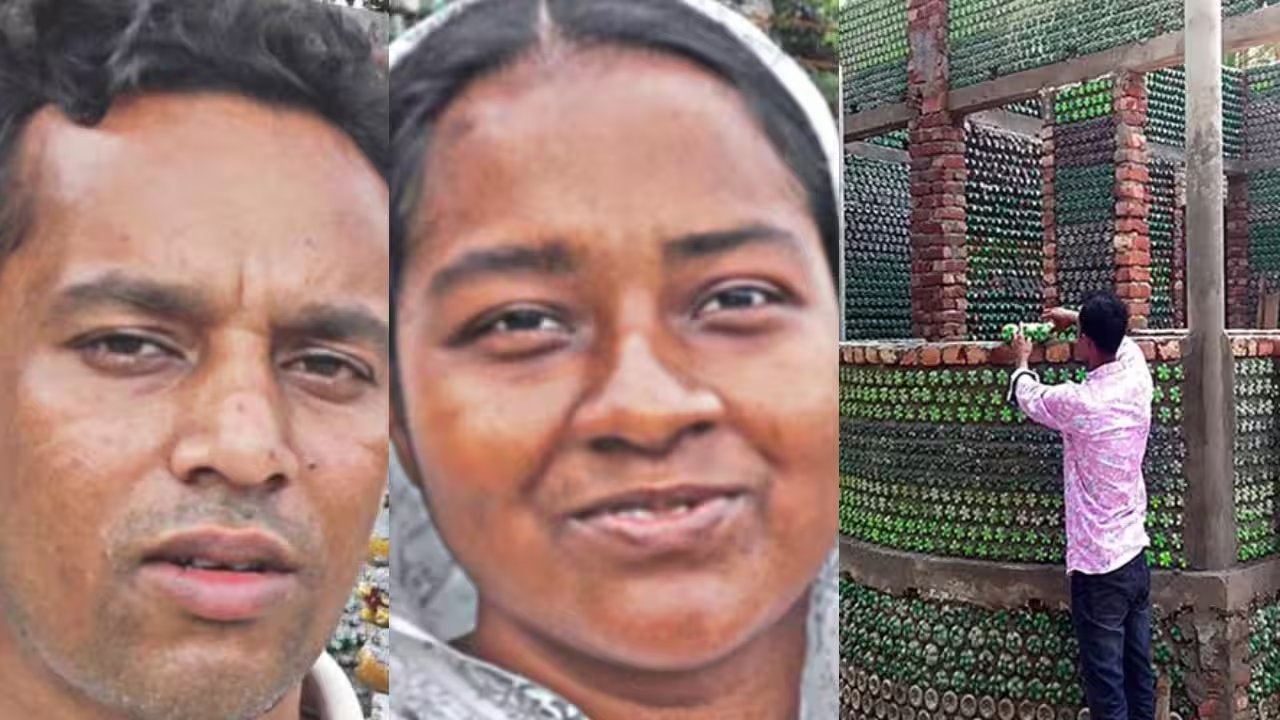
Forget the typical 'upcycling' aesthetic of a single shelf or planter. Rashedul Alam and Asma Khatun went full structural. In a remote village in Lalmonirhat, Bangladesh, this couple has erected a 1,700-square-foot residence—complete with four bedrooms, a kitchen, and two washrooms—using approximately 80,000 plastic bottles. The home is reportedly the first of its kind in the country. It wasn’t just a DIY project; it was a calculated move by two environmental science graduates to solve a housing problem while addressing local waste. For their only son, who is differently-abled, this house is a sanctuary built from materials that were once destined for landfills.
The construction method is surprisingly robust. Each bottle is filled with sand, creating a dense, weighty block. These are then bound together with a mixture of sand and cement, while brick chips and iron rods provide the necessary structural framework to handle the load. The roof is standard corrugated tin, and the doors and windows are steel and wood. It’s not a fragile art installation; it’s a load-bearing structure. The tactile difference is immediate: the walls are solid, insulated by the air pockets in the bottles, and completely different from the cold, hard brick one is used to.
Sourcing that much plastic was a logistical headache. Rashedul, 33, spent time negotiating with authorities at the BSCIC industrial zone and local vendors to secure the raw material. But the real hurdle was human. Convincing local masons to work with bottles instead of bricks was tough. They’d never seen it. Skepticism was high. Yet, as the walls rose, curiosity replaced doubt. Photos of the half-finished structure started circulating on Facebook, drawing visitors to the site who wanted to see the process firsthand. The social proof kicked in fast.
Experts are taking note. An associate professor from the architecture department at Bangladesh University of Engineering and Technology (BUET) told Prothom Alo that while bottle homes exist globally, this is the first he’s encountered in Bangladesh. He called it an environment-friendly creation. Parvez Newaz Khan, an engineer with the Local Government Engineering Department in Kaliganj upazila, pointed out the cost advantage. This type of construction is cheaper than conventional builds. He suggested that with further research, this method could even feature in future government housing policies.
If you’re looking to incorporate sustainable materials into your own home, don’t try to build a house out of bottles—that requires engineering knowledge and permits. But the principle is sound: repurposing dense, waste materials as insulation or infill can reduce costs and environmental impact. For now, the Alam-Khatun home stands as a testament to what happens when you refuse to let waste be just waste. It’s a home, first and foremost. And it’s built to last, one bottle at a time.