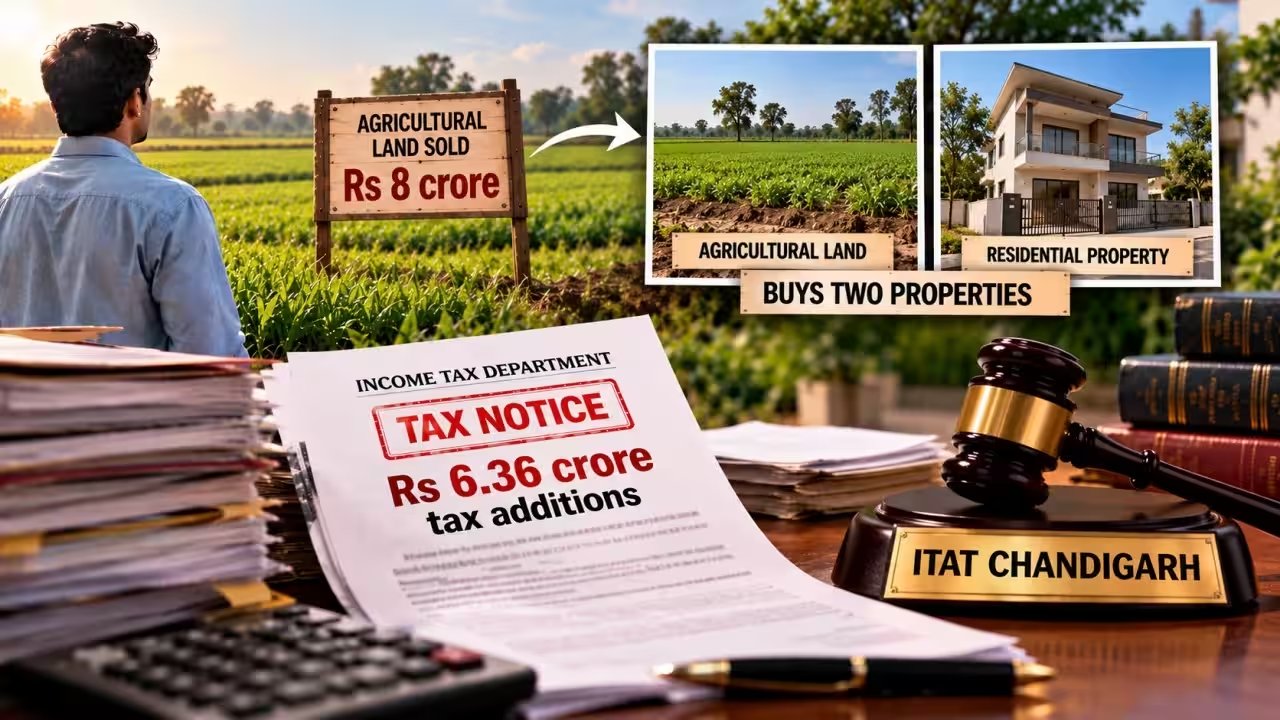
Arun Sharma, a 52‑year‑old farmer from Panchkula, sold his family’s agricultural land for Rs 8 cr in 2017, declaring a Rs 7.73 cr long‑term capital gain in his 2018 return. He sought relief under Sections 54B and 54F by buying two new properties in Chhat and Sanoli villages and operating a restaurant‑office complex in Dhakoli, Zirakpur.
The Assessing Officer denied the full exemption, disallowing Rs 2.64 cr under 54F and Rs 3.73 cr under 54B, which triggered an addition of Rs 6.36 cr and a notice. Sharma appealed to the Commissioner of Income Tax (Appeals), which granted him only partial relief on the 54B claim and upheld the 54F rejection.
The crux of the 54F objection lay in Sharma’s alleged ownership of more than one residential house. The Commissioner treated his Dhakoli property—a commercial restaurant‑office—as a residential house, thereby violating the single‑house requirement. Sharma contested this classification at the Income Tax Appellate Tribunal (ITAT) in Chandigarh.
The ITAT ordered an on‑ground verification of the Dhakoli property. A physical inspection revealed the premises were situated in a commercial zone and used exclusively for business activities. The tribunal concluded the property could not be deemed a residential house for exemption purposes.
On 1 Sept 2026, the ITAT overturned the Commissioner’s decision, cancelling the Rs 6.36 cr addition and reinstating Sharma’s full exemption under both Sections 54B and 54F. The ruling clarified that a commercial property cannot be treated as a residential house for LTCG relief, reinforcing the need for accurate property classification.
For Sharma, the victory means his family can finally invest the sale proceeds into a new farmstead planned in the outskirts of Panchkula, while his restaurant and office operations continue to serve the local community.