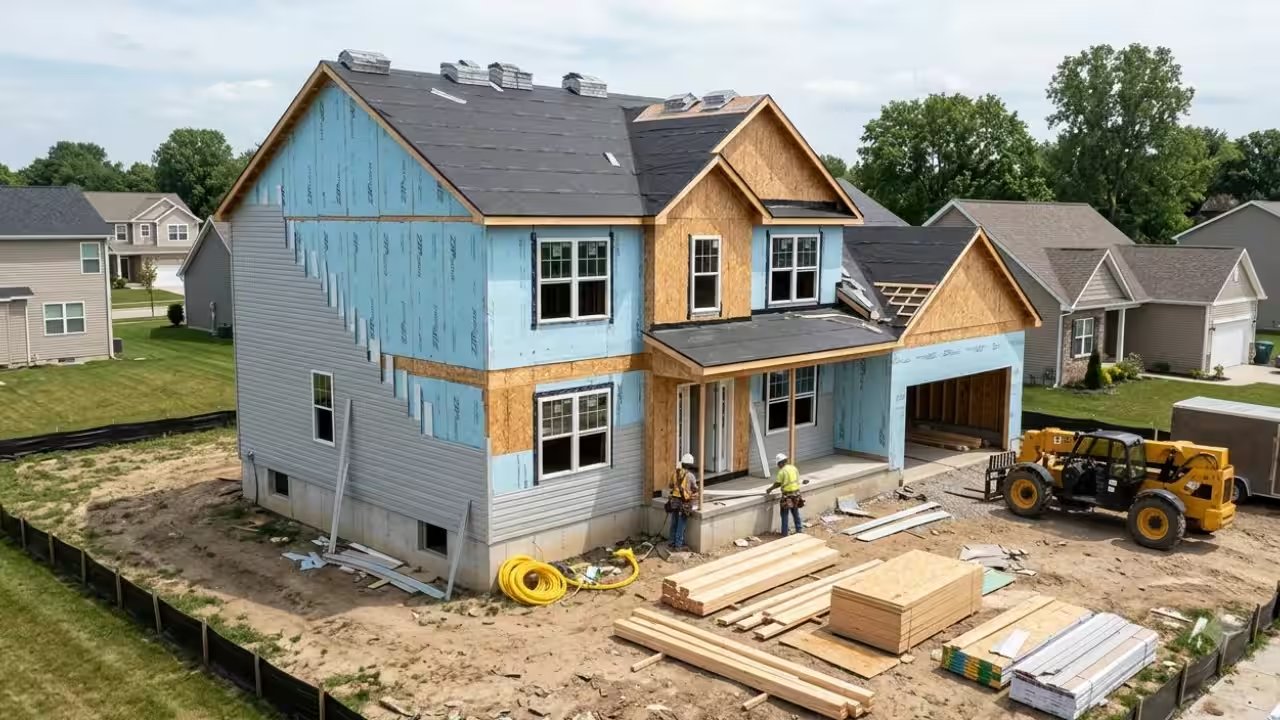
An Indiana appeals bench has ordered a couple to pay $221,704 to a contractor after they withheld more than half the cost of a modular residence over disputed structural flaws.
Losing the appeal on November 9, Tim and Judy McAfee must now cover the remaining $110,235 purchase balance alongside attorney retainers and expert witness fees. The dispute ended an escalating four-year legal brawl. The couple had refused to pay Goeglein Homes, LLC, insisting the contractor delivered an incomplete and defective dwelling.
Judges ruled otherwise. The court determined that the builder substantially completed the structure and that the homeowners unlawfully blocked crews from finishing remaining punch-list repairs.
The dispute dates back to December 2021, when the McAfees contracted Goeglein Homes to prepare and install a modular residence. The base agreement stood at $210,650, eventually climbing to $211,235 after the couple selected an upgraded stove. Under the split-responsibility agreement, Goeglein Homes undertook foundation pouring, municipal permits, and plumbing rough-ins. The homeowners assumed responsibility for site electrical service, driveway grading, well digging, the septic system, and exterior landscaping.
Goeglein Homes procured the manufactured dwelling from Cavco Manufacturing, LLC, and set the modular unit onto the property in October 2022. Two months later, the couple remitted a $100,000 partial payment. They withheld the remaining $110,235.
Tensions snapped in March 2023 following an independent private home inspection. The report cited cracked concrete piers, sloping interior floors, attic framing defects, and pooling water inside the crawl space. When Goeglein's project manager arrived on-site to inspect the grievances, Judy McAfee ordered him off the property. Tim McAfee confirmed during subsequent proceedings that he barred company tradespeople from stepping onto the parcel again.
Cooperation dissolved. Goeglein Homes filed a breach-of-contract lawsuit in May 2023 demanding the remaining contract balance. The McAfees counter-sued, claiming defective workmanship and abandonment. A court-ordered mediation in May 2024 collapsed when both sides deadlocked over who bore responsibility for inspecting the perimeter drain tile.
During the bench trial in February 2026, the dispute turned on technical engineering evidence. Goeglein Homes presented structural engineer Jeremy Bowers, who conducted an on-site structural assessment of the dwelling. Bowers testified that the residence complied fully with standard residential modular building codes. He told the court that hairline foundation fissures represented typical curing shrinkage rather than structural displacement. Addressing the crawl-space moisture, Bowers testified that water had pooled because exterior roof downspouts were improperly routed—a drainage obligation assigned under the contract to the homeowners.
The McAfees countered with Andre Mourad, whom they sought to qualify as an expert witness. That strategy unraveled under cross-examination. When asked in court to identify the underlying scientific methodology behind his structural conclusions, Mourad admitted:
Quite simply, there are none.
Andre Mourad, Proposed Expert Witness
The trial judge disqualified Mourad from offering expert testimony, leaving Bowers' engineering assessment uncontradicted. The court ruled that Goeglein Homes had substantially performed its contractual obligations by March 20, 2023, and that the McAfees breached the agreement when they withheld final payment and denied site access.
| Contract & Litigation Metric | Official Case Figure |
|---|---|
| Original Contract Value | $210,650 |
| Adjusted Contract Value (Stove Upgrade) | $211,235 |
| Initial Payment Made (December 2022) | $100,000 |
| Outstanding Principal Withheld | $110,235 |
| Offset Credit for Incomplete Items | $8,800 |
| Initial Trial Judgment (April 2026) | $197,889 |
| Final Affirmed Judgment (With Fees) |
In April 2026, the trial court ordered the McAfees to satisfy the $110,235 outstanding principal plus legal costs. After subtracting an $8,800 credit for minor unfinished tasks, the court entered judgment at $197,889, which later escalated to $221,704 following supplemental fee assessments.
The McAfees appealed, arguing Goeglein Homes had walked off the job and demanded final payment without filing a formal completion notice. The Indiana Court of Appeals rejected the argument in its November 9 ruling. The appellate bench highlighted that the contract contained no provision requiring a formal written completion notice. Crucially, the court emphasized that the couple's own actions—physically expelling the contractor's project supervisor and locking out work crews—prevented the firm from completing cosmetic punch-list items.
With the Indiana Court of Appeals affirming the judgment in full, the ruling returns to the trial docket for enforcement proceedings, leaving the McAfees liable for the complete $221,704 award alongside accrued post-judgment interest.
| $221,704 |