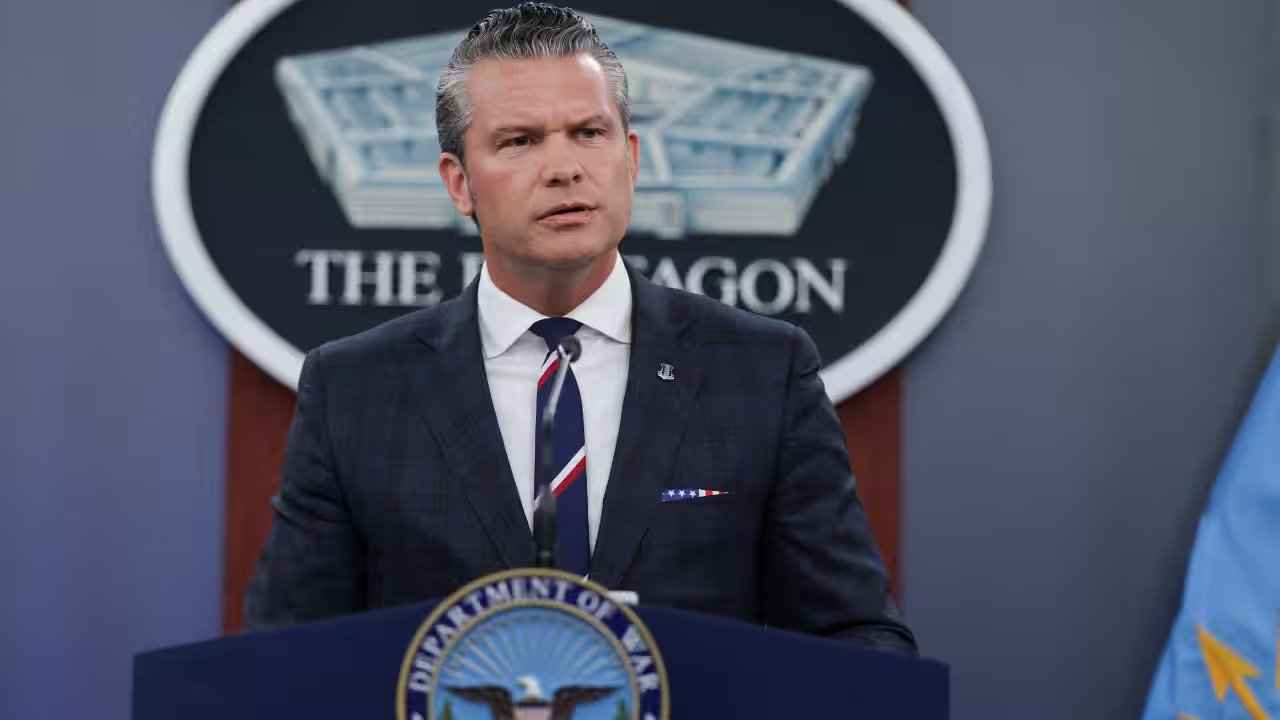
WASHINGTON — US Defence Secretary Pete Hegseth mounted a fierce defense of the administration's military campaign against Iran on Tuesday, refusing to endorse Vice President JD Vance's public assessment that the conflict triggered heavy Republican defeats in the midterm elections.
Speaking at a Pentagon news conference, Hegseth pushed back against suggestions of internal chaos, sidestepping Vance's diagnosis while backing the strikes without reservation.
“I respect JD greatly, and I’m certainly not going to engage in any finger-pointing,” Hegseth said. He drew a sharp line between battlefield command and electoral fallout. “Thankfully, politics is not really my thing. I do the Department of War and make sure we’re prepared and ready.”
The clash exposes raw friction across the administration's national security apparatus following a bruising election cycle. Vance had pinned blame for Republican congressional setbacks squarely on the decision to enter the war. Hegseth stood firm. Asked directly whether he would back the strikes again despite intense public opposition, his answer was immediate.
“Absolutely,” Hegseth said. “It was done for the right reasons to ensure Iran never gets a nuclear weapon.”
Hegseth anchored his defense to President Donald Trump's initial war authorization and aligned himself with Secretary of State Marco Rubio, who had previously acknowledged the public blowback. Hegseth echoed Rubio's calculation that military force overrode voter sentiment.
It’s not necessarily popular, but it may have been necessary, and that’s certainly how I feel.
Pete Hegseth, US Defence Secretary
The White House has cited multiple security grounds for the offensive. National security officials pointed to Tehran's accelerating ballistic missile infrastructure and intelligence detailing imminent plans to strike American military outposts and regional allies across the Middle East. That rationale followed a White House declaration in June 2025 asserting that targeted US air strikes had “obliterated” Iran's nuclear enrichment capabilities.
Yet deep fractures persist behind closed doors. Hegseth deflected questions regarding reports that White House Chief of Staff Stephen Miller is privately pushing to halt the war. He insisted Miller remained consumed with the demands of his newly assumed role, adding only that he planned to meet him soon to establish operational cooperation.
| Administration Figure | Official Stance on Iran Campaign | Post-Election Assessment |
|---|---|---|
| Pete Hegseth (Defence Secretary) | Supports military action; willing to strike again | Rejects finger-pointing; insulates Pentagon from politics |
| JD Vance (Vice President) | Critical of conflict's domestic fallout | Blames war for Republican midterm losses |
| Marco Rubio (Secretary of State) | Defends military intervention as essential | Acknowledged campaign was unpopular but necessary |
| Donald Trump (President) | Ordered strikes to cripple nuclear threat | Maintained action was fully justified |
Beyond the debate over Tehran, Hegseth faces an escalating fight for his own post. The news conference turned directly to an impeachment drive brewing on Capitol Hill, where opponents have sought to strip the Defence Secretary of his command.
Hegseth confirmed that the Pentagon's legislative affairs division is actively whipping votes alongside House Republican leadership to smother the measure before it gathers floor momentum. He credited House Speaker Mike Johnson with running point on the defensive operation and noted direct coordination with House Majority Whip Tom Emmer.
The administration is actively lobbying lawmakers on the fence, Hegseth said, arguing that members of Congress are beginning to scrutinize the foundational claims behind the resolution rather than rushing into an unwarranted floor vote.
“Whether they love everything that’s been done, they don’t want to vote for something that isn’t real,” Hegseth said, praising Republican colleagues for examining the facts before acting.
House leadership will gauge whip counts on the impeachment effort over the coming legislative days, while Hegseth is scheduled to sit down with Miller to determine whether the administration presents a unified military strategy heading into the next congressional term.