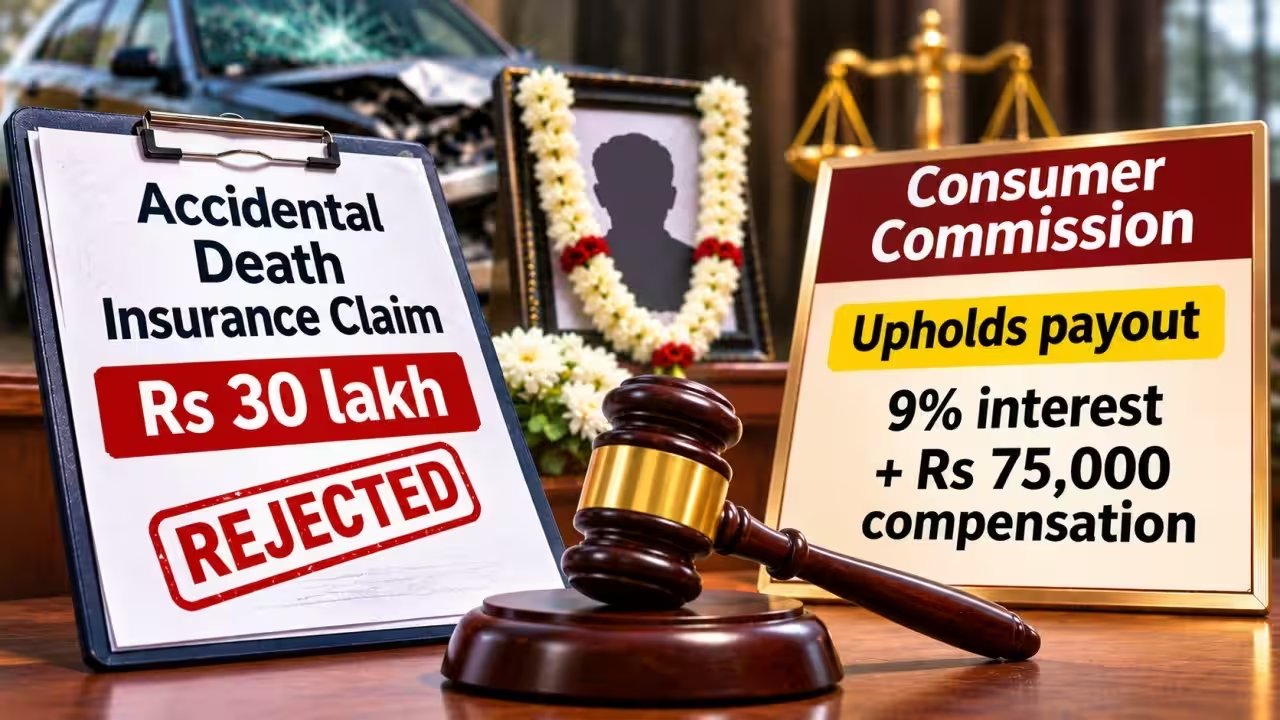
CHENNAI — The Tamil Nadu State Consumer Disputes Redressal Commission has ordered Tata AIG to settle a ₹30 lakh accidental death claim, firmly dismissing the insurer's attempt to deny compensation to a deceased pensioner's family through unsubstantiated claims of alcohol consumption.
The verdict upholds a prior ruling by the District Consumer Commission in Vellore, penalizing the insurer for arbitrarily denying legitimate claims under the guise of policy exclusions.
The deceased pensioner held accidental death coverage under a group personal accident policy tied directly to his bank pension account, valid from January 4, 2022, to January 3, 2023. On April 9, 2022, the policyholder suffered severe head trauma in a motor vehicle collision. He fought for his life in a hospital for nine days before succumbing to his injuries on April 18, 2022.
His wife and two surviving daughters lodged a formal claim for the insured sum of ₹30 lakh on December 5, 2022. The insurer slammed the door. On January 9, 2023, it formally repudiated the claim, arguing that the injuries occurred while the victim was under the influence of alcohol.
The insurer relied on the policy exclusion for being under the influence of intoxicating liquor or drugs or other intoxicants except where the insured is not directly responsible for the injury or accident though under influence of intoxication.
Vishal Jain, Founder and Senior Partner at Ayaam Legal
When the family challenged the rejection before the Vellore District Consumer Commission, the insurer's case collapsed under scrutiny. The State Commission affirmed the lower forum's findings, highlighting glaring evidential holes in the insurer's dossier.
To justify its rejection, the insurance firm presented a hospital death summary noting the policyholder was under the influence of alcohol at the time of the crash. Yet the document contained no diagnostic origin.
"The medical document did not clarify the basis for this statement," explained Vivek Kumar, Advocate at the Delhi High Court. The record failed to indicate whether the notation originated from the patient, an accompanying attendant, responding police officers, or a clinical assessment by the attending physician. Mere historical references to alcohol use cannot substitute for proof of intoxication at the time of an accident.
The insurer also brandished a reported blood plasma alcohol concentration of 106.1 mg/dL. That reading backfired.
The company failed to produce the original laboratory testing sheet. It offered no chain of custody. It could not identify the testing facility, the specimen collection timestamp, the testing technician, or any identifying bar code connecting the blood vial to the deceased pensioner. An isolated numerical reading without chain-of-custody documentation holds zero evidentiary weight in a court of law.
Compounding the failure, the insurer submitted a death summary stating the victim died on April 11, 2022. The admitted hospital charts and family records proved he died seven days later, on April 18, 2022. The tribunal ruled that such irreconcilable chronological discrepancies destroyed the credibility of the company's records.
| Case Parameter | Dispute Metric & Judicial Finding |
|---|---|
| Policy Coverage Type | Group Personal Accident / Bank Pension Account |
| Policy Period | January 4, 2022 to January 3, 2023 |
| Sum Insured | ₹30,00,000 |
| Date of Crash | April 9, 2022 |
| Confirmed Date of Death | April 18, 2022 (Insurer recorded April 11, 2022) |
| Alleged Plasma Reading | 106.1 mg/dL (Discarded due to zero laboratory provenance) |
The State Commission reiterated that an insurer invoking an exclusion clause carries the sole legal burden of proving the underlying facts. Beneficiaries do not have to disprove unauthenticated allegations cobbled together by claim adjusters.
Drawing on Supreme Court precedent in IFFCO Tokio General Insurance Company Ltd. v. Pearl Beverages Ltd. (AIR 2021 SC 2277), the Commission underscored that while insurers are not universally mandated to present breathalyzer test results, any alternate circumstantial or clinical evidence of alcohol-induced impairment must remain airtight, verifiable, and legally admissible.
Under the binding order, the insurer must disburse the entire ₹30 lakh principal alongside 9% annual interest calculated from September 1, 2023, until the settlement date. The company must also remit ₹50,000 in punitive compensation for deficiency in service and mental agony, plus ₹25,000 to defray the family's litigation costs.
| Awarded Interest |
| 9% per annum from September 1, 2023 |
| Compensation & Costs | ₹50,000 for mental agony + ₹25,000 litigation expenses |