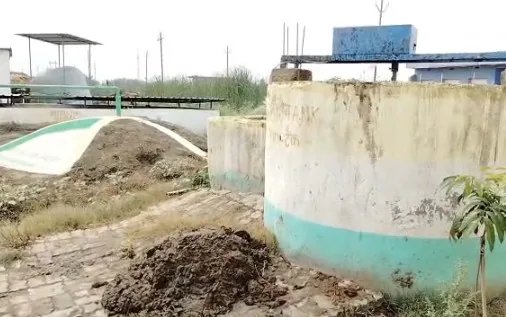
LUCKNOW — The Uttar Pradesh government is expanding its compressed biogas footprint, clearing plans to construct 78 new plants as the state pivots from penalising crop residue burning to commercialising farm waste.
The push builds on an active grid of 40 operational compressed biogas (CBG) facilities across the state, according to official disclosures from the Agriculture Department. Under the model, harvesters collect paddy and maize stubble directly from fields and transport the bales to processing units. The biomass is fermented into pipeline-grade biogas, while the digestate leftover serves as nutrient-rich organic manure for surrounding agricultural belts.
The economics make sense to growers on the ground.
For decades, farmers across northern India faced a punishing deadline between the autumn harvest and winter sowing. They could pay private labourers to remove crop residue or strike a match and burn it. In Barabanki district, the shift toward commercial collection is breaking that cycle.
Balram, a farmer from Tikra village, noted that manual stubble removal previously stripped ₹2,500 to ₹3,000 per acre from his margins.
"Transporting stubble to the biogas plant saves us the cost of removing it from the field," said Balram. He added that the system eliminates the legal and ecological penalties of stubble burning while returning processed digestate back to the soil as organic manure.
In nearby Karamat Kheda village in the Harakh block, grower Yogesh cultivates a rotation of paddy, wheat, and potatoes. Mechanised collection teams cleared his fields immediately after the harvest, preventing critical delays in sowing his winter seed.
| Operational Parameter | Deva Road Facility Metric |
|---|---|
| Active State Biogas Plants | 40 units |
| Approved Plant Pipeline | 78 units |
| Daily Stubble Intake | ~150 tonnes |
| Daily Compressed Biogas Output | 15,000 to 19,000 kg |
| Farm Clearing Savings | ₹2,500 to ₹3,000 per acre |
| Direct Plant Employment | ~2,000 workers |
Scaling residue off-take requires tight logistical synchronization. The Agriculture Department established the collection framework with technical support from the Bill & Melinda Gates Foundation's Technical Support Unit (TSU), integrating Farmer Producer Organizations (FPOs) and private aggregators.
FPOs coordinate harvest schedules and map acreage before dispatching fleets of slashers, rakers, and balers. These machines slice the stalks, compress them into dense rectangular blocks, and load them onto flatbed trucks bound for decentralized collection hubs.
At the anchor CBG plant on Deva Road in Barabanki, heavy machinery runs around the clock. The facility consumes approximately 150 tonnes of agricultural residue every 24 hours, generating between 15,000 and 19,000 kilograms of commercial compressed biogas daily.
The plant relies predominantly on paddy and maize residue. Because of high silica concentrations, such biomass resists cattle digestion and makes poor animal fodder, leaving open-field burning as the historical default.
Stubble is being removed from farmers' fields on time, while the organic residue generated after processing is being made available as manure.
Umesh Kumar Sah, Deputy Director of Agriculture, Barabanki
Umesh Kumar Sah confirmed that operational plants on Deva Road and in Haidergarh have established firm aggregation networks across the Harakh, Haidergarh, Fatehpur, and Ramnagar administrative blocks. The supply chains have also generated off-season rural jobs: local crews employ 10 to 12 workers per field baling cluster, while the Deva Road processing site sustains roughly 2,000 plant-floor workers.
State agricultural authorities are now rolling out capital subsidies for FPOs and private entrepreneurs to acquire specialized Crop Residue Management (CRM) machinery, aiming to establish complete processing infrastructure before the upcoming harvesting cycle.