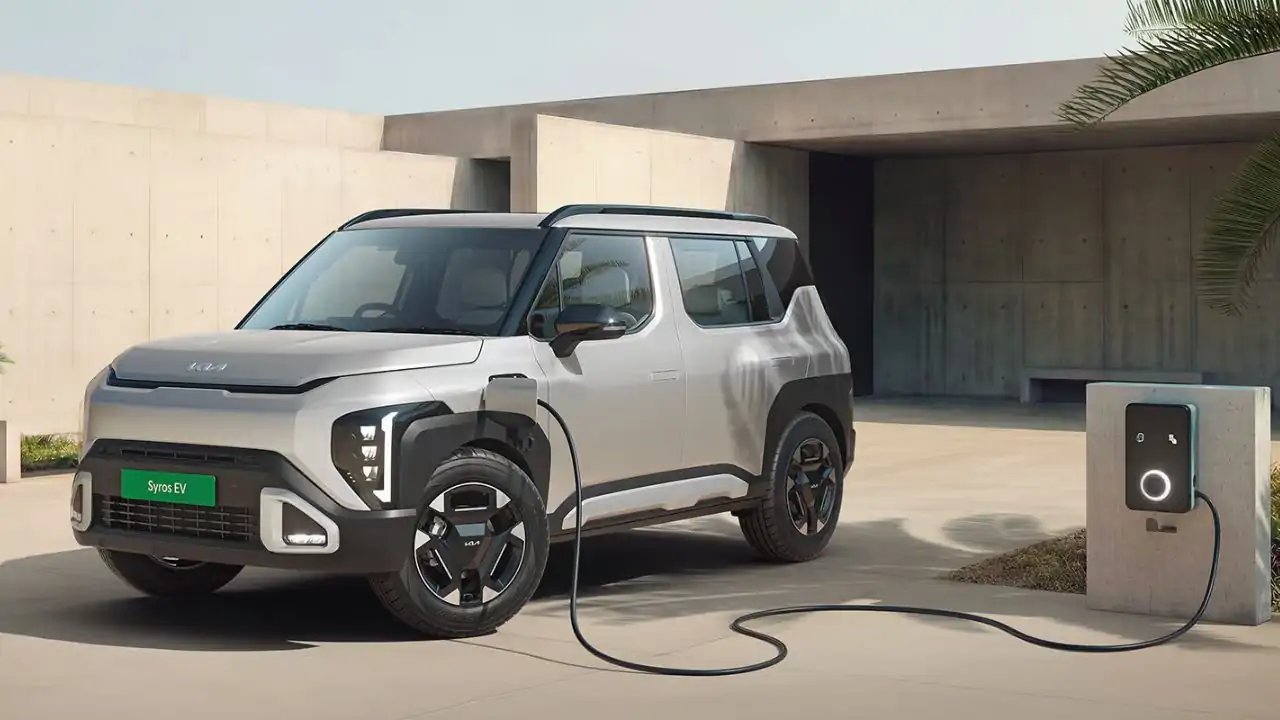
Electric SUVs have stopped being eccentric showroom novelties in India. They now target the heart of the family car budget. Buyers walking onto dealership floors this festive season hold the keys to five distinct sub-₹20 lakh contenders—each promising to slash per-kilometer running costs without stranding drivers by the roadside. The contest no longer hinges on whether an electric car works. It boils down to battery capacity, fast-charging access, and how much honest tarmac mileage remains when the air conditioner runs at full blast.
Drivers in their 30s now dominate this purchasing wave, pushing sport-utility styling and tall driving positions to the top of the sales charts. Automakers have answered by spreading battery choices across entry-level city footprints and highway-ready platforms.
Kia threw down a direct challenge to the segment with its Syros EV, pricing the lineup between ₹13.49 lakh and ₹19.99 lakh ex-showroom. The Korean automaker supplies two battery options: a standard 42kWh pack and a flagship 51.4kWh unit. In Extended Range trim, the Syros claims up to 526 kilometers on a single charge under the ARAI MIDC testing cycle. It also punches out 171hp, backing that muscle with high-speed replenishment—sucking down a 10% to 80% charge in roughly 39 minutes on a 100kW DC fast charger. Inside, Kia pitches a 30-inch Trinity panoramic screen setup, ventilated front seats, a panoramic glass roof, and sliding, reclining rear seats.
MG positions the ZS EV as a senior alternative, listing its base variant at ₹17.99 lakh ex-showroom. Power comes from a 50.3kWh battery mated to a front-mounted motor that delivers 173hp and 280Nm of torque. That output edges out the field on paper. Yet its charging architecture trails newer rivals—plugging into a 50kW DC station requires approximately 60 minutes to replenish the pack to 80%. Certified driving range stands at 461 kilometers, accompanied by a panoramic sunroof, digital key functionality, connected tech, and a central touchscreen interface.
Tata Motors built its EV leadership on the Nexon badge, and the latest iteration armors itself with a 45kWh battery. Certified at 489 kilometers under the ARAI MIDC cycle, the motor dishes out 144hp and 215Nm of torque. Step hard on the accelerator and the Nexon EV reaches 100kmph from a standstill in 8.9 seconds.
Paddle shifters control multi-level regenerative braking across three driving maps: Eco, City, and Sport. When hooked to a 60kW DC fast charger, the 45kWh pack steps from 10% to 80% juice in about 40 minutes. Connected car software, safety equipment, and a slick infotainment display complete the package, maintaining Tata's grip on cross-shopping lists.
Mahindra chose an aggressive performance tune for the XUV 3XO EV. Its 39.4kWh battery feeds an electric powertrain pushing 147.5hp and an immense 310Nm of instant torque. That pulling power launches the compact crossover from zero to 100kmph in 8.3 seconds—making it the quickest sprinter among the five.
Mahindra sells the model across two trims: the AX5 at ₹13.89 lakh and the AX7L at ₹14.96 lakh ex-showroom. Crucially, Mahindra bypasses laboratory boasting to claim an honest real-world range of up to 285 kilometers with the air conditioning active. The equipment sheet stands out in the sub-₹15 lakh bracket, bundling Level 2 ADAS active safety, a 360-degree parking camera, dual-zone climate controls, and a 7-speaker Harman Kardon audio system.
For strict city duty, the smaller Tata Punch EV lowers the financial bar. The micro-SUV comes with either a 30kWh or a 40kWh battery pack. The base 30kWh unit claims an MIDC range of 365 to 375 kilometers, while the 40kWh pack stretches claimed coverage to 468 kilometers. In official real-world C75 testing, Tata rates the 40kWh Punch EV at roughly 355 kilometers. The car fits tight parking spaces, features regenerative paddle settings, a digital gauge cluster, and multiple drive modes.
| Model | Battery Size | Claimed / Real-World Range | Power & Torque | DC Fast-Charging (10-80%) | Base Ex-Showroom Price |
|---|---|---|---|---|---|
| Kia Syros EV | 42 kWh / 51.4 kWh | Up to 526 km (MIDC) | 171 hp | ~39 mins (100 kW) | ₹13.49 Lakh |
| Tata Nexon EV | 45 kWh | 489 km (MIDC) | 144 hp / 215 Nm | ~40 mins (60 kW) | Sub-₹20 Lakh bracket |
Market Context: Lab test cycles like MIDC routinely paint an optimistic picture of battery endurance. On asphalt, factors like heavy ambient heat, continuous air conditioning, highway cruising speeds over 90kmph, and steep elevation gains eat into reserves. Urban stop-and-go driving actually favors electric cars through regenerative braking recapture, whereas sustained triple-digit expressway runs deplete lithium-ion cells at an accelerated rate.
Choosing between these five comes down to daily mileage math. If your car rarely ventures beyond city boundaries, the Tata Punch EV or Mahindra XUV 3XO EV AX5 delivers maximum efficiency per rupee spent. Those planning frequent intercity corridor trips will need the larger energy buffers inside the Kia Syros EV Extended Range, Tata Nexon EV 45kWh, or MG ZS EV.
Buyers should verify wall-box charger installation logistics at home, public fast-charger density along their frequent transit corridors, and official battery warranty clauses before laying down booking tokens. The electric SUV pipeline will not sit idle, either—Tata Motors is preparing to launch two brand-new electric SUVs featuring all-wheel-drive powertrains within the next five months, ensuring this marketplace battle escalates rapidly.
| Mahindra XUV 3XO EV |
| 39.4 kWh |
| 285 km (Real-World AC on) |
| 147.5 hp / 310 Nm |
| Rapid DC Support |
| ₹13.89 Lakh |
| Tata Punch EV | 30 kWh / 40 kWh | 365-468 km (MIDC) / 355 km (C75) | City Commuter Tune | Multi-mode DC | Accessible entry |
| MG ZS EV | 50.3 kWh | 461 km (Certified) | 173 hp / 280 Nm | ~60 mins (50 kW) | ₹17.99 Lakh |