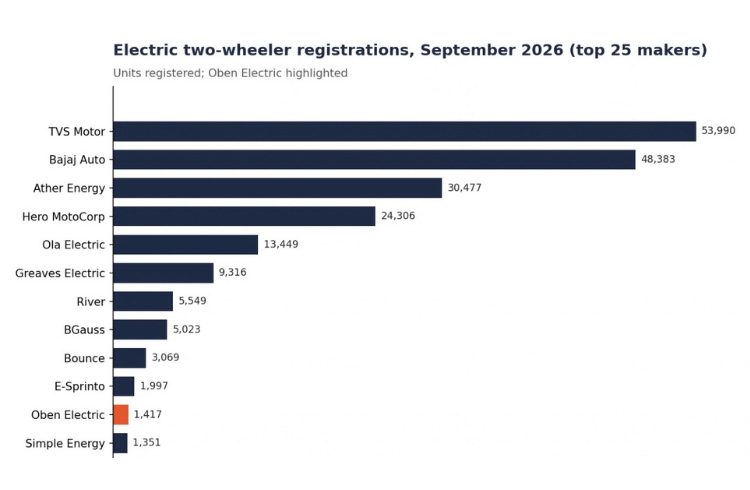
TVS Motor topped September 2026 e‑2W registrations with 53,990 units, a figure that dwarfs the next best seller. The Vahan dashboard logged the numbers on 1 October, giving us a clear snapshot of how the market is shaping up.
Bajaj Auto followed close behind, pulling in 48,383 units, while Ather Energy, Hero MotoCorp and Ola Electric rounded out the top five with 30,477, 24,306 and 13,449 units respectively. Together, TVS and Bajaj account for 49.7 % of the 25‑maker total of 2,05,951 units, and the top four alone hold 76.3 % of that volume. In other words, half the market is in the hands of two brands.
Once you drop past the top five, the numbers start to shrink fast. Greaves Electric Mobility sold 9,316 units, River 5,549, BGauss 5,023 and Bounce 3,069. E‑Sprinto Green Energy came in at 1,997 units, and the next five—Oben, Simple Energy, Lectrix, Honda Motorcycle & Scooter India and Revolt Intellicorp—each hovered around 1,100 units. The rest of the 25‑maker list is a long tail of a few hundred or even a handful of units.
For the everyday buyer, the takeaway is clear: if you want a reliable network, wide service support and a proven track record, TVS and Bajaj are the safe bets. Their combined market share shows they’ve built strong dealer footprints and battery‑swap infrastructure across major metros. On the flip side, the smaller players, while offering niche specs or unique styling, might struggle with spare‑part availability and longer wait times.
Policy‑wise, the 2,05,951 units registered in September 2026 underscore the rapid growth of the e‑2W segment, a trend the government is keen to accelerate through subsidies and reduced import duties on batteries. Buyers will feel the impact through tighter price competition and more aggressive feature bundling. Keep an eye on upcoming releases from Ola and Hero, and watch how the price wars might shift the balance in the next quarter.
The numbers are logged as of 1 October, so the market snapshot is fresh. As we head into the next fiscal year, watch the rollout of new variants across cities—especially the Tier‑2 and Tier‑3 markets—where price sensitivity and infrastructure gaps still give smaller makers a fighting chance.