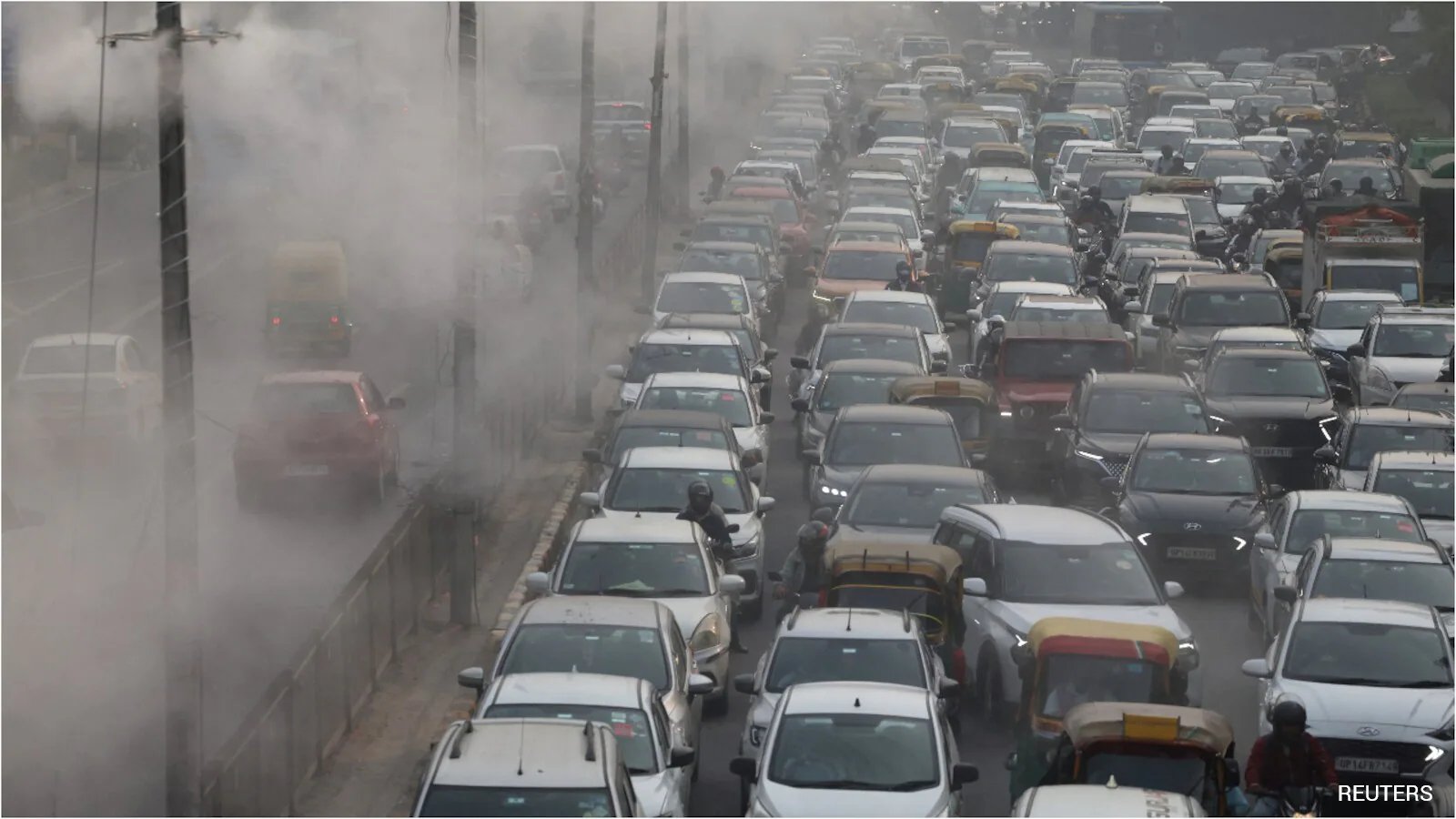
Delhi overtook Lahore on Friday to become the world's most polluted major city, blanketed by a dense, toxic smog that erased visibility across arterial corridors and pushed air quality indexes into hazardous territory. The national capital—home to over 20 million residents—woke to shrouded skylines as streetlights struggled against gray haze. Breath turned sharp. The city gagged.
Live tracking by Swiss air quality monitor IQAir clocked Delhi’s Air Quality Index at 334 on Friday morning, categorising the air as "hazardous" and elevating the metropolis above Lahore on its global pollution leaderboard. The Swiss system assesses toxic particulate concentrations against international public health standards, under which any AQI reading up to 50 represents clean air with minimal physiological threat.
Domestically, the Central Pollution Control Board registered an even grimmer reality. The central monitoring agency calculated the capital’s average AQI at 403, locking Delhi firmly inside the "severe" classification band. The divergence between the Swiss and Indian metrics stems from differing mathematical weightings, pollutant categorization formulas, and regional baseline scaling models. But the physical fallout remained identical on the asphalt below.
| Air Quality Benchmark | Index Reading | Regulatory Category |
|---|---|---|
| Standard Safe Baseline | 0–50 | Good / Minimal Risk |
| IQAir Global Toxin Monitor | 334 | Hazardous (Rank 1 Worldwide) |
| Central Pollution Control Board (CPCB) | 403 | Severe |
The choking haze reflects a chronic cross-border meteorological trap that grips northern India and eastern Pakistan every winter. As temperatures fall, cold and heavy atmospheric layers sink close to the ground, sealing the Indo-Gangetic plains beneath a thermal inversion layer that acts like a sealed greenhouse ceiling.
Surface emissions cannot disperse. Tailpipe exhaust from millions of commuter vehicles, fine dust kicked up from construction projects, and smoke plumes drifting from regional agricultural crop-residue burning remain pinned against the urban floor. On Friday, visibility tumbled so sharply that motorists and motorcyclists traversed major transit routes under headlights at midday, maneuvering past street lamps obscured by floating soot.
Environmental authorities and air quality enforcement panels are monitoring ambient concentrations across monitoring stations to determine whether emergency curbs—including stricter vehicular restrictions and bans on non-essential construction work—must be triggered as stagnant winter winds persist.