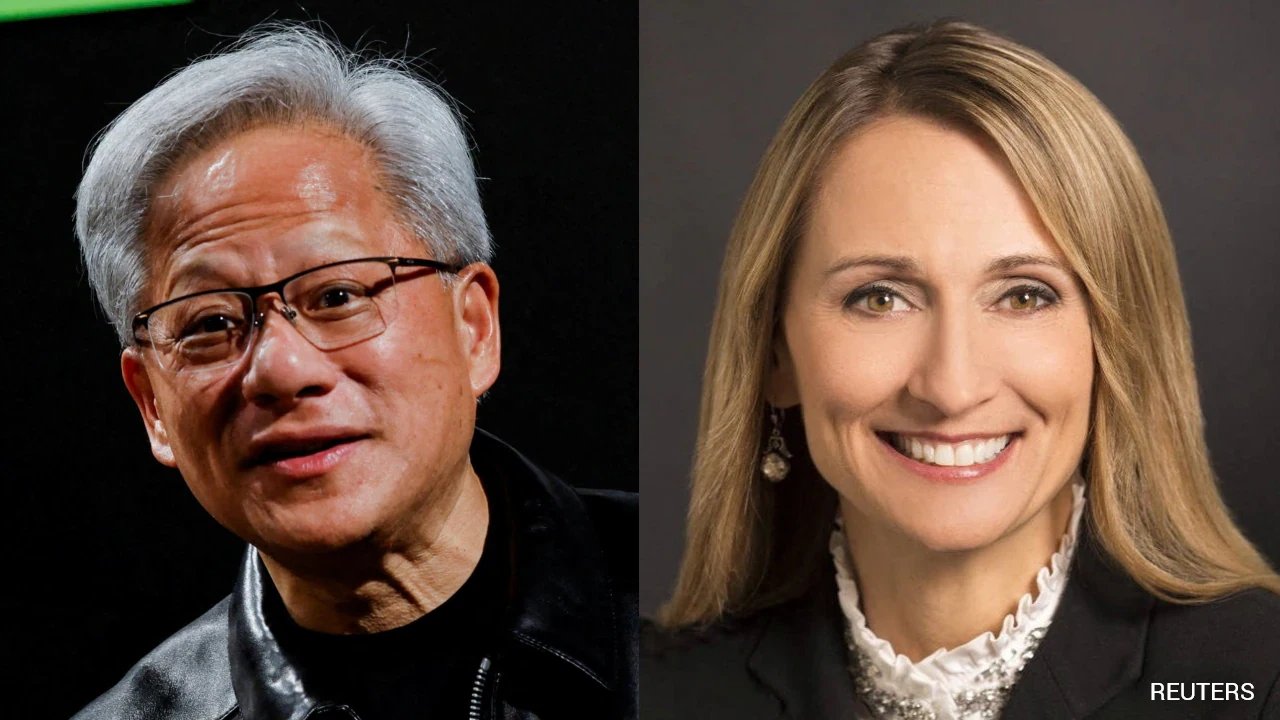
Nvidia appointed Chief Financial Officer Colette Kress as interim chief executive officer, elevating a finance veteran who previously clashed with outgoing leader Jensen Huang over hundreds of billions of dollars in aggressive artificial intelligence financing.
Huang stepped down from the semiconductor titan he co-founded 33 years ago after admitting to extramarital affairs, including an alleged relationship with Alice Huang, an individual suspected of espionage operations for China. He faces an appearance before a U.S. Senate committee next month to answer direct questions regarding the national security implications of that contact. The transition hands immediate operational control to Kress while Nvidia’s board conducts a search across internal and external candidates.
Internal friction between Huang and Kress had escalated sharply inside corporate headquarters in August. During an executive meeting convened with Nvidia’s senior finance team, Huang berated Kress as "a deer in the headlights" while interrupting her presentation. He dismissed her as a mere "reporting CFO" who lacked the capacity to construct business strategies or execute critical corporate bets. Huang feared Nvidia had committed excessive capital to outside ventures just as top-tier cloud providers sought rival silicon to break their reliance on Nvidia. He warned his finance chiefs that the swelling volume of chip wafers and memory inventory the company had agreed to procure risked becoming an "avalanche."
Kress had pushed back against speculative financing schemes steered by Huang’s inner circle. Nico Caprez, Huang’s son-in-law whom the company promoted to vice president in January, joined company executive Raj Mirpuri in approaching multiple artificial intelligence startups with financial subsidies. Under the arrangement, Nvidia arranged discounted bank borrowing for AI cloud developers in exchange for a direct slice of customer earnings.
Kress demanded strict controls. She questioned which partners warranted financial backing, how much balance-sheet risk Nvidia could safely absorb, and whether the venture arrangements would deliver verified bottom-line returns. She intervened directly to halt and restructure capital packages handled by Caprez.
No transaction carried higher stakes than a mammoth data center campus in Ohio. OpenAI negotiated to lease the entire infrastructure project to operate roughly $300 billion worth of Nvidia hardware. Nvidia initially weighed providing a colossal $250 billion financial backstop to underwrite the buildout.
Wall Street recoiled when the terms leaked into the public domain on July 26. Nvidia shares tumbled 5% the following trading session, wiping out $250 billion in market value in a single day. Kress intervened, seized control of the transaction, and slashed the proposed financial guarantee by 50%. Nvidia and OpenAI executed the contracted, downsized arrangement on August 17.
| Executive & Transaction Parameter | Official Record / Metric |
|---|---|
| Interim Chief Executive Officer | Colette Kress |
| Outgoing Chief Executive Officer | Jensen Huang (Resigned) |
| OpenAI Ohio Site Hardware Value | $300 billion in Nvidia chips |
| Original Proposed Loan Guarantee | $250 billion |
| Revised Guarantee Under Kress | Slashed by 50% (Signed August 17) |
| Single-Day Market Cap Loss (July 27) | $250 billion (Shares down 5%) |
Huang’s exit follows internal turmoil over separate personal disclosures. In an all-hands message distributed to staff on Sunday, Huang admitted to infidelity involving an employee alongside the relationship with Alice Huang.
I was unfaithful to my wife. There is no excuse for what I did.
Jensen Huang, Former Chief Executive Officer, Nvidia
Huang apologised to his family before stepping aside. In an internal communication sent to global employees on Thursday, Kress adopted an orderly tone, pledging that she will steer the tech giant forward by "building on the extraordinary foundation Jensen created over the last 33 years."
Market Context: The sudden leadership vacuum at Nvidia arrives as major hyperscalers seek to diversify their chip procurement away from proprietary silicon architectures, leaving Kress to defend product dominance while managing capital commitments.
Huang must appear before the U.S. Senate committee next month to address questions surrounding national security risks, while the Nvidia board reviews formal dossiers for a permanent chief executive officer.