Nvidia has launched an expansive hunt for a permanent chief executive to steady the world’s preeminent artificial intelligence hardware empire following the abrupt resignation of long-time leader Jensen Huang.
Huang stepped down under intense corporate scrutiny over multiple extramarital relationships, including ties to a suspected Chinese intelligence asset and an affair with an executive subordinate within the company. The departure jolted Silicon Valley. It stripped the chipmaker of its founding visionary at the peak of the global generative computing boom. Nvidia appointed veteran Chief Financial Officer Colette Kress as interim chief executive while directors screen both internal leaders and external heavyweights across an 11-candidate succession pool.
Capital markets demand stability. Nvidia commands an influential position atop the global technology supply chain, requiring an executive who balances complex semiconductor physics with relentless geopolitical statecraft. Investors face an enterprise that functions simultaneously as a premier semiconductor designer, a hyperscale platform, and an active financial investor in cutting-edge computing startups.
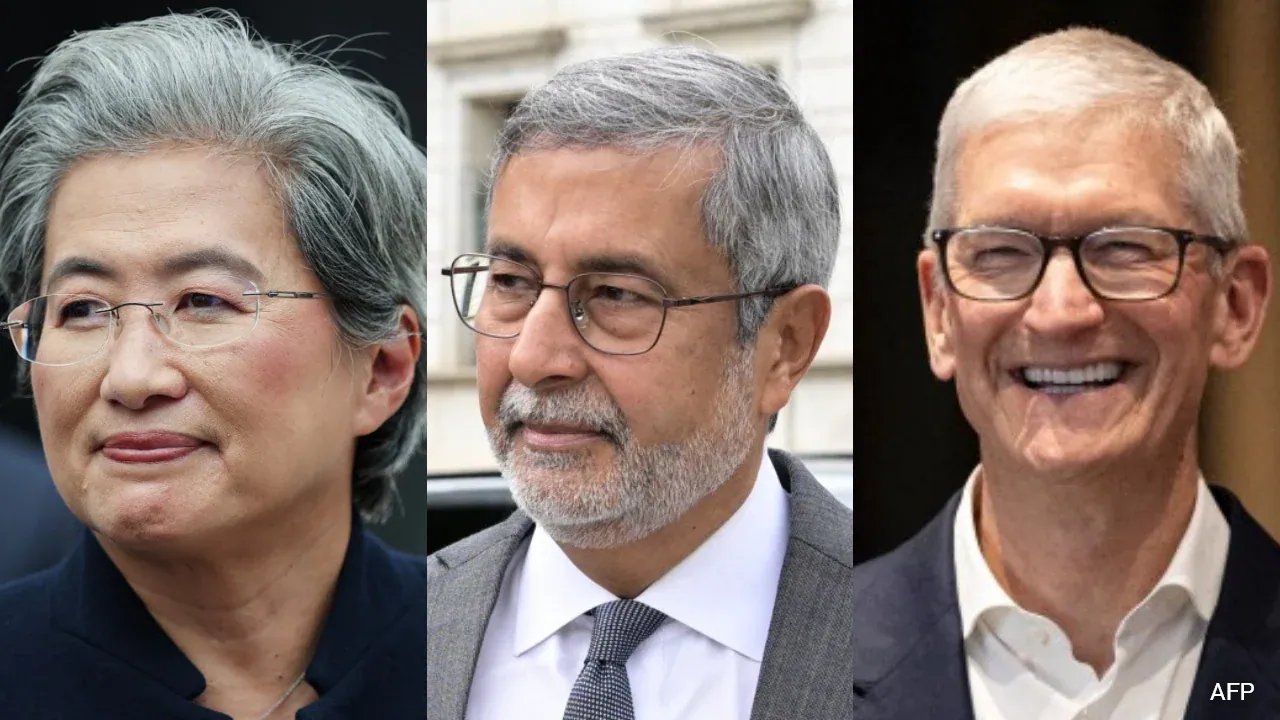
A trio of seasoned Indian-origin executives sits prominently on the board’s radar, led by Micron Technology Chief Executive Sanjay Mehrotra. Mehrotra brings more than four decades of institutional memory in silicon manufacturing. After co-founding SanDisk in 1988 and leading it as chief executive through its 2016 acquisition, he took the helm of Micron in 2017. He systematically steered the largest American memory producer toward high-bandwidth memory chips that power modern generative computing clusters, binding Micron closely to Nvidia's hardware stack and fueling Micron's rise toward a $1 trillion market footprint.
Nikesh Arora, chief executive of Palo Alto Networks, represents a different leadership paradigm. Arora took charge of the cybersecurity provider in 2018, aggressively transforming the company around autonomous software protection models. His pedigree features a decade at Google and a tenure as president and chief operating officer at SoftBank. Yet, Arora's career centers on enterprise infrastructure and software execution rather than silicon fabrication.
Google Cloud Chief Executive Thomas Kurian rounds out the Indian-origin slate. Kurian orchestrates massive enterprise deals, managing distributed data systems and client infrastructure vital to Nvidia’s everyday customer base. But like Arora, his curriculum vitae lacks direct hands-on microprocessor engineering.
| Succession Candidate | Current Leadership Role | Core Enterprise Domain | Specialized Semiconductor Experience |
|---|---|---|---|
| Sanjay Mehrotra | CEO, Micron Technology | High-Bandwidth Memory & AI Systems | Over 40 Years (SanDisk Co-Founder) |
| Nikesh Arora | CEO, Palo Alto Networks | Enterprise Cybersecurity Platforms | Software & Operations (SoftBank, Google) |
| Thomas Kurian | CEO, Google Cloud | Hyperscale Infrastructure & AI Cloud | Enterprise Software & Cloud Services |
Internal continuity centers on Kress herself. She has served as Nvidia's chief financial officer since 2013, following operational tenures at Microsoft, Cisco, and Texas Instruments. Wall Street knows her. Institutional fund managers trust her command of margins, revenue cadence, and investor communications through volatile manufacturing cycles. Yet running the company permanently presents an unanswered dilemma: can a financial operator steer foundational technical roadmaps without a pure engineering co-pilot?
Ian Buck offers the technical pedigree Kress lacks. Buck joined Nvidia in 2004 and engineered the technological pivot that saved the company from lingering as a niche video-game component supplier. He spearheaded the creation of CUDA, the proprietary software platform that unlocked parallel processing for non-graphics computations, effectively establishing the foundational bedrock of the modern artificial intelligence hardware industry.
One of the most challenging parts of my job often is to try to predict the future, but AI is always surprising us.
Ian Buck, Vice President of Hyperscale and High — Performance Computing, Nvidia
Arm Holdings Chief Executive Rene Haas bridges both external independence and internal culture. Haas spent seven years as a senior Nvidia executive, rising to vice president and general manager of its computing products unit before leaving for Arm in 2013. He climbed to Arm’s top post in 2022, navigated the British architecture designer through its landmark 2023 Nasdaq public listing, and holds a board seat at parent company SoftBank Group. His fluency in intellectual property licensing and chip architecture makes him an instinctive bridge candidate.
Nvidia's board has not set a formal deadline for the appointment, though directors are expediting committee reviews as Kress guides the executive suite through day-to-day operations.
| Colette Kress | Interim CEO & CFO, Nvidia | Corporate Finance & Wall Street Strategy | Semiconductor Finance (Nvidia, TI) |
| Ian Buck | VP, Hyperscale & HPC, Nvidia | CUDA Computing Platform & AI Hardware | 20+ Years Nvidia Engineering Lead |
| Rene Haas | CEO, Arm Holdings | Processor Architecture & Licensing | Former Nvidia VP; SoftBank Director |