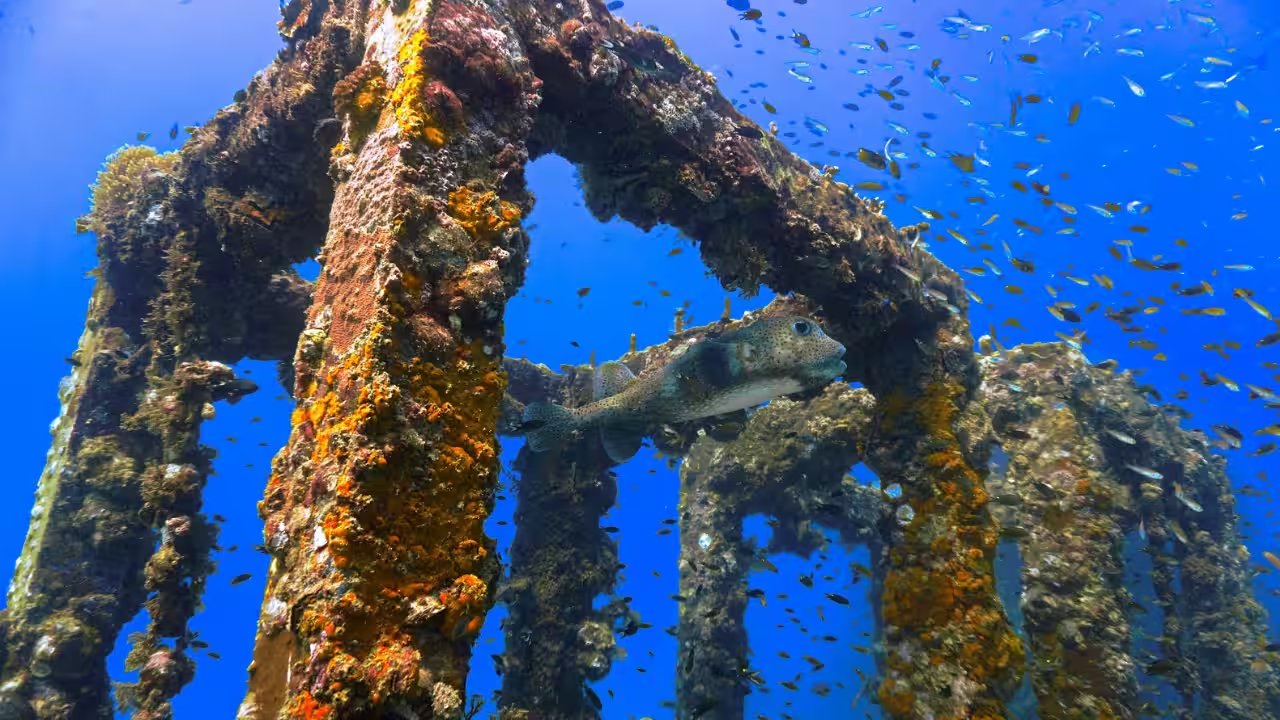
State maritime engineers and wildlife biologists have sunk the demolished 6,620-foot Queen Isabella Causeway off the South Padre Island coast, completing a 320-acre artificial reef in the Gulf of Mexico.
The massive engineering deployment finished in July 2026. Rather than hauling thousands of tons of aged concrete to mainland landfills, officials directed the salvage directly into federal waters to anchor marine life. It marks the permanent repurposing of South Texas's most historic coastal crossing.
Built in 1954, the original two-lane span carried vehicular traffic between Port Isabel and South Padre Island for two decades. Traffic ceased after the state built a replacement causeway, leaving the aging structure divided between two divergent fates. Authorities converted its eastern tip into a popular public fishing pier. The western span, however, decayed in silence.
Years of salt spray and tidal surges turned the abandoned western concrete spans into an unlit navigational hazard for commercial vessels and recreational boaters alike. The Texas General Land Office intervened. Taking command of design, structural engineering, and controlled demolition, the agency stripped out the deteriorating pilings to clear coastal shipping corridors while preserving the clean, dense substrate for marine deployment.
Pulverized spans and intact concrete footings were transferred directly to the Texas Parks and Wildlife Department's Artificial Reef Program. Biologists drafted placement protocols, secured state and federal environmental clearances, and surveyed the targeted 320-acre seabed zone near South Padre Island.
"The agency developed rigorous specifications for the materials, ensuring the demolished bridge would function as durable, stable substrate without destabilizing surrounding waters," confirmed the Texas Parks and Wildlife Department.
| Project Parameter | Official Specification |
|---|---|
| Demolished Bridge Span | 6,620 linear feet |
| Original Construction Year | 1954 |
| Artificial Reef Footprint | 320 acres |
| Completion Date | July 2026 |
| Demolition & Engineering Lead | Texas General Land Office (GLO) |
| Marine Habitat Management | Texas Parks and Wildlife Department (TPWD) |
Before demolition crews severed the structure, the submerged bridge foundations had already functioned as an accidental ecosystem for more than seven decades. The newly created Queen Isabella Reef codifies that footprint offshore. Biologists estimate that nearly 200 marine fish species frequent Texas artificial reef networks, with populations of commercial and recreational favorites—including red snapper—establishing rapid residency on submerged concrete structures.
Texas wildlife teams will continue long-term ecological monitoring and sonar mapping across the 320-acre site to measure biomass density and invertebrate colonization across the former transit span.