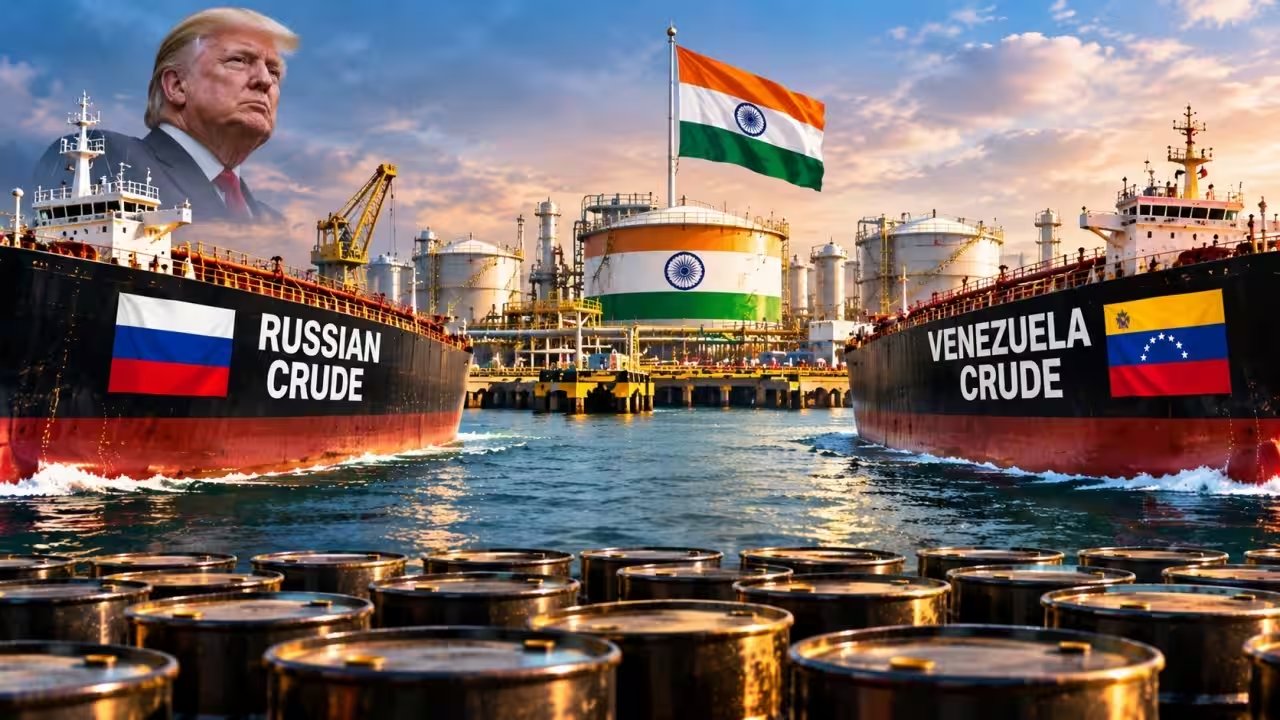
The White House wants India to ditch Russian crude and buy Venezuelan instead.
United States Secretary of State Marco Rubio visited New Delhi to pitch the trade pivot directly to Reliance Industries, framing India as an indispensable "refining superpower" capable of unlocking South American heavy crude. Washington has spent two years leaning on Prime Minister Narendra Modi's administration to curb purchases of discounted Russian barrels. Yet trade arithmetic and industrial chemistry tell a far colder story.
Russia remains India's dominant supplier. Replacing those Moscow shipments with Venezuelan grades on a massive scale is mathematically and technically impossible.
Energy analytics show India imported 4.71 million barrels per day of crude in August and 5.33 million barrels per day in September. Venezuelan volumes made up 7.4% of that intake during an August peak—reaching 444,000 barrels per day—before slipping to 3.7% in September and recovering to 5.7% in October.
"At 450 to 500 thousand barrels per day on an import base of about 5.2 to 5.5 million barrels per day, a realistic share is 6 to 9%," said Naveen Das, Senior Crude Oil Analyst at Kpler. "That would match or modestly exceed the 6.7% share recorded in FY18. A share near 10% would need more than 500 thousand barrels per day, which Venezuela’s current export base cannot supply without displacing most non-Indian buyers."
Venezuelan crude is among the dirtiest, heaviest grades on earth.
It does not flow easily. Upstream operators must dilute the extra-heavy bitumen with lighter naphtha or condensate simply to push it through domestic pipelines and load it onto export tankers. Once delivered, it presents an operational ordeal inside refinery gates. More than half of every single Venezuelan barrel consists of dense residue—the sludge at the bottom of the distillation column that requires deep cracking units to produce transport fuels.
"This is crude that suits complex refineries, but not every refinery can handle it economically," said commodity analyst Natalia Katona, warning that quality variations plague shipments. Acidity runs high. Cargoes frequently arrive laden with heavy metals like vanadium and nickel that poison costly refinery catalysts and corrode distillation towers. Water content can climb to 5%, forcing plant operators to de-water shipments before processing.
Only a handful of facilities can manage that chemical assault.
"Only complex refineries with cokers, hydrocrackers and ample hydrogen can earn a margin on it," Das said.
Reliance's massive twin-refinery complex at Jamnagar in Gujarat remains the primary destination equipped to run heavy-sour grades at scale. State-run Indian Oil Corporation carries secondary absorption potential, but most standard domestic public-sector refineries would suffer margin destruction if forced to run high ratios of Venezuelan crude.
| Crude Sourcing Metric | Official Volume / Share Parameter |
|---|---|
| India Total Crude Imports (August Baseline) | 4.71 million barrels per day |
| India Total Crude Imports (September Baseline) | 5.33 million barrels per day |
| Venezuelan Share of Indian Imports (August Peak) | 7.4% (approx. 444,000 bpd) |
| Venezuelan Share of Indian Imports (September) | 3.7% |
| Venezuelan Share of Indian Imports (October) | 5.7% |
| Sustainable Absorption Ceiling | 400,000 – 550,000 bpd (6% to 9% market share) |
Even if Indian refiners maximized their cokers, Venezuelan ports cannot supply the volume Washington envisions without cutting off existing global buyers.
"Reliance Industries’ Jamnagar complex would remain the principal buyer given its ability to process heavy-sour crude at scale," said Praveen Rai, Director at Grant Thornton Bharat. "India has already demonstrated significant absorption capacity, with Venezuelan imports reaching around 444,000 bpd. India can realistically absorb around 400,000 to 550,000 barrels per day of Venezuelan crude on a sustained basis, with short-term volumes potentially approaching 600,000 bpd under favourable conditions."
Geography further tilts the balance against Caracas.
A tanker sailing from the Persian Gulf reaches Gujarat in under a week. A supertanker departing Puerto La Cruz or Jose must cross oceans over four to six weeks, racking up immense freight charges that erode refining margins.
"Jamnagar could substitute some Basrah Heavy by Venezuelan crude, but Iraq is much closer," Katona noted. "If Iraqi barrels are available at competitive delivered prices, Venezuela has a harder case to make for Indian refiners."
Then comes American domestic competition. Refineries across the US Gulf Coast were engineered specifically for heavy Latin American crudes before sanctions severed ties. As Venezuelan output gradually returns to market, Gulf of Mexico processors will bid aggressively for those identical heavy cargoes—enjoying short pipeline and Caribbean transit corridors that Indian refiners cannot match.
Market Context: New Delhi will continue to prioritize delivered cost per barrel over Washington's geopolitical objectives. With Russian Urals continuing to arrive at deep structural discounts against Brent baselines, commercial refiners have zero incentive to surrender cheap Siberian flows for expensive, logistics-heavy South American crude.
Bilateral trade talks between Washington and New Delhi will resume next month, with the Ministry of Petroleum and Natural Gas maintaining that Indian refiners will purchase feedstock purely on spot commercial viability.
| Historic High-Water Mark (FY18 Baseline) | 6.7% import share |