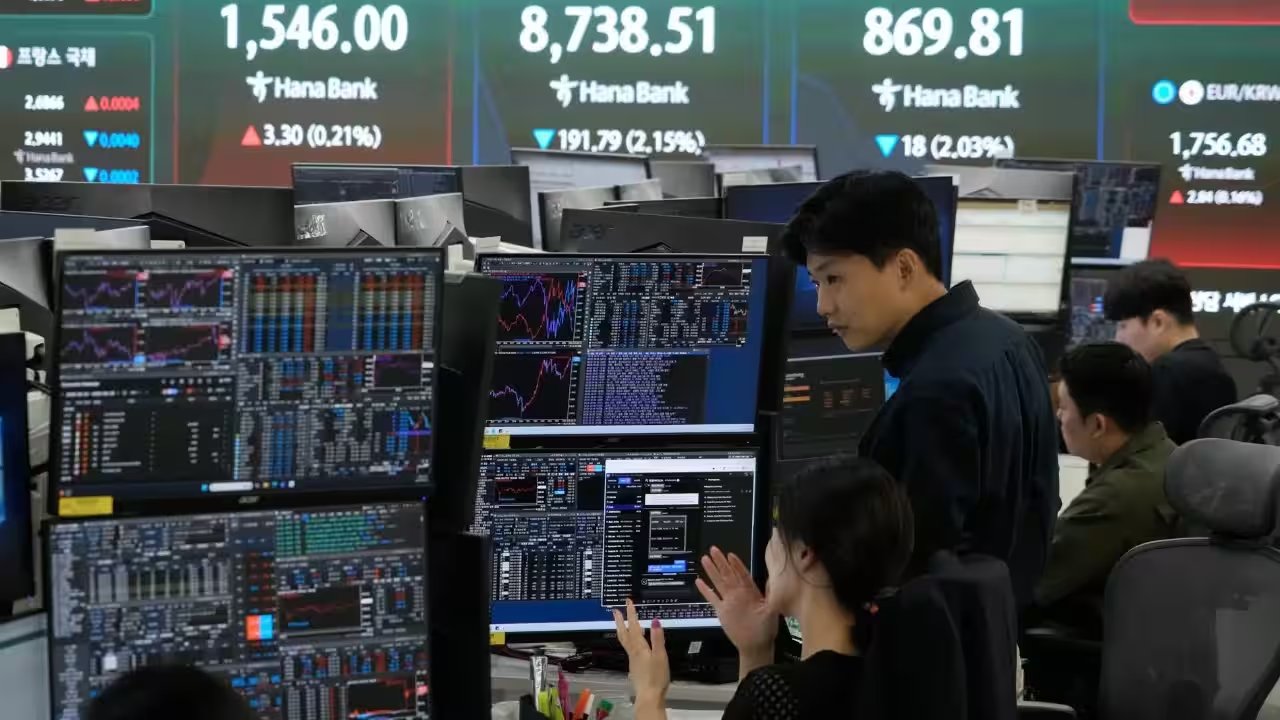
Asian equity markets roared back on Tuesday, propelled by Wall Street's steepest single-day rebound since April and an abrupt retreat in global energy prices.
Relief washed over trading desks across the Pacific. South Korea's Kospi spearheaded regional gains with a 4% surge to 5,219.37, while Tokyo's Nikkei 225 leaped 2.6% to 60,279.37. Taiwan's Taiex climbed 3.4%. In Hong Kong, the Hang Seng edged up 0.4% to 24,535.74, matching a 0.4% advance in the Shanghai Composite to 3,673.54, while Australia's S&P/ASX 200 pushed 1.1% higher to settle at 9,131.70. MSCI's broadest regional index outside Japan rose 1.5%.
The immediate catalyst emerged from Washington. Crude benchmarks slid after US President Donald Trump declared he would hold off on fresh military strikes against Iran, dampening immediate fears of a Persian Gulf supply disruption. Brent crude dropped 0.9% to $91.74 a barrel, while West Texas Intermediate slipped 1% to $85.97. Trump reported "positive momentum" following White House negotiations with Qatar's prime minister, remarking that renewed hostilities were "highly unlikely" if talks advanced, even while reiterating that US forces remained "locked and loaded."
Semiconductor and computing hardware manufacturers led the charge. SoftBank Group vaulted 15% in Tokyo ahead of its earnings disclosure, propelled by investor enthusiasm for its position in OpenAI. Japanese semiconductor equipment suppliers Tokyo Electron and Advantest climbed 5.6% and 3.4%, respectively. In Seoul, memory giants Samsung Electronics and SK Hynix jumped 4.6% and 5.6%, while Taiwanese foundry powerhouse TSMC rose over 1% alongside a 7% leap in MediaTek.
| Benchmark / Asset | Session Movement | Level / Price |
|---|---|---|
| South Korea Kospi | +4.00% | 5,219.37 |
| Taiwan Taiex | +3.40% | Regional Close |
| Japan Nikkei 225 | +2.60% | 60,279.37 |
| Australia S&P/ASX 200 | +1.10% | 9,131.70 |
| Brent Crude Oil | -0.90% | $91.74 / bbl |
| US WTI Crude Oil | -1.00% | $85.97 / bbl |
Yet vulnerability lingered in parts of the hardware sector. Nvidia shares dropped 4.3% overnight in New York after its board confirmed an internal inquiry into whether chief executive Jensen Huang was targeted in a foreign intelligence operation connected to a Chinese business executive. Nvidia's board stated it has "no reason to believe" national security or trade secrets were breached, while Chinese Foreign Ministry spokesperson Guo Jiakun dismissed the allegations as "nothing but smears against China."
Geopolitical peace premiums may also prove fragile. "The risk now is that markets have moved too far, too quickly," warned Nick Twidale, chief market strategist at ATFX Global. "Any indication that negotiations are faltering could see a substantial rebound in prices as traders rapidly rebuild the geopolitical risk premium."
Focus now shifts directly to macroeconomic data and corporate balance sheets. Later on Tuesday, the US Department of Labor releases October consumer inflation data, with economists projecting a 0.3% monthly uptick in headline prices and 0.2% in core CPI. With the CME FedWatch gauge pricing an 84% probability of a Federal Reserve interest rate hike next month, incoming results from cloud firm CoreWeave and Nvidia's earnings report next week will determine whether the tech-led rally holds its ground.