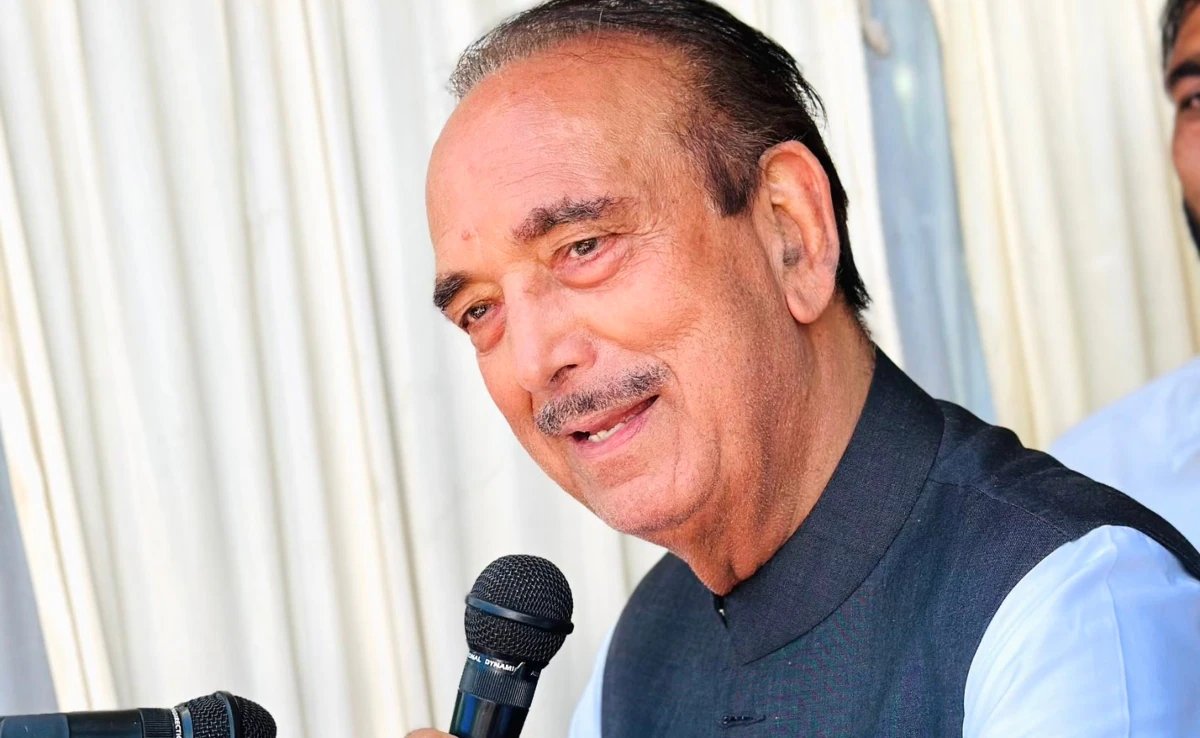
Ghulam Nabi Azad did not mince words on Sunday, bluntly rejecting the narrative spun by his own party's top brass just two days prior. The former Jammu and Kashmir chief minister called National Conference president Farooq Abdullah's assertion—that Pakistan’s international lobbying kept the region safe—"completely incorrect." It was a sharp departure from the usual NC internal harmony, signaling a fracture in how the party’s senior leadership views the state's security architecture.
The friction began when Abdullah, speaking at a party event in Budgam district on Saturday, argued that Pakistan raising the Kashmir issue at global forums had been a protective factor for the region. Azad dismantled this logic in a post on X, pointing to the ongoing protests in Pakistan-occupied Kashmir (PoK) as evidence of the instability Pakistan actually fosters. "Since 1947, successive central governments, from Nehru to Modi, have contributed to J&K's development irrespective of political affiliations," Azad wrote, firmly placing Pakistan in the role of adversary rather than benefactor.
The political fallout was immediate and aggressive. Imran Ansari, a Shia leader and former minister, joined the chorus of criticism, urging Kashmiris not to "emulate" Abdullah. He went further, labeling the NC leadership "rebels on rent," arguing that their dissent is tolerated only because they are a select few, while ordinary Kashmiris face detention under the Public Safety Act (PSA) or Unlawful Activities (Prevention) Act (UAPA) for similar speech.
The Bharatiya Janata Party (BJP) escalated the matter from political debate to legal demand. Spokesperson Altaf Thakur stated on Saturday that Abdullah’s comments were "seditious and anti-national," demanding he be booked for questioning the country's intentions while granting legitimacy to Pakistan’s narrative. "Pakistan has given Kashmir nothing but terrorism, bloodshed, fear and uncertainty," Thakur said, challenging the populace to forget the decades of violence Pakistan-sponsored terror inflicted on the valley.
The next move lies with the J&K police and the central government. With the BJP explicitly calling for criminal proceedings against a sitting party leader, the administration now faces pressure to either file a case under sedition laws or publicly dismiss the demand, a decision that will test the boundaries of political speech in the state.