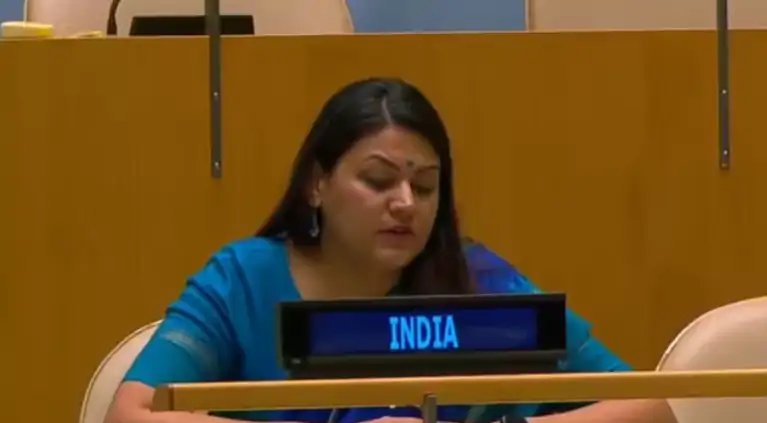
Petal Gahlot, India’s First Secretary at the UN, dismantled Pakistan’s narrative at the General Assembly, pointing directly to the 25th anniversary of the 9/11 attacks. She noted the timing was no coincidence, reminding the world that Osama bin Laden was hiding near Pakistan’s premier military academy. The reference was a sharp jab at Islamabad’s claim of being a democracy, a point she reinforced by highlighting the 27th Amendment and the lifelong immunity granted to Pakistan’s military leadership.
This rebuttal was a direct response to Prime Minister Shehbaz Sharif’s address earlier that day. Sharif had declared that any attempt by India to stop or divert Pakistan’s share of the Indus River waters would be treated as an “act of war.” He described the treaty’s suspension as having “no legal basis” and urged the international community to prevent the weaponization of water. The tension stems from India placing the 1960 Indus Waters Treaty in abeyance following the April 2025 Pahalgam attack.
Gahlot did not hold back on the issue of cross-border terrorism. “At the heart of the issue is the long-standing practice of cross-border terrorism by Pakistan,” she stated. She warned that New Delhi had already demonstrated last year that terrorists would have nowhere to run or hide. For India, the diplomatic fight is inseparable from the security threat posed by the country’s establishment.
The exchange marks a significant escalation in rhetorical warfare between the two nuclear-armed neighbors. While Sharif sought to frame the water dispute as a humanitarian and legal crisis, Gahlot reframed it as a consequence of Pakistan’s internal governance failures. The next phase of this diplomatic standoff will likely see further international mediation attempts, though India has signaled it will not back down on security concerns.