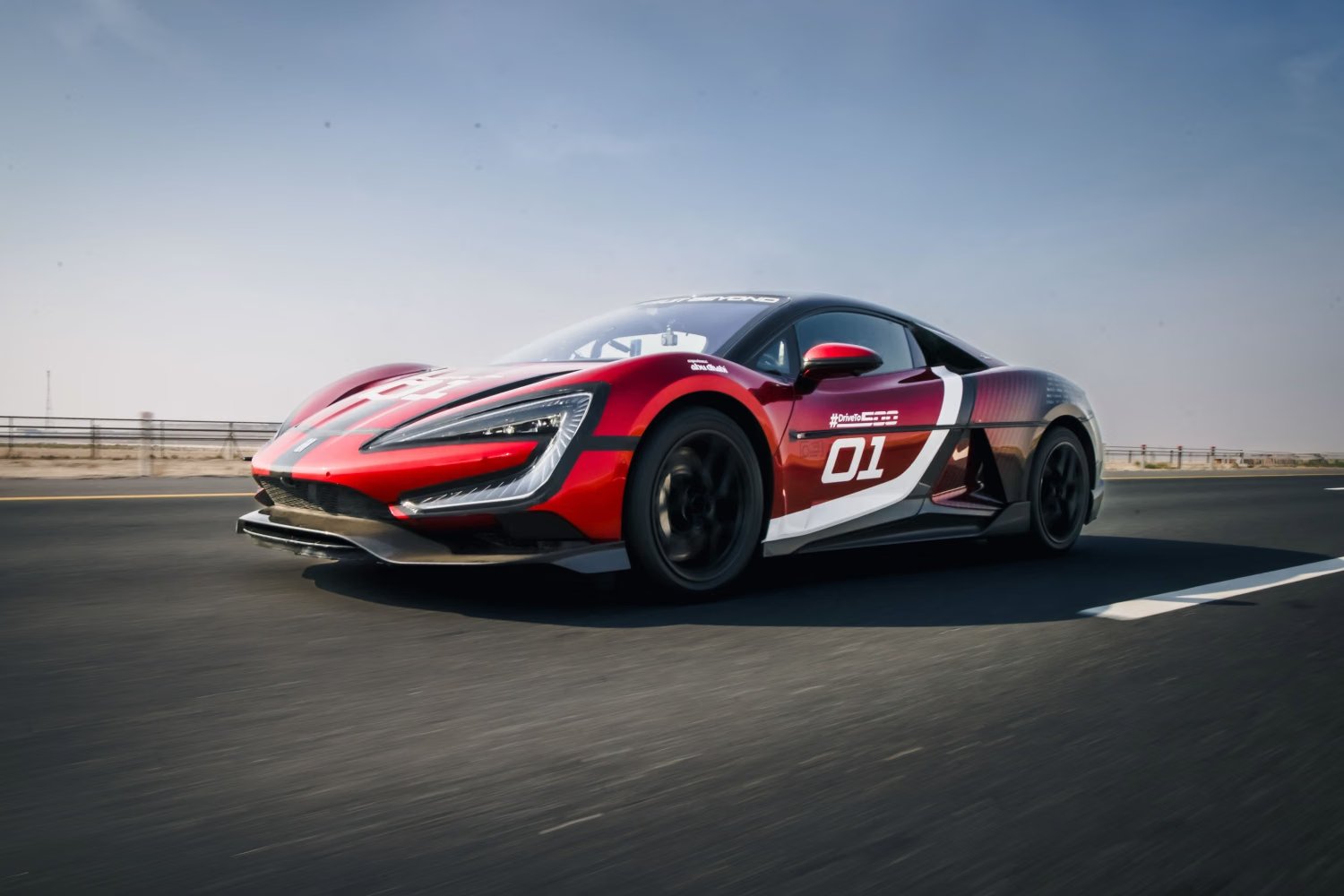
Five hundred and three kilometers per hour. That is roughly 140 meters covered every single second, a velocity where tarmac acts like sandpaper and atmospheric air turns into a concrete wall. On November 1, 2026, BYD’s bespoke luxury performance arm, Yangwang, officially crossed that threshold on public asphalt, sending its limited-run U9 Xtreme into the record books. The electric hypercar topped out at 503.17kph along the Sheikh Khalifa Bin Zayed International Road (E11) in Abu Dhabi’s Al Dhafra Region, rewriting the global benchmark for street-legal performance machinery.
The run was not an informal radar gun claim. Guinness World Records officially verified the feat across two separate categories: highest speed achieved by a production car in a single-direction run, and highest speed achieved by an electric production car in a single-direction run. World motorsport governing body, the FIA, also certified the run. Behind the wheel sat German racing veteran Marc Basseng—the exact driver who piloted the U9 Xtreme to its previous high-water mark of 496.22kph on a test circuit in Germany back in September 2025. This time, the machine eclipsed its own standard by nearly 7kph.
High-speed physics demand an unbroken runway. Authorities shut down a 10-kilometer stretch of the E11 motorway in the desert expanses of Al Dhafra, carving out a continuous seven-kilometer straight dedicated solely to flat-out acceleration. Track workers spent hours inspecting and vacuum-sweeping the asphalt, because running at five times highway limits means even a thumb-sized pebble can rip a tyre carcass to shreds.
The assault unfolded over two disciplined days. On October 31, Basseng conducted two preliminary high-speed passes, maxing out at 490kph. The car was quick, yet data logs exposed aerodynamic lift and road chop issues along specific surface undulations. Yangwang’s trackside engineers immediately went to work through the night. They reprogrammed the electronic suspension software to increase damper rebound rates, altered the active rear wing angle to press more downforce directly over the rear axle, fine-tuned tyre cold-pressures, and thermally pre-conditioned the battery cells and quad drive units.
Two concluding runs followed on the morning of November 1. The initial trial validated the altered aero balance and tyre bite. The second run pushed all the way through, with the U9 Xtreme hitting its record-breaking 503.17kph velocity. Basseng committed to full throttle only after clearing 380kph (236mph), letting traction systems stabilize the vehicle before unlocking absolute motor output down the desert straight.
| Technical Parameter | BYD Yangwang U9 Xtreme Verified Metric |
|---|---|
| Top Speed | 503.17 kph (312.65 mph) |
| Nürburgring Nordschleife Lap Time | 6 minutes 59.157 seconds |
| Total System Output | Exceeds 3,000 PS (>2,200 kW) |
| Motor Configuration | 4 Independent Motors (755 PS / 555 kW each) |
|---|---|
| Maximum Motor Speed | Up to 30,000 rpm |
| Power-to-Weight Ratio | 1,217 PS per tonne claimed |
| Electrical System Voltage | 1,200V Architecture (1,000A peak current) |
| Battery Chemistry & Density | LFP Blade Battery (170% higher single-cell power density) |
| Discharge & Output Limits | 30C discharge rate; 1,800 kW output at 20% SoC |
| Active Body Control System |
Sustaining 503kph without catastrophic heat soak requires rewriting standard EV plumbing. The regular road-going Yangwang U9 runs an 800-volt high-voltage setup. The U9 Xtreme throws that out in favor of an experimental 1,200-volt electrical backbone capable of drawing up to 1,000 amperes of current. Raising the voltage ceiling yields a massive mechanical dividend: internal electrical heat generation drops by up to 67% compared to an 800-volt layout working under identical output loads.
Energy flows through an ultra-dense iteration of BYD’s proprietary lithium iron phosphate (LFP) Blade Battery. By re-engineering the internal cell chemistry, Yangwang pushed single-cell power density up by 170% over the standard 800V cell, unlocking continuous discharge rates of up to 30C. Even when depleted down to a 20% state of charge, the pack punches out 1,800kW of instantaneous power, while dynamic kinetic recuperation exceeds 700kW during heavy braking.
That electrical torrent feeds four independent electric drive units mounted on BYD’s e4 platform. Each motor generates 755PS (555kW), taking collective powertrain output past the 3,000PS mark. The rotors spin up to a dizzying 30,000rpm. To prevent centrifugal forces from tearing the drivetrains apart at those rotations, the stators use ultra-thin 0.1-millimeter super-silicon steel, while the rotors are forged from 970MPa high-strength silicon steel wrapped inside aerospace-grade aluminium cases. Power-to-weight settles at an astonishing 1,217PS per tonne.
Market Context: The hypercar performance conversation long belonged entirely to quad-turbocharged W16 European engines. BYD’s 503.17kph run proves that Chinese battery chemistry and high-discharge LFP cells can sustain top-end thermal and mechanical loads that previously melted electric motors, shifting ultra-luxury engineering prestige eastwards.
Raw power is useless if the tyres break traction or spin freely inside the wheel rims. Each wheel on the U9 Xtreme is managed independently via the e4 platform’s torque vectoring brain, which reads surface slip and recalculates individual torque demands at over 100 hertz.
Mechanical grip pairs with BYD's DiSus-X Intelligent Body Control System. Utilizing fast-acting dual-valve electronic dampers, the suspension operates across a structural bandwidth exceeding 12 kilonewtons. If road heave threatens to unsettle the chassis, the system can deploy up to 50 kilonewtons of counter-force within 120 milliseconds. The active suspension independently balances vertical load across every corner, and can physically produce up to 2.43 degrees of negative body roll at 0.3g—deliberately pulling the car's body into the inside apex of a turn to keep the floor pan level. That dynamic control is why the same vehicle clocked a blistering 6-minute 59.157-second production EV record lap around Germany’s brutal 20.8-kilometer Nürburgring Nordschleife.
Then comes the tyre interface. Yangwang collaborated with Giti Tire to formulate a semi-slick tyre using an aggressive high-stability compound and custom carcass grooves. At 3,000 horsepower, the rotational torque generated by the electric motors can cause the alloy wheels to spin inside the rubber beads during hard launches or high-speed transitions. To eradicate rim slip, engineers machined a specialized knurling pattern into the inner bead seats of the alloy wheels and applied an ultra-high-viscosity bead lubricant, locking the tyre mechanically to the wheel rim.
Yangwang debuted the first fully completed production-spec model—christened the 'Dawn Moment'—at the 2026 Beijing Auto Show. The car carries an artisanal multi-stage paint scheme integrating micron-scale gold powder beneath deep clear coats, contrasted against satin matte-gold body sections.
Exclusivity will remain ironclad. Global production of the Yangwang U9 Xtreme is capped at just 30 units worldwide. BYD confirmed that an initial group of vetted global clients have already finalized their personal build configurations, with contracts currently being signed ahead of final build slot allocations at the company's dedicated low-volume assembly facility.
| DiSus-X (50 kN active force in 120 ms) |
| Global Production Cap | 30 Units |