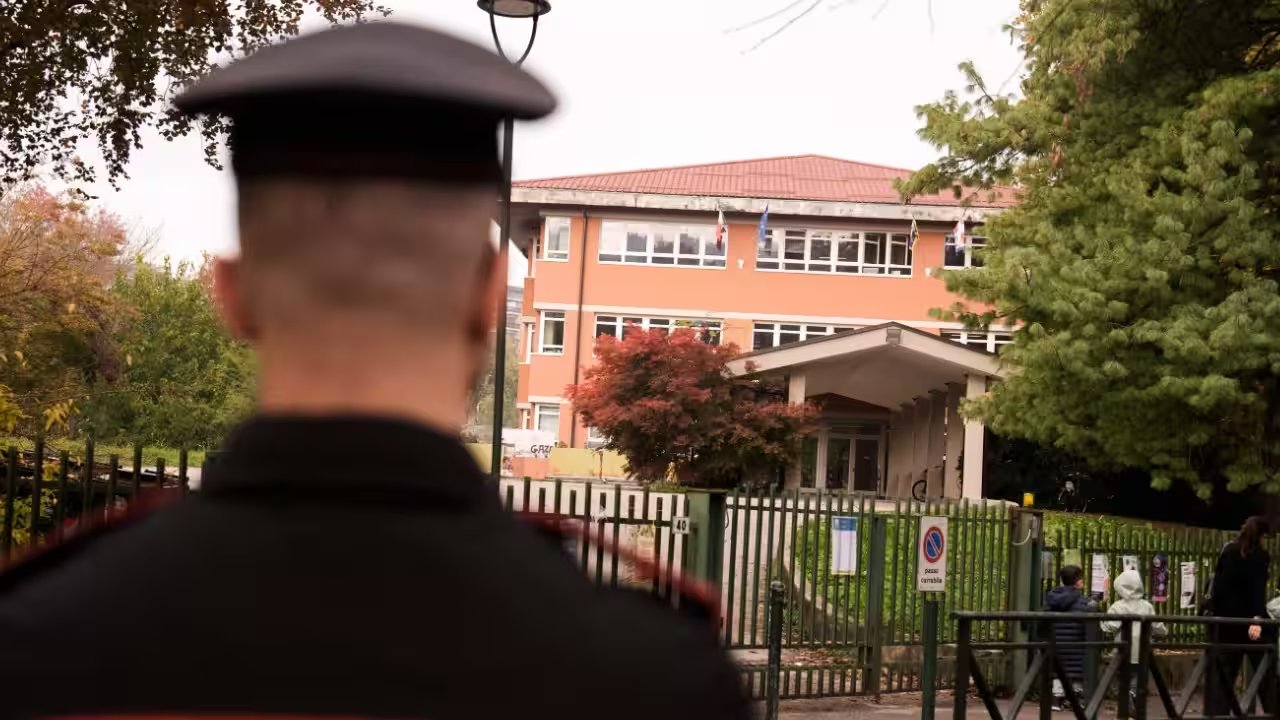
Italian police evacuated more than 300 schools across the country on Wednesday after coordinated digital bomb threats flooded over 6,000 institutions, warning of a mass attack against citizens and targeting Prime Minister Giorgia Meloni.
The alarm bell rang. Most students assumed it signaled afternoon recess.
Yet within minutes, anti-terror squads, canine units, and emergency services cleared classrooms spanning from Friuli in the northern alpine foothills to Basilicata in the southern peninsula. In Rome, teaching staff escorted hundreds of students into open courtyards as bomb technicians searched boiler rooms and lockers for concealed explosives. The panic erupted from an identical electronic dispatch signed by an operative identifying himself as “Mikhail Andropov, leader of the Vilayat of Misoginistan.” The text declared that a remote-controlled explosive device sat primed inside school infrastructure, threatening mass casualties before alleging an explosive had also been wired into the engine block of Prime Minister Meloni’s official vehicle.
“They are saying it was a bomb alert because an email arrived from Russian hackers in which they said they would have killed everyone,” said Anita Bartocci, an 18-year-old student at a Rome high school evacuated during the operation. “It was pretty violent.”
Education Minister Giuseppe Valditara confirmed that over 300 institutions initiated immediate emergency protocols, noting that the tally of alerted facilities could climb as regional directorates file log reports. The scare paralyzes an education system already on edge. Just eight days prior, on November 2, a similar electronic barrage targeted 270 Italian educational facilities, forcing disruptive security sweeps that ultimately yielded no detonators or hazardous materials.
But the operational disruption remains severe.
Italian Defence Minister Guido Crosetto slammed the campaign as a deliberate attempt to sow public dread and exhaust emergency response units across the republic. Law enforcement agencies face an escalating dilemma: dismiss the alerts and risk catastrophic oversight, or clear entire city blocks and paralyze civil infrastructure on demand.
Law enforcement agencies are working to distinguish genuine dangers from threats manufactured purely to sow fear and systemic paralysis.
Guido Crosetto, Italian Defence Minister
| Threat Parameter | Incident Record | Official Response |
|---|---|---|
| Institutions Alerted | 6,000+ schools across Italy | Digital triage by postal police |
| Facilities Evacuated | 300+ primary and secondary schools | Sweeps conducted by canine & bomb squads |
| Regions Impacted | Rome, Friuli, Basilicata | Full emergency clearance protocols |
| Named Targets | School facilities, PM Giorgia Meloni's vehicle | Security perimeter sweeps verified clear |
Similar threatening dispatches landed simultaneously in school administrative inboxes across Northern Ireland, Scotland, and the Republic of Ireland. Scottish and Irish authorities took a divergent operational stance. Police Scotland classified the communiqués as an unsubstantiated hoax and directed headmasters to keep pupils in classrooms, while Northern Ireland law enforcement launched inquiries into identical digital headers without ordering campus clearances.
European security services are tracing the alias. In recent weeks, the pseudonym Mikhail Andropov appeared in intimidation notices transmitted to European commercial television broadcasters and anonymous warnings targeting passenger aviation. The episode unfolds against a broader backdrop of hybrid digital disruption throughout the continent, where untraceable cyber intrusions recently crippled commercial cold-chain systems, forcing French hospitals to hastily relocate blood bank reserves.
To counter the escalating frequency of digital sabotage, Interior Minister Matteo Piantedosi convened an emergency assembly of state security chiefs to overhaul national cyber-incident response. Former Interior Minister Marco Minniti warned that piecemeal police reactions no longer suffice, calling for a centralized, dedicated cyber-intelligence apparatus to counter coordinated psychological warfare. Italian cybercrime prosecutors and Rome police investigators continue digital forensic tracing on the server hops used to route Wednesday’s emails, with initial jurisdictional findings expected before the end of the week.