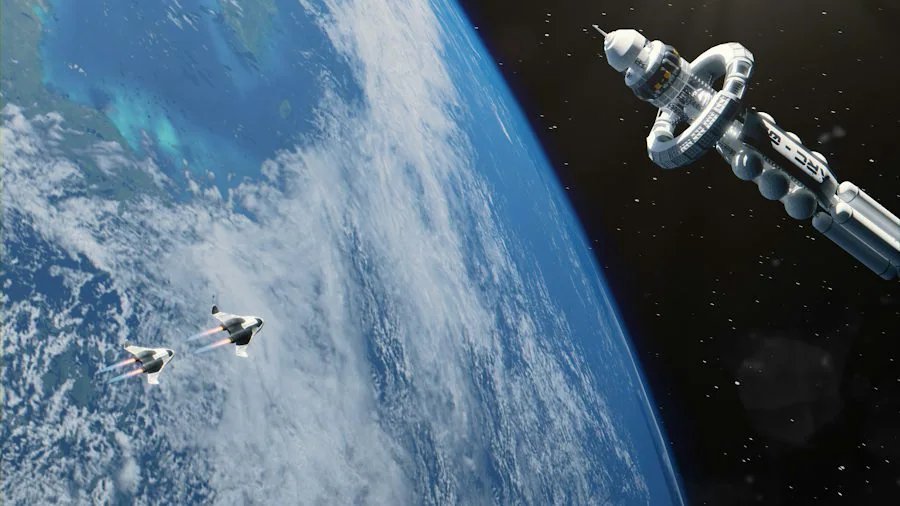
A war in space is no longer a sci-fi scenario; it is a five-year countdown. Dr. Julia Balm, a leading voice at King's College London's Freeman Air and Space Institute, delivered the stark assessment this week. She stated that allied nations are already under daily fire in orbit. "We are looking at conflict emerging not only in the domain, but in the next five years," she told a room full of industry leaders at an Astroscale meeting in London. The warning cuts through the usual diplomatic fog. Things are changing fast.
The stakes on the ground are brutal. A single major strike on a satellite constellation could blind GPS, sever internet links, and freeze air traffic control. Banking systems would stutter. Modern life would grind to a halt. Dr. Balm said adversaries are "targeting" Western assets daily. The tech to do this is no longer theoretical. It is in active development. Orbits are becoming the new trench lines.
Russia and China are pushing the boundaries. US intelligence agencies track the Russian satellite Cosmos 2553, launched in 2022. They believe it may carry nuclear components. A detonation in low Earth orbit would shower thousands of other spacecraft with high-energy particles. That could render parts of the planet's orbit unusable for decades. This week, a Russian military satellite made a suspicious close approach to ICEYE X36, a satellite supporting Ukraine. China has tested spacecraft capable of capturing objects in orbit. They have also demonstrated refuelling in deep space. These are not accidental flybys. They are demonstrations of capability.
Britain is pivoting hard to defence. The Royal Air Force announced its first dedicated space squadron in September. Defence Secretary Wes Streeting stated that threats are "growing in speed, scale and sophistication." Commercial firms are following suit. Nick Shave, managing director of Astroscale, said the company shifted from debris removal to military work after the 2024 strategic defence review. "We have been able to just put objects in orbit and be fairly happy that they're not going to get attacked, but I think that's changing now," Shave said. Orbit Fab, which builds satellite refuelling tech, is now working with the Ministry of Defence on "defensive and offensive capabilities." Jacob Geer, Orbit Fab's managing director, noted that the same technology used for refuelling can be used for kinetic engagement. The line between commercial and military space is erasing itself.
The European Space Agency is now weaving security applications into its core projects. The era of peaceful exploration is ending. The next five years will define whether humanity can keep its most critical infrastructure alive in the vacuum. Diplomats are drafting frameworks, but the hardware is already building.