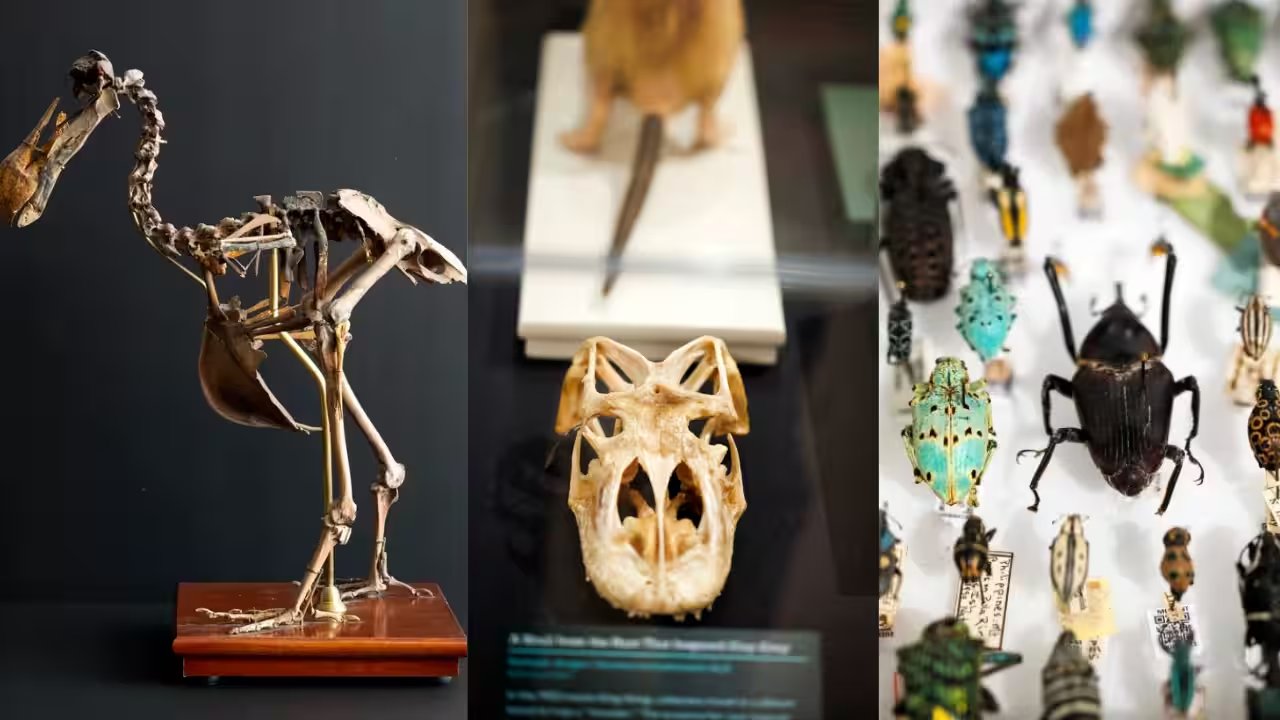
The Harvard Museum of Natural History in Cambridge opened 'Collecting Wonders: Tomorrow's Discoveries' on June 27, 2026. The exhibition, a joint effort of the Harvard Museums of Science and Culture, the Museum of Comparative Zoology, the Harvard University Herbaria, and the Mineralogical and Geological Museum, draws on more than 26 million objects. It will run through April 2027 in the museum's main gallery space.---The centerpiece of the show is an articulated dodo skeleton, the last widely accepted sighting of the flightless bird was in 1662. Visitors will also see the extinct golden toad, first discovered in 1964 in Costa Rica's Monteverde Cloud Forest and declared extinct in 2004, and a 300‑million‑year‑old fern preserved in coal from the era that powered the Industrial Revolution.---Other highlights include George Washington's golden pheasants, once kept in Louis XVI's aviary and later gifted to Washington; a Komodo dragon skull linked to the 1926 expedition that inspired 'King Kong'; and an oyster from around 1856 containing a mummified pearlfish.---Scientists use these specimens to trace genetic changes and ecological conditions. For example, genetic material from a fully articulated polar bear, in the collection since 1878, informs researchers about population diversity, while stable isotopes in its fur reveal past climate.---The exhibition is open daily from nine a.m. to five p.m. and will remain on display until April 2027.