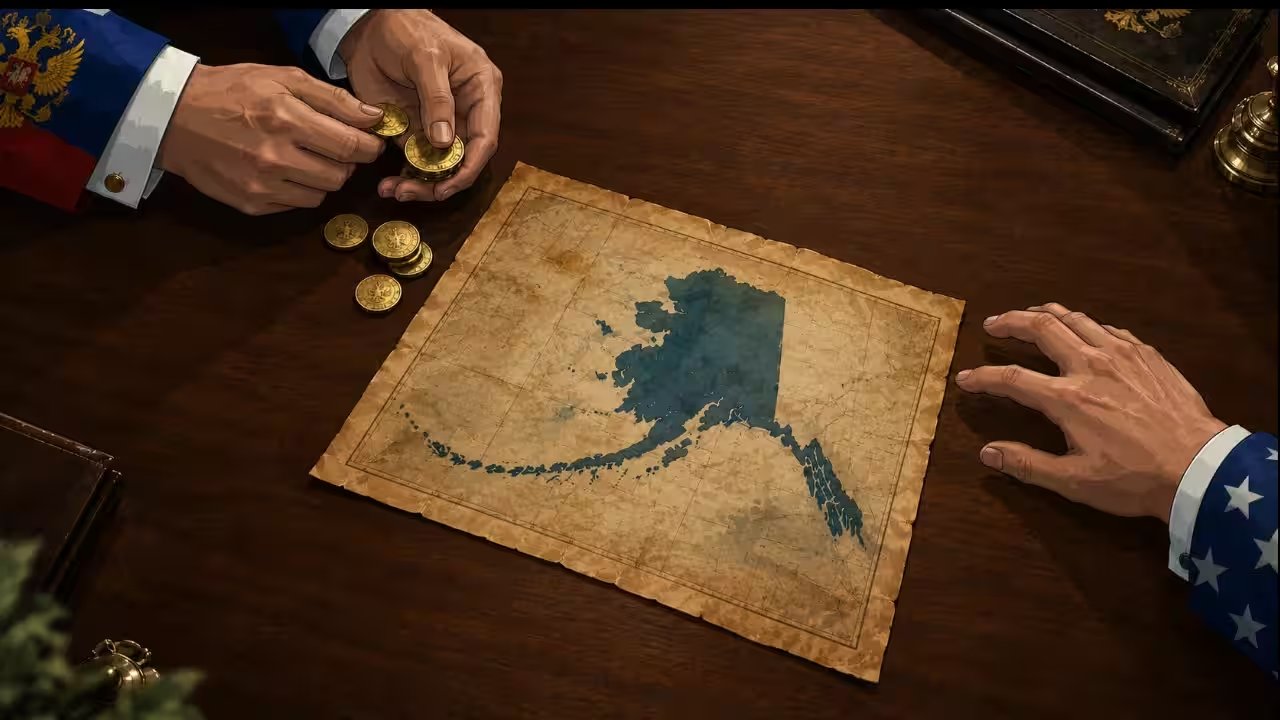
Russia closed its last North‑American outpost by selling Alaska for $7.2 million in gold on 30 March 1867, a transaction that covered nearly 600,000 sq mi at just under two cents per acre. The American purchase was driven by Washington’s hunger for Pacific access and the U.S. desire to cement a foothold that would later prove indispensable in the Arctic.
The Russian foothold had been a fur‑trade ghost town since the 1740s, when Vitus Bering’s ships first landed on the coast. By 1799 the empire had thrust the Russian‑American Company into a monopoly, yet the colony’s 400‑person population never crackled with imperial power, and the sea‑otter pelts that once flooded the ports were all but extinct.
Crimean War scars sharpened the Russian calculus: a British‑controlled Canada loomed across the Bering Strait, and a future conflict could have left Alaska stranded in hostile hands. Grand Duke Konstantin Nikolayevich, brother to Tsar Alexander II, argued that Russia should offload its most distant asset before it vanished without a penny.
Negotiations in Washington moved in a flash. Secretary of State William H. Seward met Russia’s minister Eduard de Stoeckl in a cramped Washington room on 30 March 1867, and the two signed the treaty overnight. President Andrew Johnson’s assent sealed the deal, and the U.S. annexed a landmass that would later host Alaska’s first military air stations.
Alaska’s strategic value exploded in the 20th century. During World War II the U.S. built the Lend‑Lease airstrip at Ladd Field, and the Cold War saw the state become a critical listening post as Soviet planes circled the Arctic. The sale that once seemed a cheap bargain thus cemented Alaska as a bulwark protecting the continental United States from Moscow’s reach.