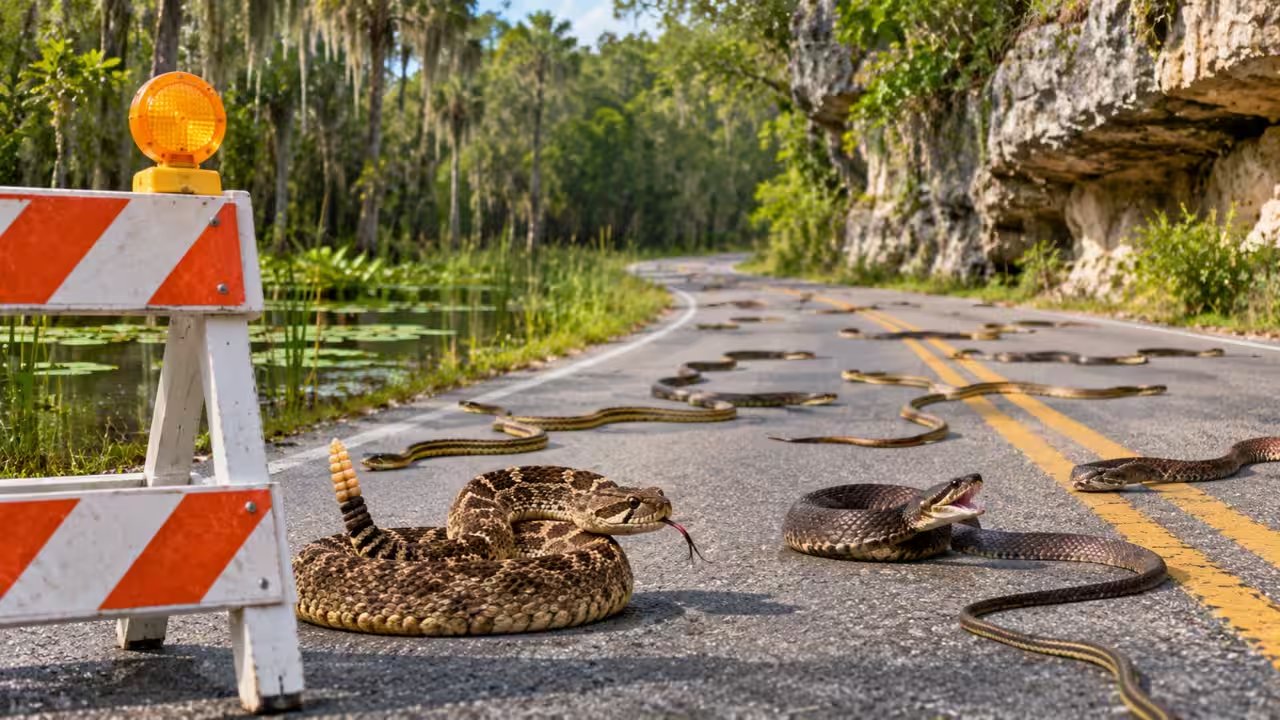
The barricades drop twice every year on a remote ribbon of asphalt in southern Illinois, cutting off cars to let thousands of reptiles crawl across in peace.
It is known simply as Snake Road. For four kilometres through the Shawnee National Forest, this narrow lane separates two critical ecosystems: the murky waters of LaRue Swamp to the west and the towering 46-metre limestone bluffs of LaRue-Pine Hills to the east. When temperatures shift, the bluffs empty. Thousands of cold-blooded animals—including three pit viper species—hit the asphalt, navigating a seasonal transit route where a single passing tire can wipe out years of biological growth.
To keep them alive, the US Forest Service locks down the entire corridor. No passenger cars. No commercial vehicles. Just two solid months of foot-only access every spring and autumn.
The ecological calendar here runs strictly on ambient air temperature.
Come spring, the forest awakens. As winter frost yields to warmer air, snakes, salamanders, and toads pull themselves out of hibernation deep inside the limestone fissures and crawl west toward the Mississippi River basin wetlands. LaRue Swamp offers prime feeding, mating, and resting grounds for the summer months. But when autumn arrives and temperatures plunge, the journey reverses. The animals turn back toward the dry, fractured rock faces of the 46-metre cliffs to escape the coming winter freeze.
That migration cuts directly across Snake Road.
| Migration & Habitat Parameter | Official Field Specification |
|---|---|
| Corridor Length | 4 kilometres |
| Forest Location | Shawnee National Forest, Southern Illinois |
| Spring Closure Window | 15 March – 15 May |
| Autumn Closure Window | 1 September – 30 October |
| Adjacent Bluffs Elevation | 46 metres above surrounding landscape |
| Total Documented Snake Species | Exceeding 23 species |
| Venomous Snake Species | 3 (Northern cottonmouth, copperhead, timber rattlesnake) |
| Primary Governing Authority | US Forest Service |
The protection program was not always this expansive.
Federal foresters first cordoned off the route in 1972, imposing a three-week vehicular ban during peak spring and autumn movements. It was a well-intentioned start. Yet it was insufficient.
Field investigations led by herpetologist Scott Ballard of the Illinois Department of Natural Resources revealed that the reptiles took far longer to complete their crossing than the original three-week window permitted. Cold-blooded animals move slowly in chilly transitional air. They do not hurry. As temperatures dip in the early mornings and late evenings, black asphalt absorbs and radiates residual heat—drawing snakes out onto the road surface to warm themselves. Instead of scurrying across, they linger. And when headlights approach, their natural survival instinct is fatal: they freeze.
Field documentation proved the lethal toll of open traffic. Research led by biologist Rich Siegel demonstrated that nearly one in every four snakes gathered during an ecological survey had already been struck and killed by moving vehicles. Confronted with the mortality rates, the US Forest Service overhauled the policy, lengthening the seasonal road closures from three weeks to a full two months in both spring and autumn.
The biodiversity along this four-kilometre corridor remains unmatched in the American Midwest.
Biologist Mark Vukovich documented more than 23 distinct snake species inhabiting the surrounding forest. Three are dangerously venomous: the northern cottonmouth (Agkistrodon piscivorus), the copperhead (Agkistrodon contortrix), and the timber rattlesnake (Crotalus horridus). Alongside them march hundreds of southern leopard frogs, lizards, turtles, toads, and rare salamanders—all funneling through the same pass.
While the Forest Service keeps vehicles locked out, the gates remain open to naturalists, photographers, and hikers on foot. The encounters require patience.
If you see twenty snakes while you're out here, that's a good day.
Scott Ballard, Biologist and Herpetologist
Forest rangers enforce strict ground rules for every pedestrian entering the corridor. Approaching, touching, harassing, or startling the reptiles is entirely prohibited. Collecting any reptile or amphibian along the route violates both federal and state conservation statutes, carrying severe financial and criminal penalties.
The seasonal closure remains in effect through 15 May, after which the gates will briefly open to summer vehicle traffic before snapping shut again on 1 September.