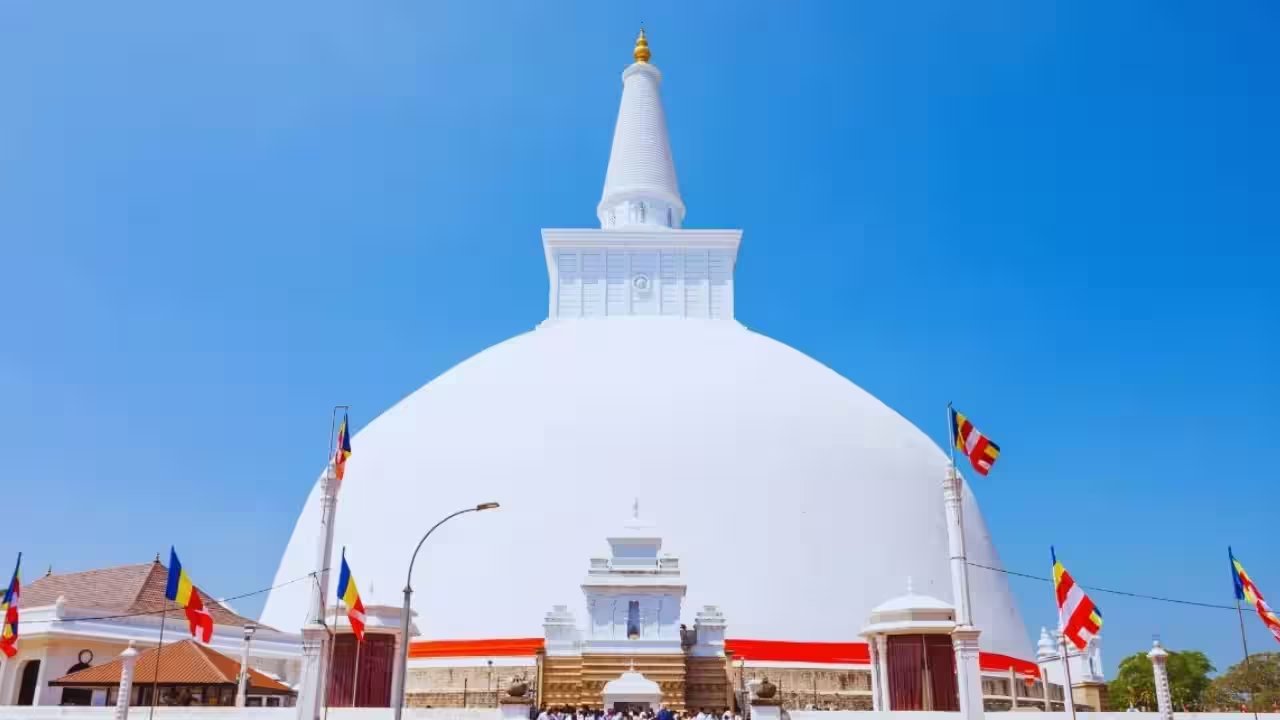
Buddhist monks defied a magistrate's eviction order overnight in Sri Lanka's sacred city of Anuradhapura, escalating an open-ended sit-in against an LKR 8.8 billion government redevelopment blueprint.
Bearing monastic robes and saffron banners, the demonstrators dug in around the venerated Ruwanweli Maha Seya and Jaya Sri Maha Bodhi shrines. The Anuradhapura Magistrate's Court had ordered them to dismantle temporary encampments and vacate the archaeological perimeter following violent clashes between demonstrators and police over an elevated observation structure. They refused. The agitation, led by Ven. Balangoda Kassapa Thera, demands the outright revocation of an official gazette published on February 27, 2026, by the National Physical Planning Department.
"We will not leave until the gazette is abolished," Kassapa said, alleging police officers manhandled him during the weekend skirmish.
The contentious state notification expands the protected boundaries of Anuradhapura—a UNESCO World Heritage site since 1982—from approximately 28 to 38 square kilometres. Urban planners argue the LKR 8.8 billion outlay modernises pilgrim infrastructure, strengthens archaeological conservation, and formalises civic zoning. Yet monastic factions and local lay groups suspect the spatial reclassification will curb traditional religious practices, encircle Ruwanweli Maha Seya with restrictive fencing, and allow rival places of worship inside the ancient Atamasthana enclave. Local residents pointed to a recently erected board identifying a 'Kali Kovil' site roughly 600 metres from Thuparamaya toward Lankaramaya, warning against further non-Buddhist developments.
State authorities pushed back sharply against the claims. National Physical Planning Department Director General Ruchira Vithana confirmed that the gazette authorises neither fresh religious shrines nor curbs on pilgrimage access. The ruins of a tenth-century Kali Kovil remain legally protected by the Antiquities Ordinance, he noted, while zero archaeological proof exists for rumored new shrines. A 500-metre security barrier erected near Ruwanweli Maha Seya serves strictly to deter stray livestock and looters, with plans underway to replace metal sheets with an environmentally friendly bio-fence.
The broader urban masterplan was prepared in concert with the chief incumbent of the Atamasthana, the Maha Sangha, and the Urban Development Authority. The blueprint gained significant regional momentum after Indian Prime Minister Narendra Modi offered infrastructure backing during a state visit in 2025. Urban Development Authority Director General Damith Dissanayake revealed that a 32-member presidential advisory council, appointed on October 30, already submitted draft proposals to the Indian High Commission, dispatching 45 specific sub-projects to the Department of National Planning.
The foreign engagement has fractured monastic consensus. While Most Venerable Pallewewa Dharmakeerthi Thera welcomed the broader infrastructural upgrade, he demanded strict veto rights for the chief incumbent and questioned duplicate barricades around Ruwanweli Maha Seya, pointing out that dedicated wild elephant barriers already protect the perimeter. Dharmakeerthi cautioned that historic Indo-Lankan ties dating back to Emperor Ashoka and King Devanampiyatissa must never dilute local Buddhist autonomy.
Legal representatives for the protesting monks will file a formal motion before the Anuradhapura Magistrate's Court on Monday, seeking to vacate the site clearance order and halt project tenders.