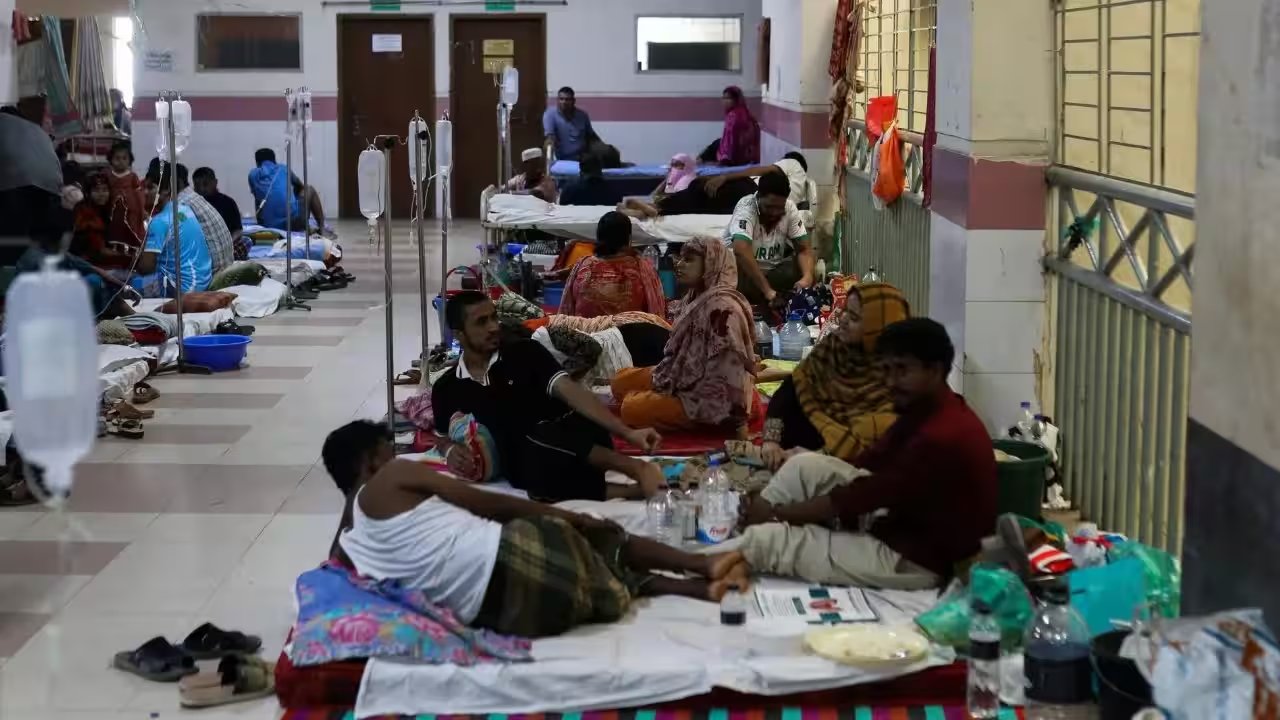
Dhaka’s healthcare infrastructure is buckling under a dengue surge that has left 145 patients fighting for space in a ward designed for just 38. At Mugda General Hospital, nurses and doctors reported on Thursday that every designated bed is occupied, forcing them to administer saline and monitor vitals for patients lying directly on the floor and verandas. The overcrowding has made it nearly impossible to provide emergency care or properly administer medication, according to hospital staff.
The pressure is not isolated to this single facility. The Directorate General of Health Services (DGHS) confirmed 747 new dengue admissions across Bangladesh in the 24 hours leading up to 8 am on Friday. While no deaths were reported in that specific window, the cumulative toll is heavy: 79 people have died from dengue in the first 18 days of September. Since January 1, 2026, 59,147 individuals have been hospitalized for the disease, resulting in 176 total deaths.
Afrin Akter, a resident of Narayanganj, illustrates the desperation on the ground. Her mother described days of fever and body aches that ignored oral medicines, leading the family to scour multiple hospitals without finding a vacant bed. They eventually reached Mugda, where Afrin was admitted despite the lack of space. She was seen vomiting intermittently, too weak to speak clearly, while a nurse administered IV fluids on the floor.
Nasima, the sub-in-charge at Mugda, stated that patients are arriving daily from Dhaka and surrounding districts, necessitating the use of non-standard spaces. “Due to the bed shortage, patients are being admitted to the floor and veranda out of necessity,” she said. Dr. Nurul Islam, deputy director of the hospital, acknowledged that while current staff are managing the load, additional beds and manpower are urgently required to handle the critical cases arriving in large numbers.
The outbreak has spread well beyond the capital. Chittagong division recorded 180 admissions, Mymensingh 92, and Khulna 81 in the same period. Entomologist Professor Kabirul Bashar warned that forecast models suggest the situation could worsen in October, despite the typical seasonal decline in Aedes mosquito visibility. He urged for stronger mosquito-control measures, noting Bangladesh’s status as a “country of mosquitoes.”
DGHS director general Professor Dr Prabhat Chandra Biswas said patients will be referred to private hospitals if government facilities exceed capacity. He claimed hospitals have been instructed to increase bed numbers and strengthen treatment at district and upazila levels. Public health expert Dr Mushtak Hossain countered that treatment alone is insufficient, calling for the destruction of mosquito breeding grounds and improved early detection to stem the tide.