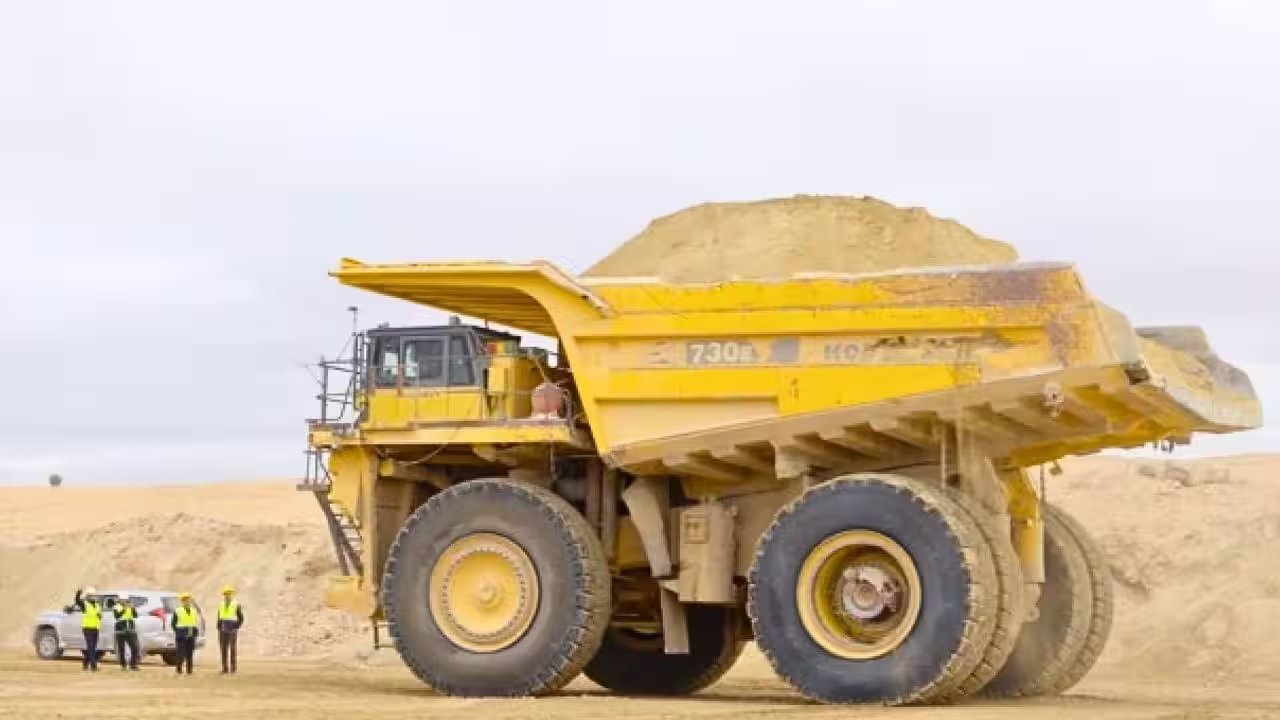
At the Benguerir phosphate mine in Morocco, engineers replaced standard unpaved haul roads with a pavement constructed entirely from local waste rock, slashing dust emissions by 91% during field trials. The study, published in the journal Mining, details how a three-layer structure—comprising a 0.35-metre sub-base, 0.25-metre base, and 0.07-metre asphalt wearing course—handled the extreme loads of mining trucks that move 22.35 kilotonnes of material daily. This approach directly addresses the operational bottleneck of heavy-haul logistics while repurposing extraction byproducts.
The mechanical performance proved robust. Laboratory tests identified a 5.1% bitumen content as optimal, yielding a stiffness modulus of 9,160 MPa and fatigue resistance of 139.6 microstrains at failure. In the field, the compacted sub-base recorded an average EV2 value of 153 MPa, while the base layer reached 181 MPa, confirming the design’s ability to withstand permanent deformation and structural rutting without excessive maintenance.
Dust reduction was the headline metric. On the unpaved section, which relied on daily watering and grading, average PM2.5 and PM10 concentrations hit 91,730.16 micrograms per cubic metre. After installing the waste-rock pavement, readings dropped to 8,570.10 micrograms per cubic metre. This 91% reduction surpassed OCP Group’s internal target of cutting airborne dust by more than 80%, significantly improving visibility and air quality for workers.
Economic analysis suggests the infrastructure pays for itself. The experimental section cost approximately €23.97 per square metre, including a 25% allowance for bulking and wastage, with assumptions placing the crushing unit within 5 kilometres and the asphalt plant within 25 kilometres of the site. OCP’s internal assessment indicates that after 15 months of continuous operation, wider deployment could boost annual productivity by roughly 15%. Gains stem from higher truck speeds, extended fleet service life, and reduced wear on tyres and wheel motors.
OCP Group is currently evaluating the rollout of this pavement design across other high-traffic haul roads in the Benguerir complex. The next phase involves scaling up the crushing infrastructure to handle the volume of waste rock required for broader implementation, with a focus on standardizing the 0-100 mm and 0-63 mm grading specifications used in the initial trial.