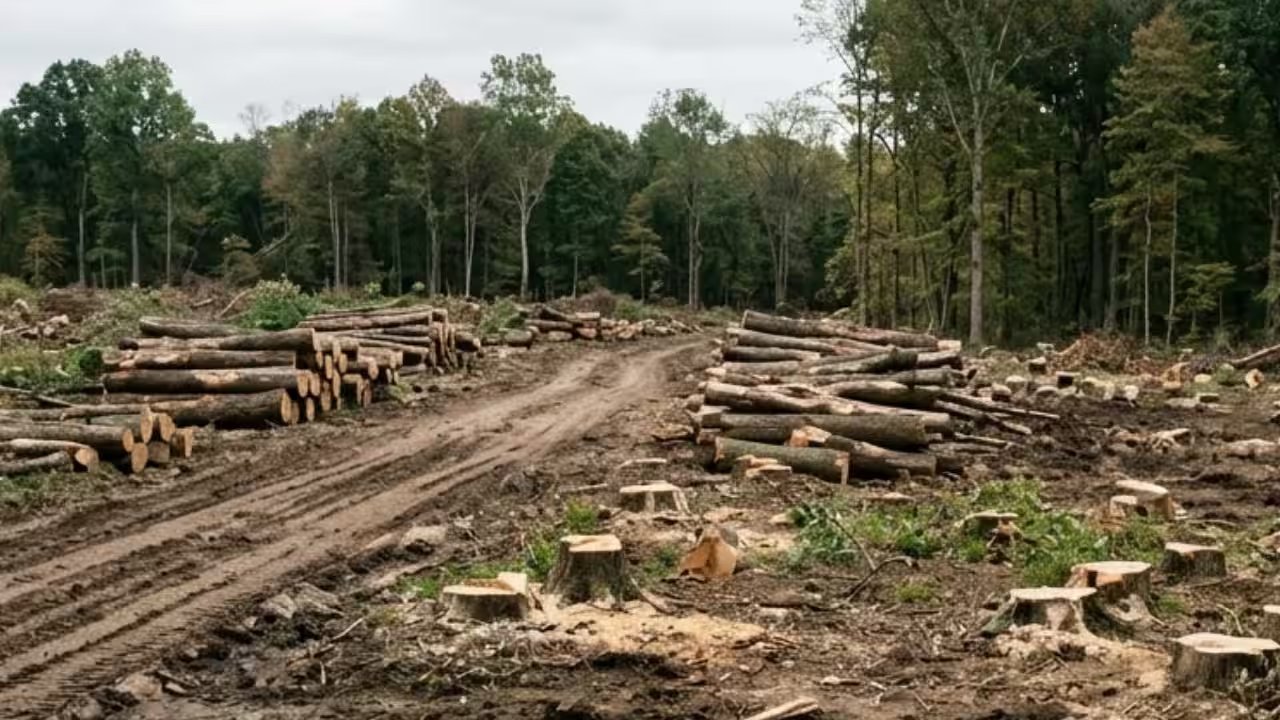
CINCINNATI — A high-stakes federal trial opened in Cincinnati on November 9 as Pierce Township residents took Commercial Liability Partners to court, demanding $3.3 million in damages after the Missouri developer cleared roughly 250 mature trees from a protected forest buffer.
The forest was no ordinary woodland. It formed a vital greenbelt bordering the shuttered William C. Beckjord coal-fired power plant along the Ohio River, acting as an ecological barricade between township neighborhoods and more than five million tons of toxic coal ash buried in unlined pits. Now, a federal civil jury must rule whether the company ripped through a binding 1986 legal covenant that required the parcel to remain in a "substantially undisturbed" condition.
The legal showdown traces back to February 2018, when Commercial Liability Partners purchased the 1,443-acre industrial tract from Duke Energy. While the Missouri firm secured outright title to the land, an organized citizens' collective known as Neighbors Opposed to Pit Expansion—abbreviated as NOPE—held legal control over the protective conservation easement guarding the greenbelt.
The standoff ignited one year later.
In 2019, contractors hired by Commercial Liability Partners moved heavy machinery onto the site, felling 50-foot hardwoods and carving haul roads through the woods. Plaintiffs filed suit immediately.
Allen Freeman, chairman of the Pierce Township Board of Trustees, testified that township residents discovered the destruction during routine inspections of the perimeter. The company, he stated, systematically liquidated standing timber across the tract after acquiring the deed.
In 2019 CLP had full title to the property, and they started basically on a process of selling anything that they could make money off of, and that included selling the hardwood trees. We were walking the site, and you could just literally see how the tree line was just shaved off. The backs of trees that were just cut straight down.
Allen Freeman, Chairman, Pierce Township Board of Trustees
Contractors felled valuable stands of black walnut, sugar maple, black cherry, and pine. Beyond the timber losses, the lawsuit documents the wholesale destruction of the forest understory—stripping native floor vegetation, flattening wild turkey breeding habitats, and opening pathways for invasive honeysuckle.
Freeman explained that the trees provided an indispensable physical shield. Their deep root systems anchored the steep hillsides holding back the power plant's coal ash repositories. The canopy masked the visual blight of exposed industrial waste.
| Case Parameter | Detail on Record |
|---|---|
| Court Venue | U.S. District Court, Cincinnati |
| Plaintiffs | Neighbors Opposed to Pit Expansion (NOPE) / Pierce Township Residents |
| Defendant | Commercial Liability Partners (CLP), Missouri |
| Total Acreage Purchased | 1,443 acres (Acquired February 2018 from Duke Energy) |
| Felled Timber Volume | Approximately 250 mature trees (Walnut, Maple, Cherry, Pine up to 50 ft) |
| Damages Sought | $3.3 million |
Inside the courtroom, the dispute turns on the precise text drafted nearly four decades ago.
In 1985, the former utility operator, Cincinnati Gas & Electric, began buying up farmland and residential plots across Pierce Township to dig expanded waste ponds. Threatened with immediate municipal litigation, the utility struck a peace pact with residents in 1986, establishing the perpetual greenbelt.
Christopher Knoop, a former Pierce Township trustee and charter member of NOPE's 1985 steering committee, served as the plaintiffs' opening witness. He testified that the community demanded the buffer to protect the township's character and forest canopy, keeping the steep hillsides intact and free of invasive plants.
"We wanted it to be left alone," plaintiffs' lead attorney Dave Altman declared during opening arguments.
Defense counsel Gregory DeGulis countered that Commercial Liability Partners stayed strictly within the letter of the law. The developer argued that the 1986 compact contains broad phrasing rather than strict silvicultural prohibitions.
"'Substantially undisturbed state' is the main term we're arguing about," DeGulis stated in court, emphasizing that the original contract text nowhere explicitly mentions "mature forests" or bans removing individual trees.
Jury deliberations will resume in Cincinnati federal court following witness testimony, with jurors weighing whether the felling of 250 trees constituted a $3.3 million commercial breach.
| Governing Covenant | 1986 "Substantially Undisturbed" Easement Agreement |