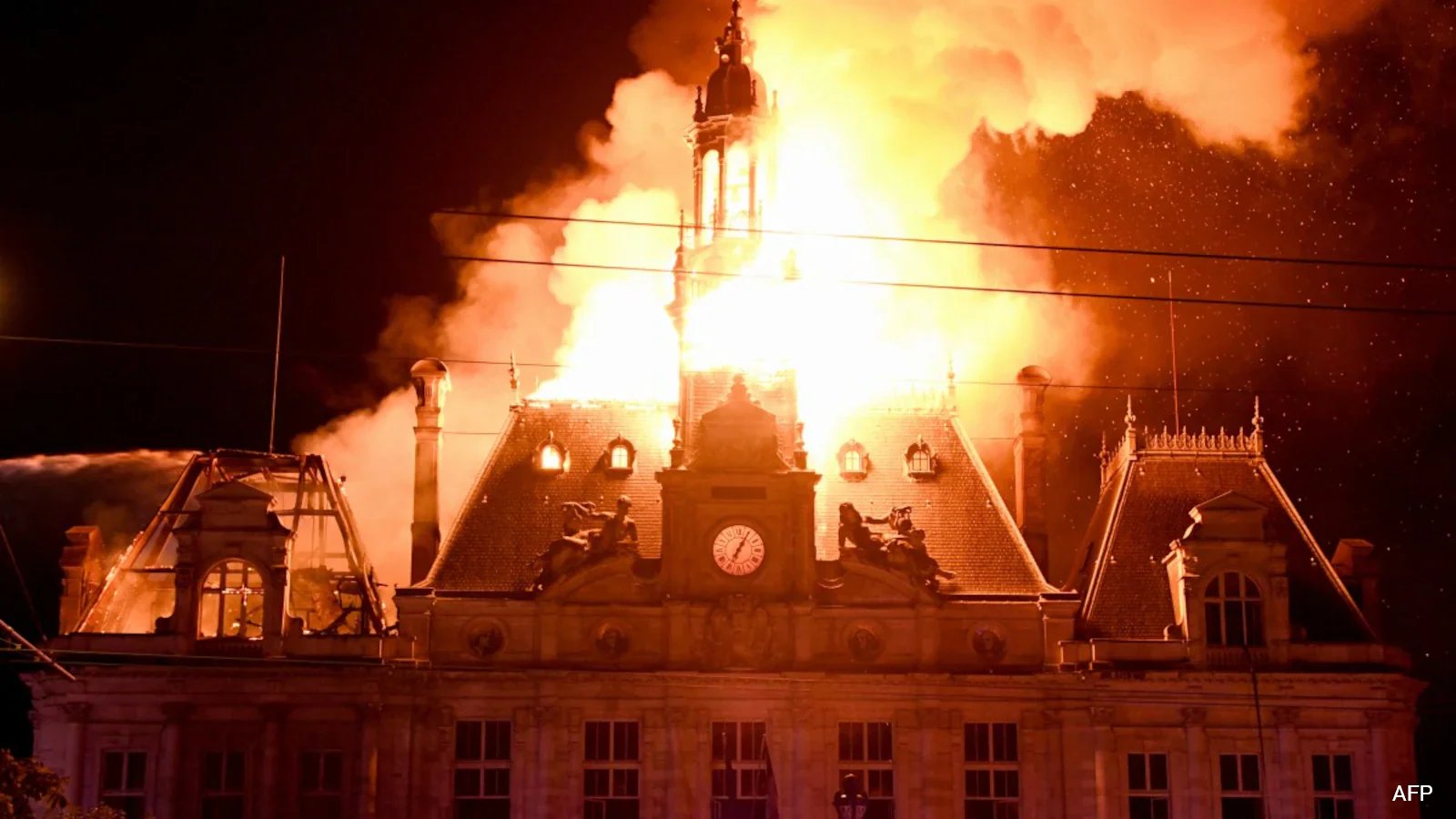
On Saturday, Oct. 17, 2026, masked rioters broke into the historic town hall of Limoges and set it alight, reducing the 1876‑built building, once a silent witness to both World Wars, to smoldering ruins—
The incident unfolded amid a nationwide wave of violence sparked by soaring inflation, with up to 800,000 demonstrators marching across Paris, Marseille, Nice, Nantes, Bordeaux, Lille, Toulouse, and Strasbourg, according to the CGT union.
Police deployed tear gas and water cannons as protesters hurled projectiles, and a 17‑year‑old boy in Saint‑Étienne lost his right hand when a crowd‑control grenade detonated nearby—
In total, Interior Minister Gérard Collomb announced that 1,200 protestors had been arrested and 150 officers injured across the country.
Looters seized cameras, smashed glass, and ransacked supermarkets, pharmacies, luxury boutiques, and electronics stores, leaving a trail of fire and vandalism that extended beyond Limoges to other town halls in Marseille and Lille and to a police compound in Bordeaux.
The violence drew sharp reactions from political leaders: Macron vowed on X that those who carried out vandalism would be prosecuted; Marine Le Pen condemned the rioters and warned that a future Le Pen administration would protect France from the "extreme left"; and Jean‑Luc Mélenchon urged demonstrators to avoid looting, labeling it "contrary to our methods."
In the streets, a shopkeeper in Marseille’s Rue de la République described the chaos: "We were watching the shutters lift, and then the fire— we had nowhere to go." The image of a shuttered storefront, a city on the brink of chaos, grounds the headline in lived reality.
As the nation grapples with the aftermath, Interior Ministry officials have begun forensic investigations, and the Ministry of Culture has pledged to oversee the reconstruction of the destroyed hall— a city that once survived two world wars now faces a new kind of destruction.