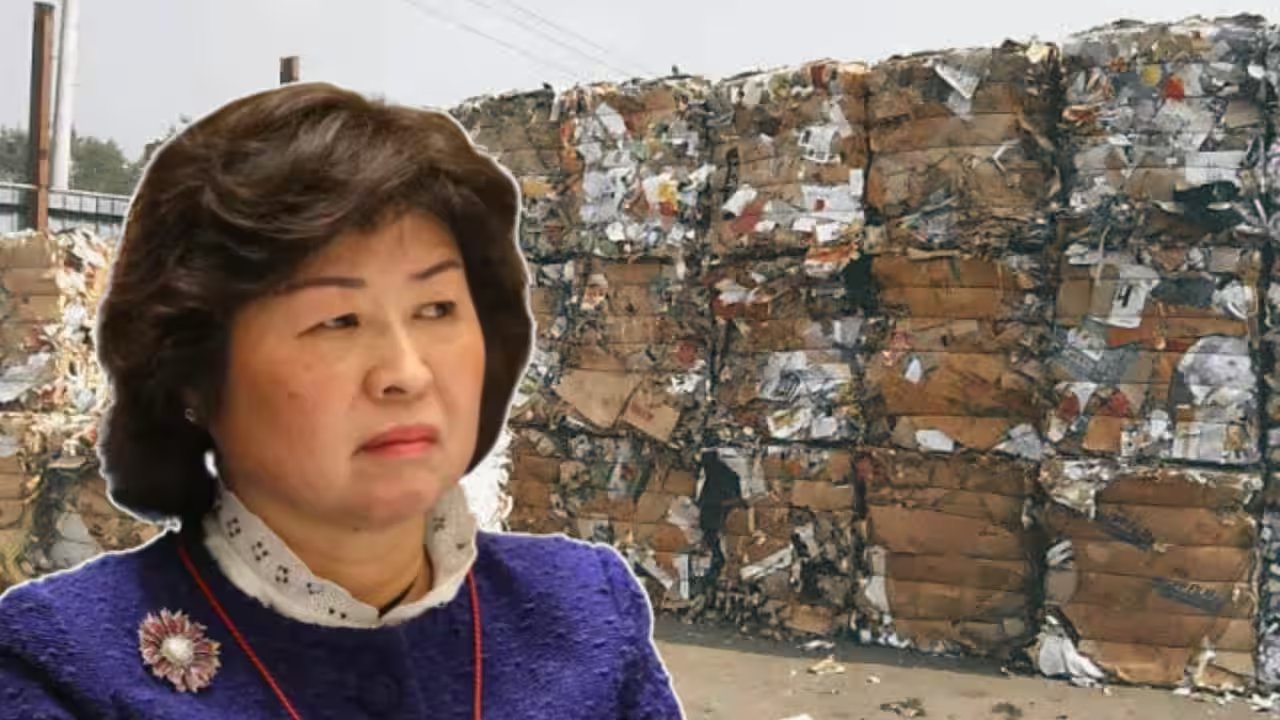
Zhang Yin didn't start with a factory. She started with a used Dodge minivan and a pile of scrap paper in 1990. In Los Angeles, she and her husband drove from dump to dump, buying waste paper that Americans tossed in trash bins. It was a dirty, unglamorous business. But Zhang saw what others missed: China was hungry for raw materials, and the US had an overflow of discarded fiber. That mismatch became her lifeline.
The mechanics were deceptively simple. Chinese container ships unloaded electronics and textiles in US ports, then returned to Shanghai with empty holds. Zhang negotiated rock-bottom rates to fill that empty space with baled waste paper. Rupert Hoogewerf, publisher of the Hurun Report, noted that this logistical hack made the trans-Pacific transport of bulky, low-value material commercially viable. By 2002, her company America Chung Nam was shipping roughly 3 million tons of waste paper annually. It became the largest waste-paper exporter in the United States, holding that spot for 18 consecutive years according to the Journal of Commerce.
Money flowed fast. In 2006, the Hurun Rich List named Zhang China’s richest person with an estimated $3.4 billion fortune. But she wasn't content to be just a middleman. In 1995, she founded Dongguan Nine Dragons in Guangdong province to manufacture containerboard herself. The first paper machine, capable of churning out 200,000 tonnes a year, started running in July 1998. Within two years, a second machine with double that capacity joined the line. By the time she listed the company on the Hong Kong Stock Exchange in 2006, production capacity had exploded to 3.3 million tonnes annually. She controlled both ends of the pipe: sourcing in America, manufacturing in China.
The growth was fueled by China’s manufacturing boom. Every toy, every appliance, every shirt produced in Guangdong needed a cardboard box. Zhang supplied the raw material and the finished product. Her early days were brutal. She admitted to reporters in November 2006 that she didn't speak a word of English when she arrived. “I had to learn from scratch,” she said. “The business was just my husband and me.” But the market rewarded her grit. Today, Nine Dragons stands as a global packaging giant, a testament to a business model built entirely on what the West threw away.