For anyone shopping for an electric vehicle, battery safety sits at the very top of the checklist. The nightmare scenario is thermal runaway—a compromised cell setting off an uncontrollable chain reaction of heat and toxic fire. Sheet metal and heavy steel pack enclosures have long served as the default defense, but they extract a brutal penalty in vehicle weight and driving range.
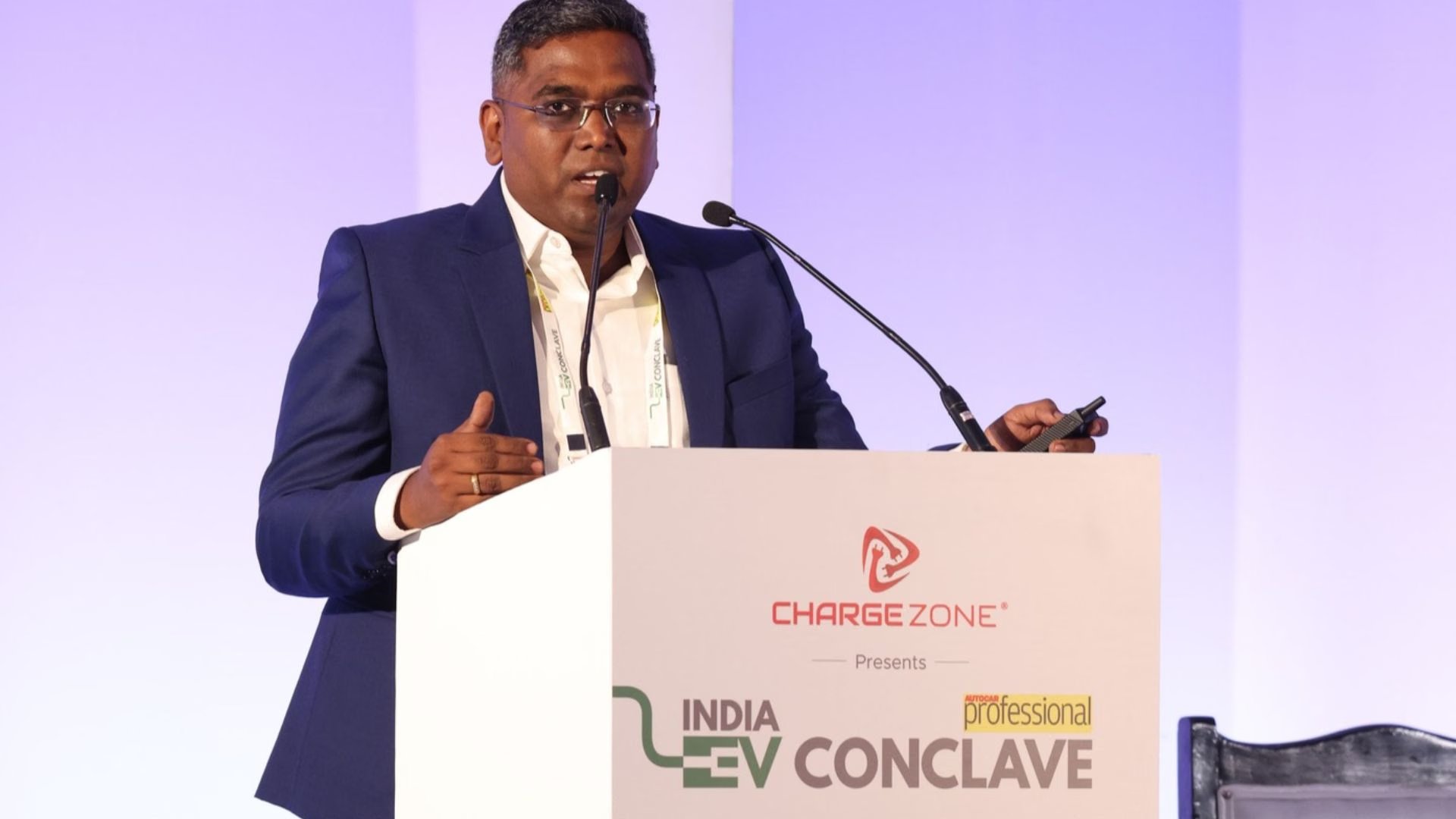
That equation is shifting toward advanced plastics. Speaking at the India EV Conclave 2026, Anton Kumanan, Technology Leader – India at Ascend Performance Materials, detailed how molecular-level engineering can help passenger vehicles survive battery fires without packing on excess curb weight. The core of this effort rests on Starflam X-Protect, a specialized polyamide 66 formulation designed to resist catastrophic heat through electron-beam cross-linking.
Standard plastics drop out early when fire strikes. Conventional unreinforced polyamide 66 softens and loses structural stiffness as temperatures near its melting threshold of 240 to 260 degrees Celsius. When a damaged lithium-ion cell spikes beyond that range, ordinary plastic walls melt into slag.
Ascend alters that chemical behavior through radiation chemistry. The material is first shot through standard injection-moulding machines into complex shapes. Then, an electron-beam treatment blasts the part, creating covalent bonds between polymer chains.
“It nearly becomes a thermoset,” Kumanan explained. Instead of liquefying at extreme temperatures, the cross-linked network locks the component's geometry in place.
But what does this mean inside an actual vehicle cabin? Minutes. In destructive validation tests subjecting standard flame-retardant PA66, aluminium, and cross-linked X-Protect PA66 to a direct 1,100°C flame at 1.4 kW of power, the cross-linked polymer held its structural posture. Kumanan pointed out that the material buys vehicle occupants over two minutes of additional escape time during a thermal runaway event. That window separates a controlled evacuation from tragedy.
Battery packs are not the only components feeling the heat. Ultra-fast DC fast chargers push hundreds of amps through internal distribution lines, turning electrical busbars into thermal hotspots. Ascend is collaborating with global automakers to deploy cross-linked polyamides across overmoulded busbars.
Busbars require rock-solid dielectric insulation alongside heat resilience. Ascend already holds more than 100 UL yellow cards for flame-retardant compounds under its Starflam portfolio, but high-temperature charging places severe strain on ordinary electrical grades. The cross-linked polymer delivers flame self-extinguishment while preventing discoloration under continuous electrical load.
| Material / Compound | Base Chemistry | Thermal / Melting Threshold | Primary EV Application | Key Performance Characteristic |
|---|---|---|---|---|
| Conventional FR PA66 | Polyamide 66 | Melts at 240°C–260°C | Low-voltage brackets & ducting | Basic flame retardancy; loses stiffness under intense heat |
| Starflam X-Protect | Electron-beam cross-linked PA66 | Survives direct 1,100°C flame exposure (1.4 kW) | Battery pack structural covers & overmoulded busbars | Acts like a thermoset; buys >2 minutes occupant escape time |
| HiDura PA610 & PA612 | Specialty Long-Chain Polyamides | Low moisture absorption matrix | Coolant lines, fluid connectors & sensors | >50% mechanical property retention after 1,000 hrs chemical exposure |
| Aluminium Enclosure Alloy | Non-ferrous metal | Melts at ~660°C | Outer structural pack casings | High structural rigidity but incurs substantial weight penalties |
Ascend established its Indian operating base in 2022 after acquiring Chennai-based Formulated Polymers. From its compounding plant in Tamil Nadu, the supplier produces reinforced and flame-retardant blends for domestic part suppliers. Now, the company wants to localize the complete Starflam X-Protect production loop on Indian soil.
No automaker wants to import heavy plastic battery covers when local supply chains exist. Ascend's localization roadmap relies on a four-step framework:
First, Ascend ships a ready-to-use compound from its Chennai facility. Second, an Indian Tier-1 supplier moulds the component using standard, existing injection-moulding machinery. Third, the unlinked part travels to an industrial radiation contractor for precise electron-beam bombardment. Finally, the finished component undergoes physical validation inside the OEM's battery system.
Kumanan confirmed that industrial-scale electron-beam irradiation facilities already operate in India. Ascend has tapped these domestic processing centres to prove that suppliers do not need capital-intensive retooling to produce high-voltage safety components.
Beyond high-heat runaway barriers, modern EV architecture demands long-term chemical resilience. Automotive battery packs circulate corrosive glycol coolants through tight passages, while exterior chassis parts face road splash and fuel residue.
Standard PA6 and PA66 nylons absorb ambient moisture, which swells the part and degrades dimensional tolerances over five to ten years. To counter this, Ascend is marketing its HiDura range—long-chain polyamides based on PA610 and PA612. These grades exhibit lower moisture absorption, preserving tight fits around fluid connectors and sensitive sensor housings. In fluid-aging benchmarks, the HiDura compounds retained more than 50% of their base mechanical properties after 1,000 hours of continuous chemical exposure.
To help Indian automakers simulate these stresses before cutting metal tools, Ascend set up an engineering centre at the IIT Madras Research Park. Technical teams in Chennai, Pune, and Gurugram run Moldflow and computer-aided engineering (CAE) simulations directly alongside OEM design teams.
Ascend is now inviting Indian Tier-1 suppliers and EV manufacturers to run joint pilot validation programs on localized Starflam and HiDura grades. As domestic automakers prepare high-voltage 800-volt architectures and accelerated charging capabilities across upcoming platforms, the ability to source crash- and fire-resistant materials locally will decide which models pass safety evaluations without pricing themselves out of showroom floors.