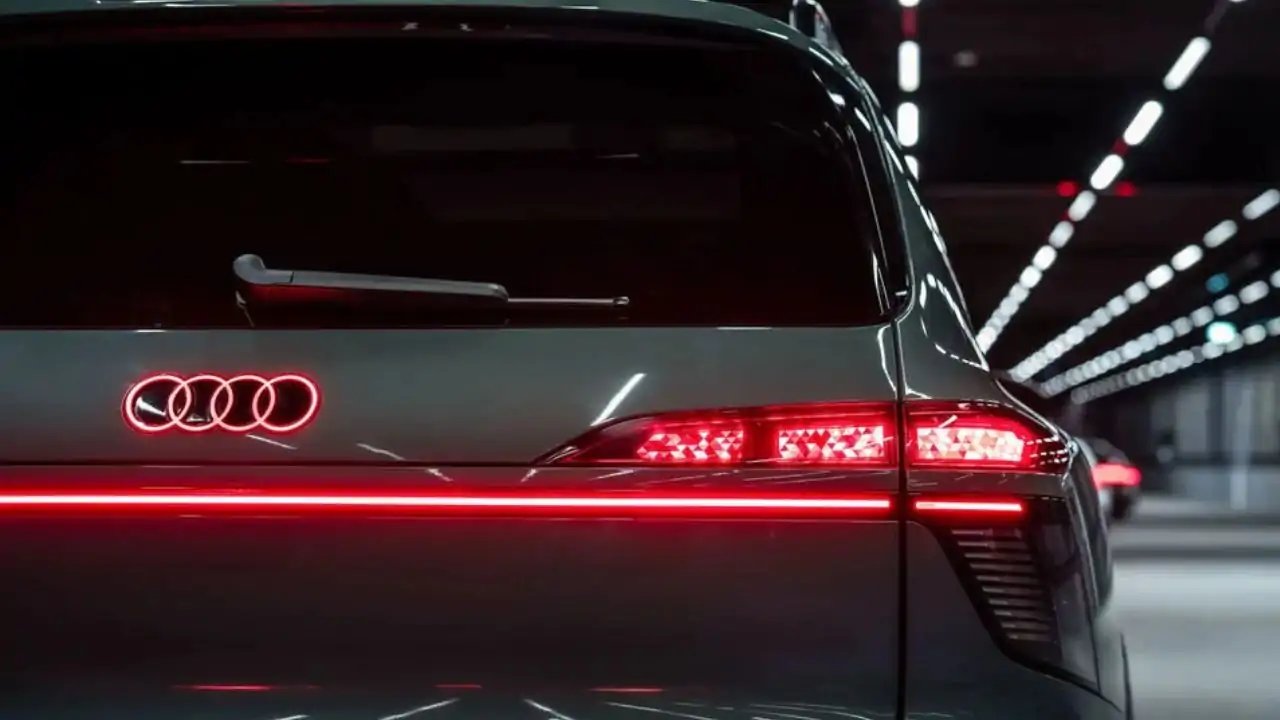
The Audi Q9 is going to look like nothing else on the highway, largely because of its rear end. Audi has confirmed it will be the first production car to use three-dimensionally curved digital OLED panels. No flat, static LED strips here. The system uses third-generation digital OLED tech, packing 512 individually controllable segments across six panels. For buyers, this isn't just about looking cool at a traffic light; it's about visibility. The curved design, made possible by ultra-thin glass only 0.1mm thick, bends to a 200mm radius, meaning drivers approaching from the sides get a much clearer view of the vehicle's width and intentions.
Under the hood of the lighting system, the complexity is staggering. The panels vary in size, with the largest housing 99 segments, the middle one 84, and the inner 73. This granularity lets the Q9 display up to eight different digital light signatures, ranging from fully active animations to static designs. But the real utility lies in the 'communication light function.' If the car detects a hazard ahead—like an accident or a breakdown—it can project warning symbols directly into the rear-light signature. It's a way for the car to tell the driver behind it, "Slow down, something's wrong up there," without them needing to look at the road far ahead.
Up front, the Q9 relies on digital Matrix LED headlights powered by micro-LEDs. A single module is just 13mm wide but contains 25,600 individual micro-LEDs. This high density allows for precise lane lighting and orientation guidance. In tight construction zones, the system modifies light distribution to help the driver stay centered. It also projects a moving indicator onto the road surface during turns, letting pedestrians and cyclists know exactly where the heavy SUV is heading. It’s a driver-assist feature, sure, but one that significantly reduces blind-spot anxiety in urban environments.
For now, this tech is exclusive to the Q9, but it sets a new benchmark for the luxury segment. Rivals like the Mercedes GLS or BMW X7 currently offer sophisticated lighting, but none match the level of interactive, curved digital display in the rear. As EVs and luxury SUVs get heavier and wider, these visibility aids are becoming less of a luxury and more of a safety necessity. Keep an eye on the Q9's launch timeline, as this lighting system will likely be a key differentiator against its German rivals in the coming years.