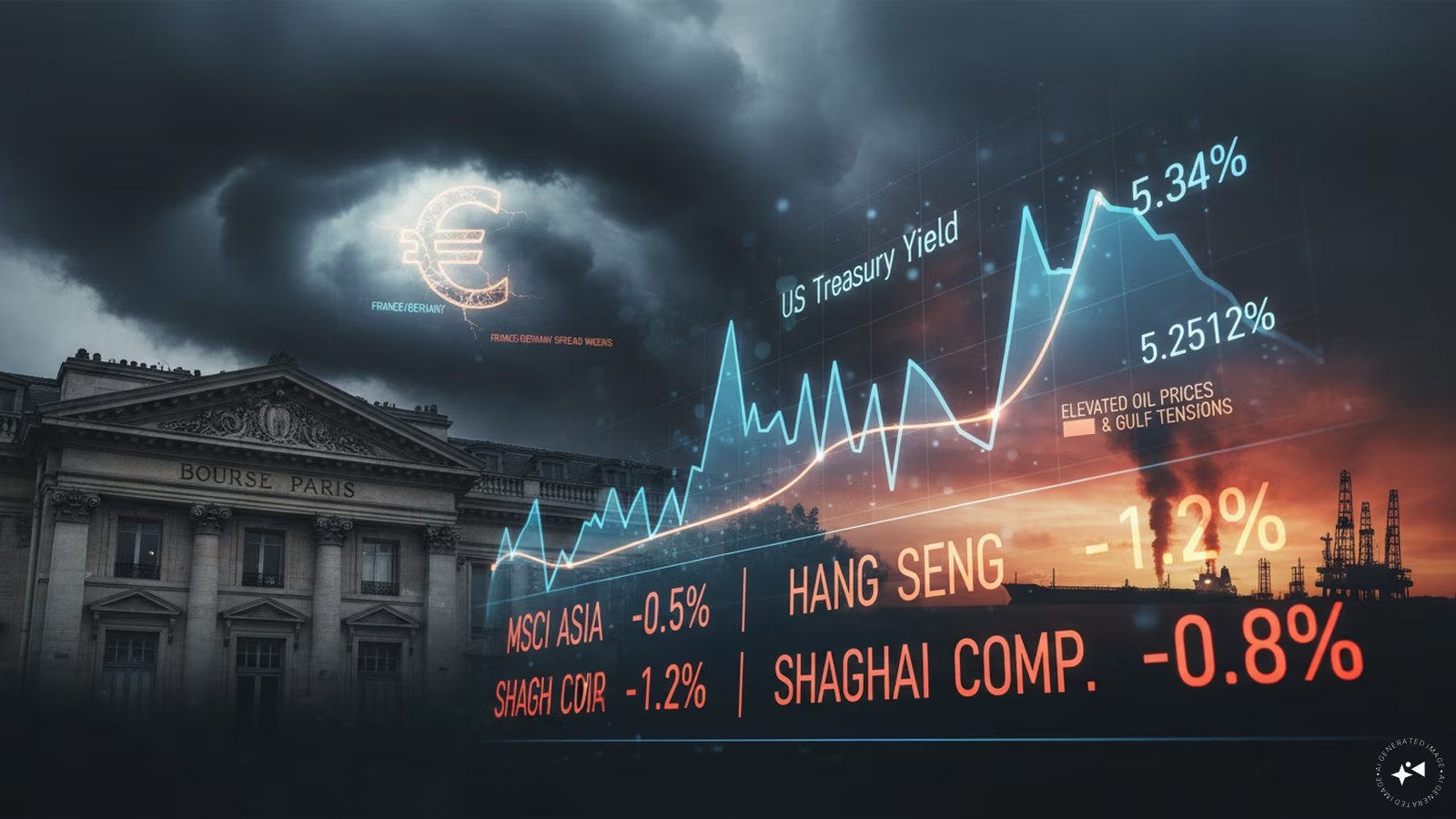
The bond market just set a record it didn’t want to. The 10-year US Treasury yield punched through 5.34% on Friday, the highest since 2002 and the capstone to the biggest quarterly rise in 32 years. It wasn’t a clean breakout; the yield retreated slightly to 5.25% in Asian trading, but the damage was already done for equity traders. MSCI Asia-Pacific ex-Japan shed 0.5%, tracking a 1.7% weekly loss. Japan’s Nikkei fell 0.7%, though it still managed a 3.1% weekly gain. Mainland China is dark for the holiday, leaving the rest of the region to absorb the shock.
France is bleeding. Sovereign bond spreads between French and German yields blew past 140 basis points, the widest gap since 2012. The euro took the hit, sliding to $1.1215, its lowest since May 2025. It also crumbled against the yen and Swiss franc. Safe-haven flows are flooding back into US Treasuries and the dollar. The USD index hit 102.09, its highest since April 2025, extending a three-week winning streak.
The real story is the Fed. Markets are now pricing a 25% probability of an October rate hike, a massive drop from 69% just last week. Two top policymakers signaled a pause to gather more data, but a December hike remains fully priced in. Chris Weston, head of research at Pepperstone, warned that a hot wage print could be the trigger. “With the Fed now myopically focused on inflation and price pressures, a hot wages print could prove particularly influential for US rates, Treasuries and the USD,” Weston said. The nonfarm payrolls report is due later today. Forecasts point to 90,000 jobs added and a steady 4.1% unemployment rate. But the ISM survey showed a huge jump in prices paid, signaling cost pressures that could force the Fed’s hand.
Oil isn’t helping. USWTI crude held at $92.84 after jumping nearly 3% overnight. Brent stayed above $102. The US is reportedly sending more troops and carriers to the Middle East, and China just suspended oil product exports. That’s a supply shock waiting to happen. For now, risk assets are absorbing the real yield spike, but a sustained term premium increase would be far more problematic. The yen is at 158.13 per dollar, with Tokyo’s underlying inflation hitting 2.7% in September, adding fuel to the rate hike debate.