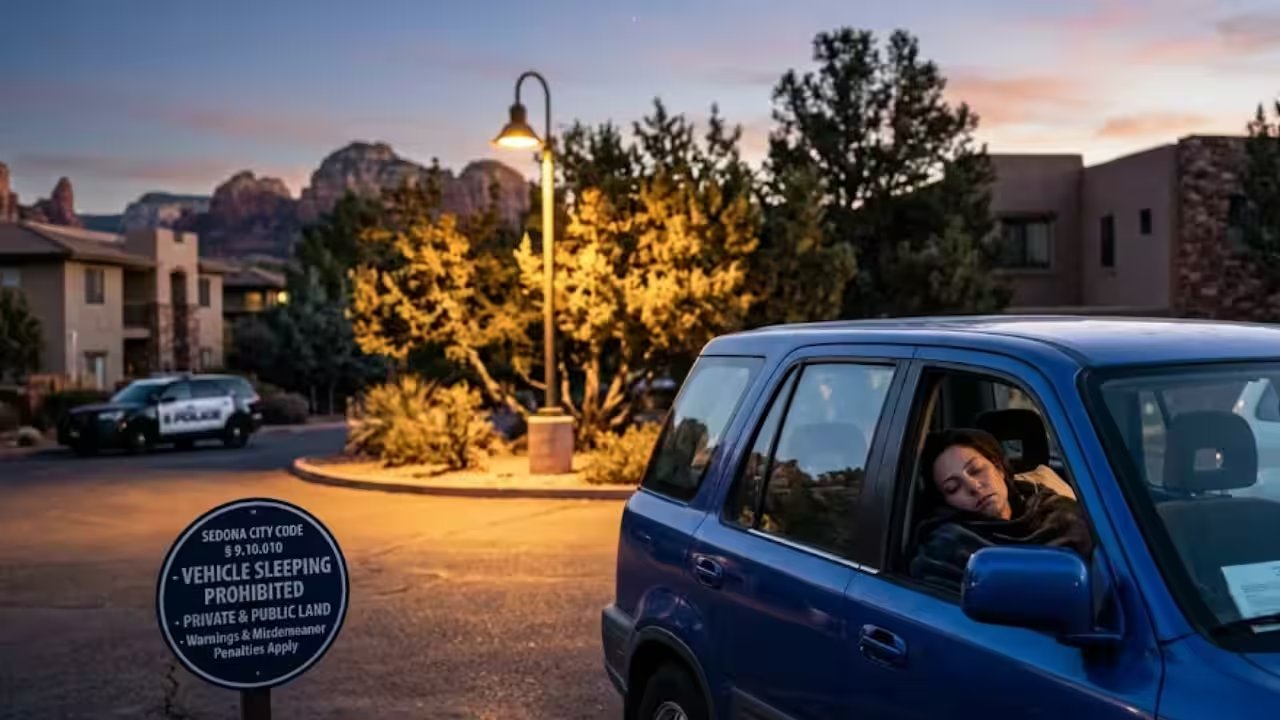
PHOENIX — Federal appellate judges have reinstated a disability discrimination lawsuit against the City of Sedona, ruling that a local resident with severe obsessive-compulsive disorder can challenge a municipal ban that criminalizes sleeping inside vehicles.
Sabrina Beram cannot enter her Sedona apartment when contamination triggers take hold. Her car is her only refuge. Yet under Sedona City Code Section 9.10.010, resting inside a parked vehicle anywhere within city boundaries—even on private residential lots—constitutes a class 1 misdemeanor carrying six months in jail and a $2,500 fine. A three-judge panel of the U.S. Court of Appeals for the Ninth Circuit ruled on November 12, 2026, that a lower court erred when it threw out Beram's complaint under Title II of the Americans with Disabilities Act.
The decision clears the way for Beram to pursue monetary damages and an injunction barring Sedona police from enforcing the ordinance against her.
Court records filed in the Ninth Circuit detail how severe obsessive-compulsive anxiety regularly locks Beram out of her own home. When she perceives unclean conditions in the unit, she experiences an intense sensory sensation that functions like an electric fence commanding her not to step through the door. To manage the episode, she engages in rigorous decontamination rituals. These routines drag on for hours. She frequently runs out of time to finish them before nightfall.
Sleep becomes impossible inside. On those nights—which occur at least three times every week—she reclines her driver's seat in her apartment complex's parking lot. If those spaces fill up, she seeks out other parking stalls across Sedona.
Sedona's municipal code, however, leaves zero margin for medical shelter. Section 9.10.010 outlaws vehicle dwelling on public streets and private real estate alike. The statute also penalizes landlords who knowingly allow tenants or visitors to sleep inside parked vehicles on their property. City regulations require officers to issue a preliminary warning before making a custodial arrest.
Police confronted Beram twice. During the first encounter at a public trailhead, an officer knocked on her window, commanded her to leave the site, and placed an official warning note in her police file. That marker signaled to every patrol officer in Sedona that she had used up her informal caution.
A second officer intercepted her in a city park. The officer woke her, reiterated that sleeping inside a vehicle violated municipal law, and stated that noncompliance would trigger an immediate criminal citation.
Housing peril followed swiftly. When Beram's landlord discovered she was sleeping in the apartment lot, the property manager ignored two successive disability accommodation requests. Instead, management handed her a lease addendum citing Sedona's vehicle sleeping prohibition and warned her lease would not be renewed. While Beram eventually negotiated a private settlement with the owner, the agreement contained an escape clause: the landlord can terminate the pact the moment either party receives another police warning or formal charge under the city ordinance.
Beram appealed to the municipal government. She petitioned the Mayor of Sedona for an ADA Title II reasonable modification to exempt her vehicle resting from police enforcement, eventually narrowing her request exclusively to her apartment's designated parking lot. The city government rejected her plea.
Attorneys from Community Legal Services subsequently filed a federal complaint on her behalf in the U.S. District Court for the District of Arizona. U.S. District Judge Diane J. Humetewa dismissed the action, ruling Beram lacked legal standing because two preliminary warnings failed to demonstrate an imminent threat of prosecution. Judge Humetewa also barred Beram from submitting amended pleadings.
The Ninth Circuit dismantled that logic.
Circuit Judge Roopali H. Desai, joined by Circuit Judge Ana de Alba and visiting U.S. District Judge Edward M. Chen, held that being denied a statutory disability accommodation inflicts an immediate, legally cognizable injury. Judge Desai wrote that Beram's lost working hours and documented emotional distress gave her direct standing to demand financial restitution.
The panel rejected the city's argument that Beram faced no genuine enforcement hazard.
The officers' warnings were not mere threats of enforcement: they were the first step of enforcement.
U.S. Circuit Judge Roopali H. Desai
| Case Parameter | Official Detail |
|---|---|
| Plaintiff | Sabrina Beram |
| Defendant | City of Sedona, Arizona |
| Challenged Ordinance | Sedona City Code Section 9.10.010 |
| Statutory Classification | Class 1 Misdemeanor |
| Maximum Statutory Penalties | Six months imprisonment, $2,500 fine, or both |
| Federal Statute Invoked | Title II, Americans with Disabilities Act (ADA) |
Sedona municipal attorneys must now defend the legality of their absolute exemption denial before the U.S. District Court in Arizona as trial proceedings resume on remand.
| Appellate Forum |
| U.S. Court of Appeals for the Ninth Circuit |
| Decision Date | November 12, 2026 |
| Ruling Circuit Judges | Roopali H. Desai, Ana de Alba, Edward M. Chen |
| Trial Court | U.S. District Court for the District of Arizona |