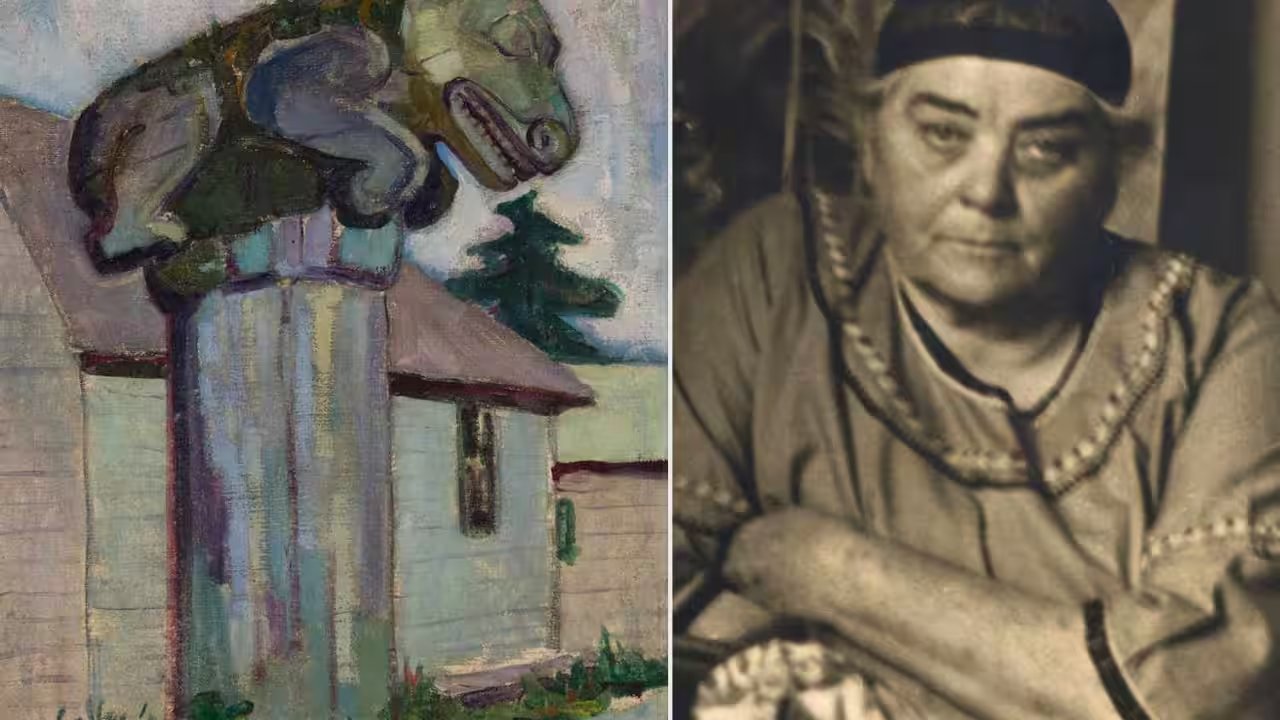
Allen Treibitz paid $50 for a dusty canvas at a Hamptons barn sale. He didn’t know who Emily Carr was. He certainly didn’t realize he was holding a piece of Canadian art history.
The painting, titled Masset, Q.C.I., depicts an Indigenous memorial post topped with a carved grizzly bear in a village on British Columbia’s Haida Gwaii archipelago. Painted in 1912, it captures a pivotal moment in Carr’s career when she was documenting landscapes and Indigenous subjects. Treibitz, a New York-based dealer, initially browsed the sale without recognizing the artist, but something about the piece caught his eye. He took it home, researched it online, and contacted Heffel Fine Art Auction House in Vancouver.
Heffel’s specialists confirmed the work was authentic. They also uncovered clues to its journey. An inscription on the reverse references an address on Boulevard Montparnasse in Paris, linking the painting to Carr’s study period in France around 1910 and 1911. Provenance records suggest Carr gifted the work to her friends Nell Cozier and her husband in the 1930s. The couple, originally from Victoria, moved to the Hamptons to work on a large estate. The painting sat in their barn for decades, overlooked amid clutter, until Treibitz stumbled upon it.
Heffel listed the 41 by 33-centimetre oil on canvas for its November 20, 2024, Toronto auction. The estimate stood at C$100,000 to C$200,000. Bidders pushed the price higher. The hammer fell at C$290,000. Including fees, the final price reached C$349,250. This result made the piece one of the most remarkable bargain finds of the year.
The sale underscores how high-value art can hide in plain sight, buried in rural storage. For Treibitz, it validates the instinct to trust a visual pull, even without immediate expertise. The painting now rests in a new collection, its journey from a Parisian address to a Hamptons barn to a Toronto auction room complete. Collectors will watch similar auction houses for hidden gems, knowing that a $50 find can rewrite an art dealer’s year.