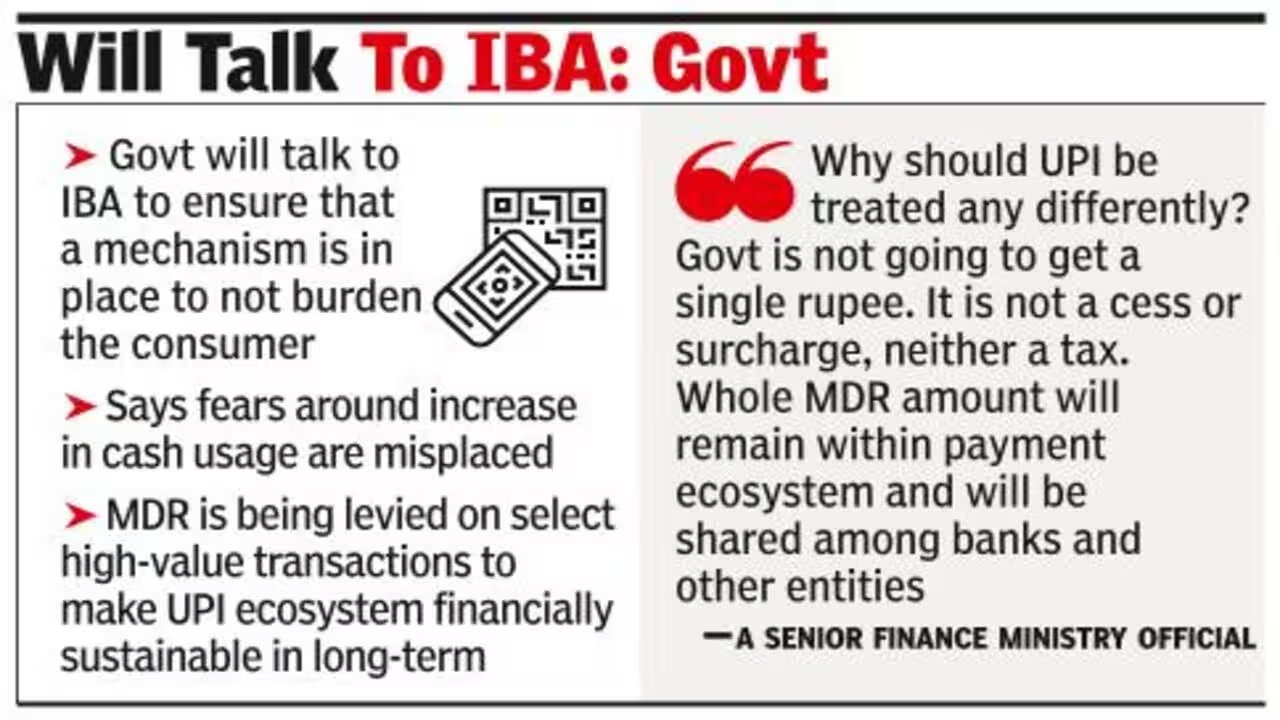
New Delhi, May 29, 2026 — The Finance Ministry has drawn a hard line: UPI users will not pay a single extra rupee. A senior finance ministry official stated on Thursday that the merchant discount rate (MDR) on Unified Payments Interface transactions must be treated identically to plastic card payments, meaning merchants will absorb the cost within the Maximum Retail Price (MRP).
The clarification comes as the new MDR regime kicks in next month, targeting select high-value transactions to fund India’s indigenous payment infrastructure. Currently, all person-to-person UPI transfers remain free regardless of amount, and merchant payments under Rs 2,000 carry zero MDR. RuPay debit card transactions also continue to enjoy this exemption. The official emphasized that the MDR is not a tax or cess; the revenue stays within the payment ecosystem, shared between banks and other entities to maintain servers, cybersecurity, and fraud detection systems.
But the government’s stance hinges on a forthcoming review by the GST Council. Officials are hopeful the council will take a "favourable" view regarding the 18% tax levied on UPI MDR charges, arguing that this tax burden indirectly affects common consumers. If the tax structure remains unchanged, the cost of running the ecosystem might still exceed the MDR collected, leaving the National Payments Corporation of India (NPCI) dependent on government support.
To prevent confusion at the point of sale, the government will engage with the Indian Bank Association (IBA) to ensure merchants do not quietly pass on costs. "IBA needs to hold awareness campaigns and outreach programmes, preferably in regional and local languages," the official said. While no formal advisory has been issued yet, talks are underway to establish a mechanism that protects consumers from indirect price hikes.
The move aims to make UPI financially sustainable for the long term, particularly as the system expands to feature phones in rural and semi-urban areas. With nearly 56 crore UPI users, the government argues there is substantial room for growth without burdening the average citizen. Fears of a return to cash are described as "misplaced," with the ministry ready to engage trader bodies to clarify that the MDR is a standard global practice for credit card systems, typically ranging between 1.5% and 3%.
The next critical step is the GST Council meeting scheduled for next month, where the 18% tax on MDR will be under scrutiny. If the council agrees to revise the tax, it could significantly lower the operational cost for merchants, reinforcing the government’s promise that digital payments will remain cheaper than their plastic counterparts.