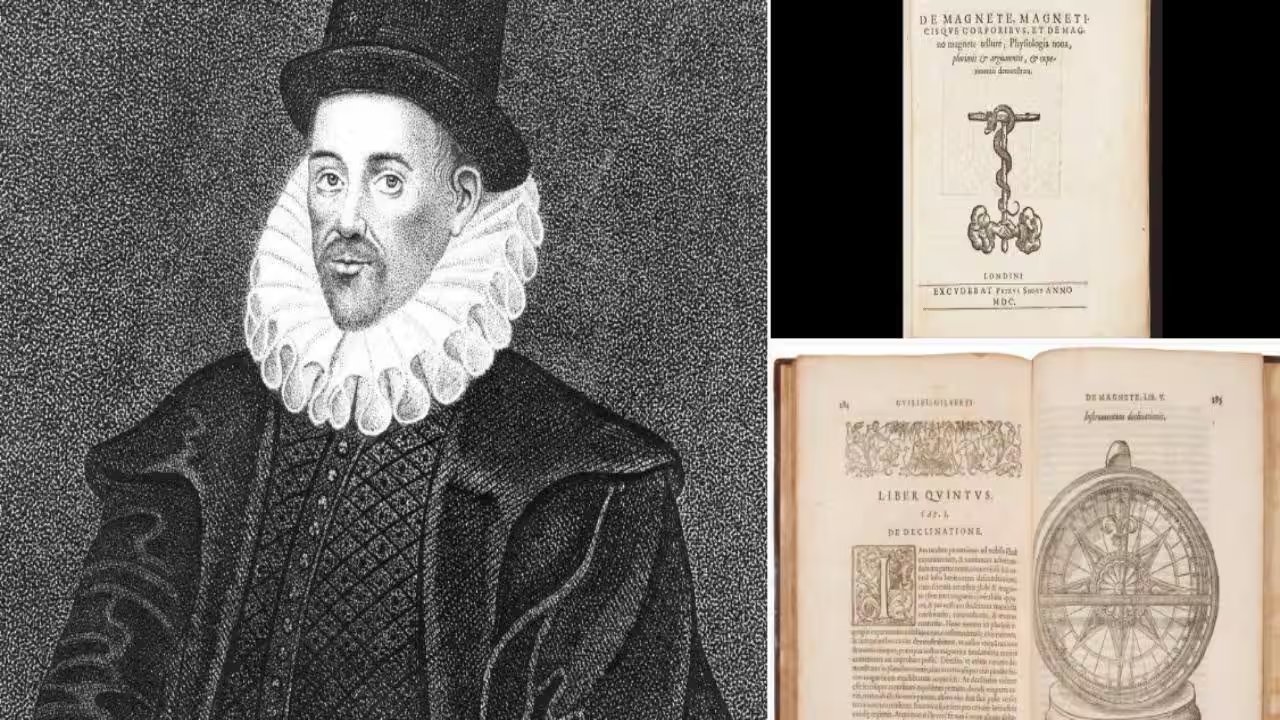
A first edition of William Gilbert's 'De Magnete,' the 1600 treatise that defined Earth as a giant magnet, sold for $61,440 at Christie's New York on October 13, 2026. The 17th-century volume, listed as Lot 61 in the Fine Printed Books, Manuscripts, and Science sale, exceeded its pre-sale estimate of $25,000–$35,000. The buyer, identified in the catalogue as a California collector, secured the copy for roughly Rs 58.5 lakh.
Gilbert, a physician to Queen Elizabeth I, didn't just guess about magnetism; he proved it. Using a spherical model called a terrella, he demonstrated that compass needles aligned with the Earth's own magnetic field. This experiment killed the prevailing idea that magnets were mere curiosities and laid the groundwork for modern geophysics.
The book also gave us the word 'electricity.' Gilbert studied amber, which attracts light objects when rubbed, and coined the Latin term 'electricus' to describe it. He distinguished this from magnetism, creating the vocabulary for a field that didn't yet exist. Without his taxonomy, we might still be calling it 'amber force.'
This specific copy has a storied pedigree. It once belonged to the Signet Library in Edinburgh, bearing the library's arms on its 18th-century calf binding. It sold at Sotheby's in 1960 and again at Christie's in 2014 before returning to the auction block. The volume features a woodcut printer's device and a large folding diagram measuring 28.2 by 18.4 centimetres.
The sale highlights the premium placed on foundational scientific texts. Collectors aren't just buying paper; they're buying the moment science shifted from philosophy to experiment. The next major milestone for this lineage of books will likely be the next major Christie's or Sotheby's science sale, where similar 17th-century works are expected to command six-figure sums.