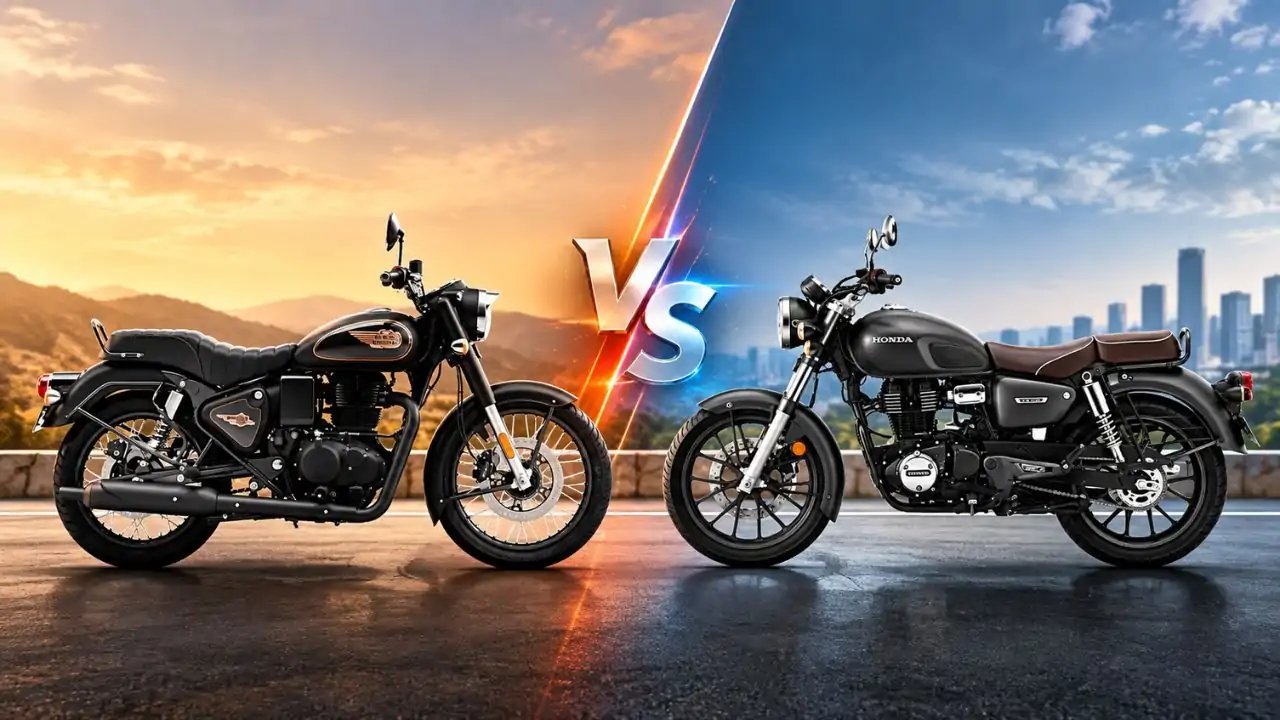
At ₹1.66 lakh, the Bullet 350 offers the cheapest 350cc single in India, a decisive point for first‑time buyers.
Both bikes share a 349cc, single‑cylinder layout, but the Bullet’s 20.2 bhp at 6,100 rpm and 27 Nm at 4,000 rpm sit a touch behind the CB350’s 20.7 bhp at 5,500 rpm and 29.4 Nm at 3,000 rpm. The earlier torque peak on the CB350 means it feels a bit punchier in stop‑and‑go traffic, while the Bullet’s slightly higher claimed mileage of 36.2 kmpl versus Honda’s 35 kmpl can translate to fewer fill‑ups on long rides.
On the road, weight matters: the CB350 comes in at 187 kg, 8 kg lighter than the Bullet’s 195 kg. That advantage shows up when shuffling through city lanes or parking in tight spots. The Bullet’s twin‑downtube cradle gives it a bit of a classic feel, whereas the CB350’s half‑duplex cradle feels a touch more modern.
Tech is where the two diverge most. The CB350 carries Honda Selectable Torque Control, RoadSync smartphone connectivity, and an assist‑and‑slipper clutch—features that the Bullet omits in favour of a digi‑analogue cluster, a USB port, and a pure retro aesthetic. If you value traction assistance and on‑board navigation, the CB350’s price premium pays off. If you prefer a lower cost, classic styling, and better claimed fuel efficiency, the Bullet is the pragmatic pick.
Both models are currently available across major Indian cities. Test‑riding will reveal whether the CB350’s extra tech and lighter weight justify its higher price, or whether the Bullet’s affordability and heritage still win the day for most buyers.