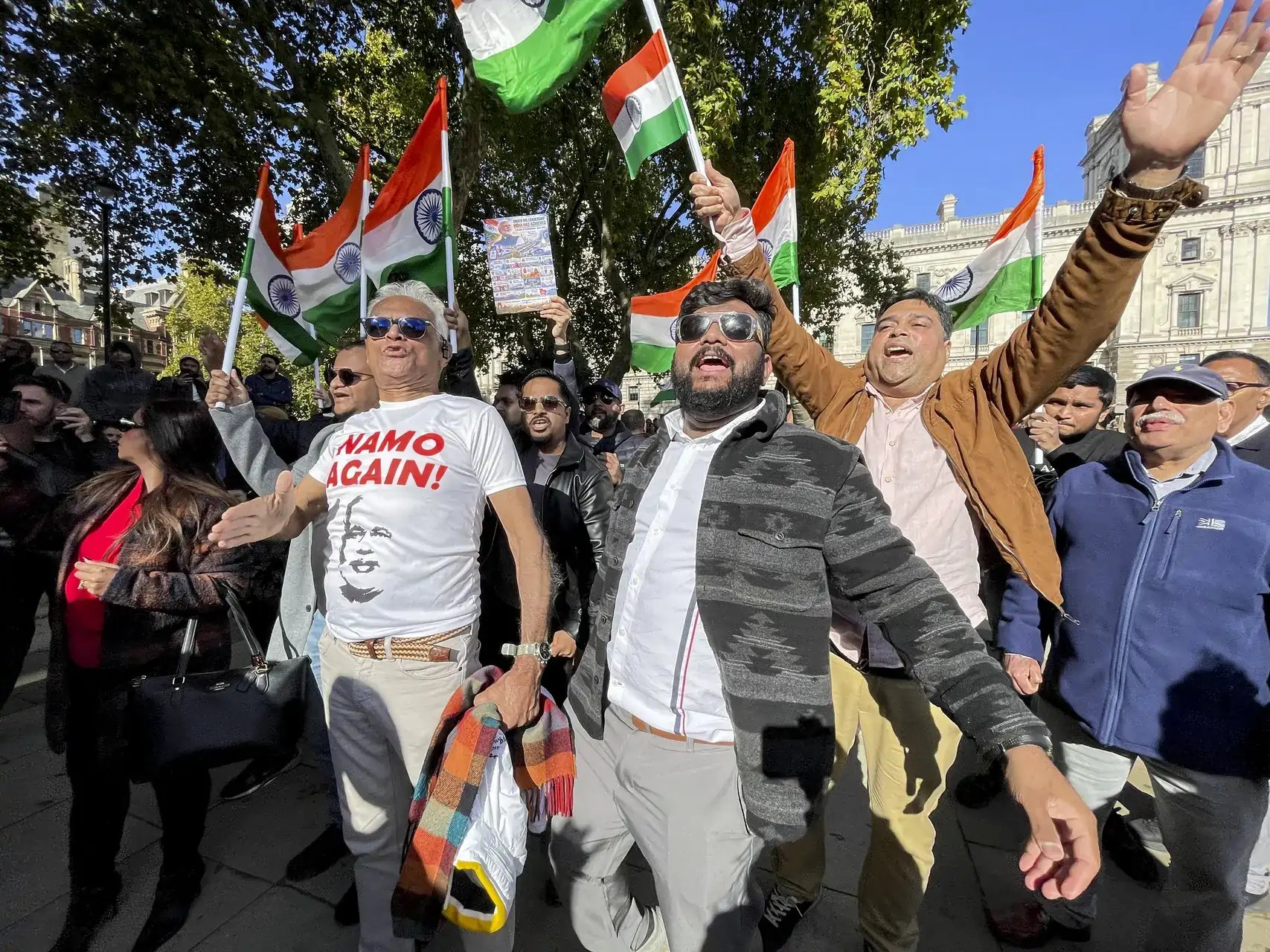
The quiet dignity of Mahatma Gandhi’s statue in London’s Parliament Square shattered on Saturday. Hundreds of Indian diaspora members descended on the site, not for a memorial, but for a political war. Metropolitan Police officers formed a physical barrier between two screaming factions, separating the 'Stop Vote Chori' protesters from a smaller but loud group chanting 'Modi, Modi.'
Dhruv Rathee, the activist who has become a polarizing figure in Indian social media, took the stage as the keynote speaker. He addressed the crowd in Hindi, framing the protest as a defense against 'foreign interference' and a demand for democratic purity. "We don't want any foreign interference," Rathee said, his voice cutting through the noise. "These protests will stop the moment the Chief Election Commissioner is replaced by a candidate chosen in agreement between the government and the Leader of the Opposition." His speech was punctuated by slogans like 'Inquilab Zindabad' and 'Vande Mataram,' echoing the rhetoric of the 'Emergency Protest' held earlier in the week.
Across the police line, the mood was distinctly different. Hirdesh Gupta, founder of India Diaspora (ID) UK, had issued an 'Urgent appeal' to 'London Bharat Premi Janta' to counter the opposition. Gupta stood with his supporters, declaring that the diaspora stands 'shoulder to shoulder' with Prime Minister Modi. "We are here for a strong, united, and developed India," Gupta said, his stance a direct rebuttal to the 'vote chori' (vote theft) narrative gaining traction online. The face-off turned heated as each group attempted to drown out the other’s chants, a sonic battle that the Metropolitan Police struggled to contain.
This confrontation is the latest escalation in a series of events triggered by the 'Cockroach Janata Party' (CJP) movement, which has mobilized the diaspora to demand the removal of Chief Election Commissioner Gyanesh Kumar. The Election Commission of India maintains that the Special Intensive Revision (SIR) is a standard procedure to update electoral rolls by identifying deceased, duplicate, or ineligible entries. However, critics argue the process is flawed and politically motivated. The outcome of these protests remains uncertain, but the next major gathering is expected following the upcoming Supreme Court hearing on related petitions challenging the CJI's authority.