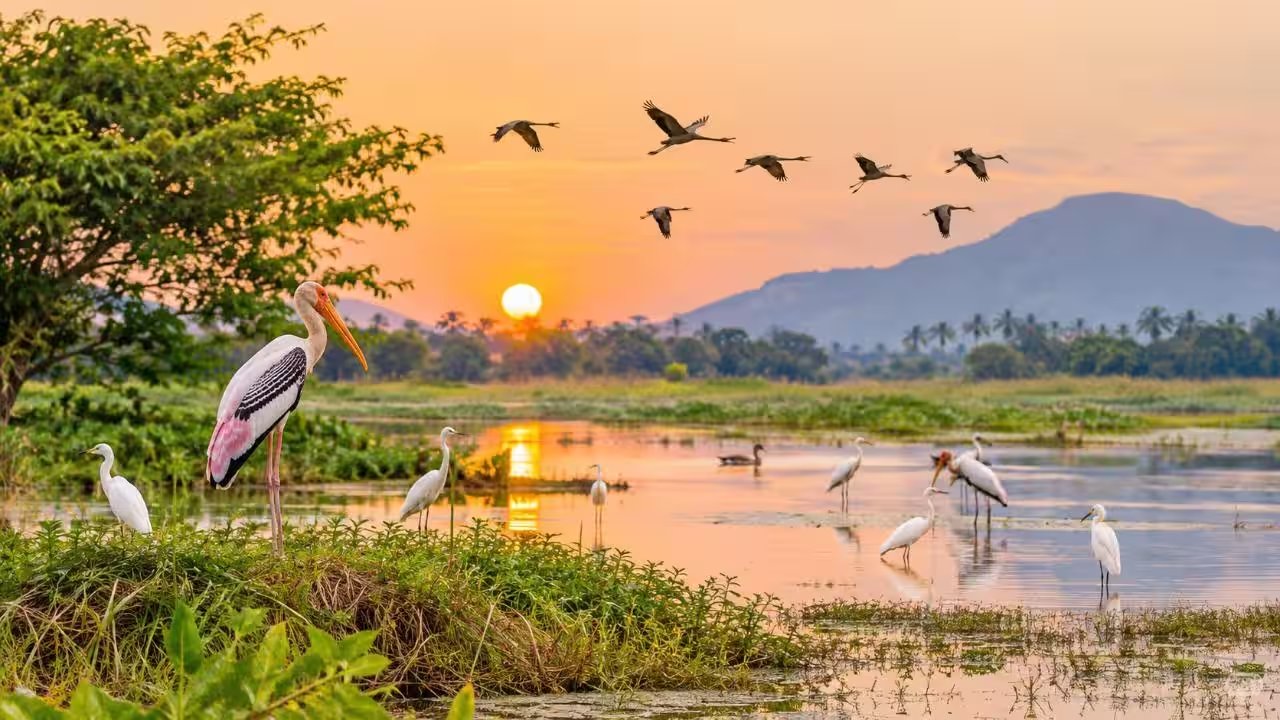
Night fell over Erode, but the skies stayed pitch-black and silent. No deafening aerial bombs rattled the tree canopies. No sulfur fumes choked the wetland air.
For the 21st consecutive year, families across more than 10 villages bordering the Vellode Bird Sanctuary gave up firecrackers this Diwali. They chose silence over spectacle. The community pact shields more than 20,000 resident and migratory waterbirds that flock to the freshwater lake every autumn, sparing fragile flocks the disorientation, terror, and physical trauma caused by concussive blasts.
The sanctuary spans 77.185 hectares in Perundurai taluk, roughly 12 kilometres from Erode town. At its heart lies Periyakulam, an expansive freshwater lake fed by seasonal monsoon rains and seepage from the Lower Bhavani Project canal system. The water irrigates nearby agricultural belts and anchors one of western Tamil Nadu’s most vital aquatic havens. The Tamil Nadu Forest Department notified the perimeter as a protected reserve under the Wildlife (Protection) Act, 1972, through an official order on February 29, 2000.
Ten core agrarian settlements ring the waterbody: Vadamugam Vellode, Sellappampalayam, Pungambadi, Mettupalayam, Ellapalayam, Semmandampalayam, Karukkankattu Valasu, Koothampalayam, Vadagalpudur, and Kalarpalayam. In each hamlet, the festival followed a quiet, deliberate routine. Households bought new clothes, prepared traditional sweets, and lit oil lamps along their courtyards. Children voluntarily put away loud aerial crackers, lighting only sparklers or stepping back from pyrotechnics entirely so roosting flocks remained undisturbed.
The restraint stems from two decades of shared domestic habit rather than police enforcement. Villagers recognized early that sudden flashes and concussive shocks caused roosting birds to abandon nests, drop eggs, or collide with tree lines in blind panic.
Local geography raises the conservation stakes. Data from the Tamil Nadu Wetlands Mission logs 148 bird species at Vellode, establishing the sanctuary as an integral stopover along the Central Asian Flyway. Long-distance fliers pour in from Sri Lanka, Nigeria, the Himalayan ranges, and Australia. The lake supports dense feeding grounds of spot-billed pelicans, Eurasian spoonbills, western marsh harriers, bar-headed geese, black-tailed godwits, and blue-tailed bee-eaters, alongside thriving populations of storks, ibises, egrets, and cormorants.
The wetland now enters its peak winter birding window, accessible via the Erode-Chennimalai road, with Erode Junction 15 kilometres away and Coimbatore International Airport 90 kilometres to the west. While regional sanctuaries across south India face creeping urban noise, Vellode's buffer remains intact—held firm by neighbours who refuse to ignite a single shell.