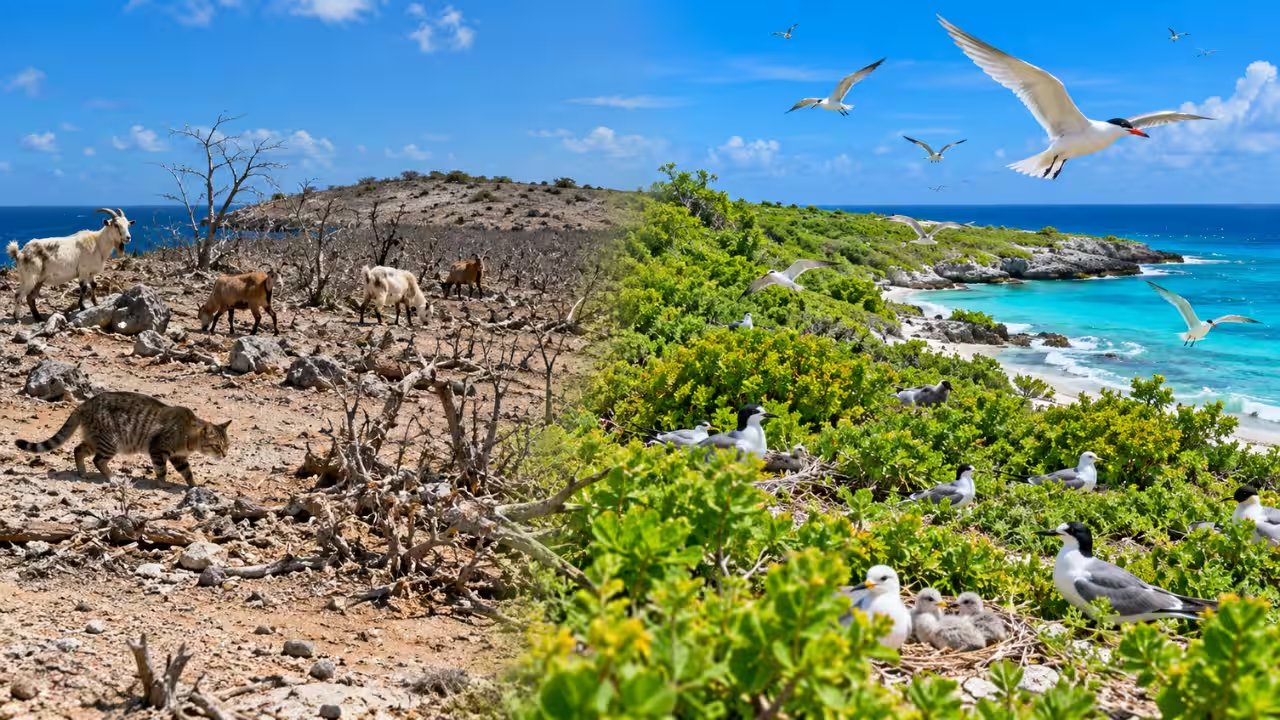
The Carmabi Foundation launched a comprehensive eradication and restoration program on Klein Curacao in the early 1990s, removing a feral goat herd that had decimated the island’s scrub for over a century. Cat removal followed in October 2001, after a grim discovery of a littered Least Tern colony in July of that year. Concurrently, between August 2000 and November 2005, 58 native plant species were transplanted from the main island, including 1,174 saplings and 482.7 kg of succulent cuttings, reshaping a landscape that had been flattened by guano mining and grazing.
The island’s transformation was quantified through bi‑annual surveys conducted by ornithologists Rob Wellens and Henriette de Vries. Using the research vessel Mermaid, they logged sightings, photographs, and GPS coordinates into the eBird database from January to December 2021 and 2022. Their meticulous work documented nine species nesting, a dramatic jump from the single Least Tern colony recorded in 2002.
Cayenne Terns now number roughly 500 pairs in 2022, up from 230 the previous year, while Laughing Gulls hold about 75 breeding pairs—a first confirmed breeding record for the species on the island. Sooty Terns expanded from nine to 40–45 pairs, and Bridled Terns, Roseate Terns, and Common Terns each produced their first documented chicks. The island also hosts the first-ever Green Heron and American Oystercatcher breeding pairs in the region. With 650 pairs across all species in 2022, Klein Curacao has become the Caribbean group’s most diverse seabird breeding site.
Despite this success, the research team warns that invasive species could return, and climate‑driven sea‑level rise threatens nesting habitats. Continuous monitoring and community engagement have been pledged by the Carmabi Foundation to sustain this ecological recovery.
Local stakeholders, including fishing families who once relied on the island’s guano, now see a new economic opportunity: eco‑tourism and research visits, signalling a shift from exploitation to stewardship.
The next phase will involve a formal Ramsar designation review in 2024, aiming to lock in conservation status and secure funding for long‑term habitat management.