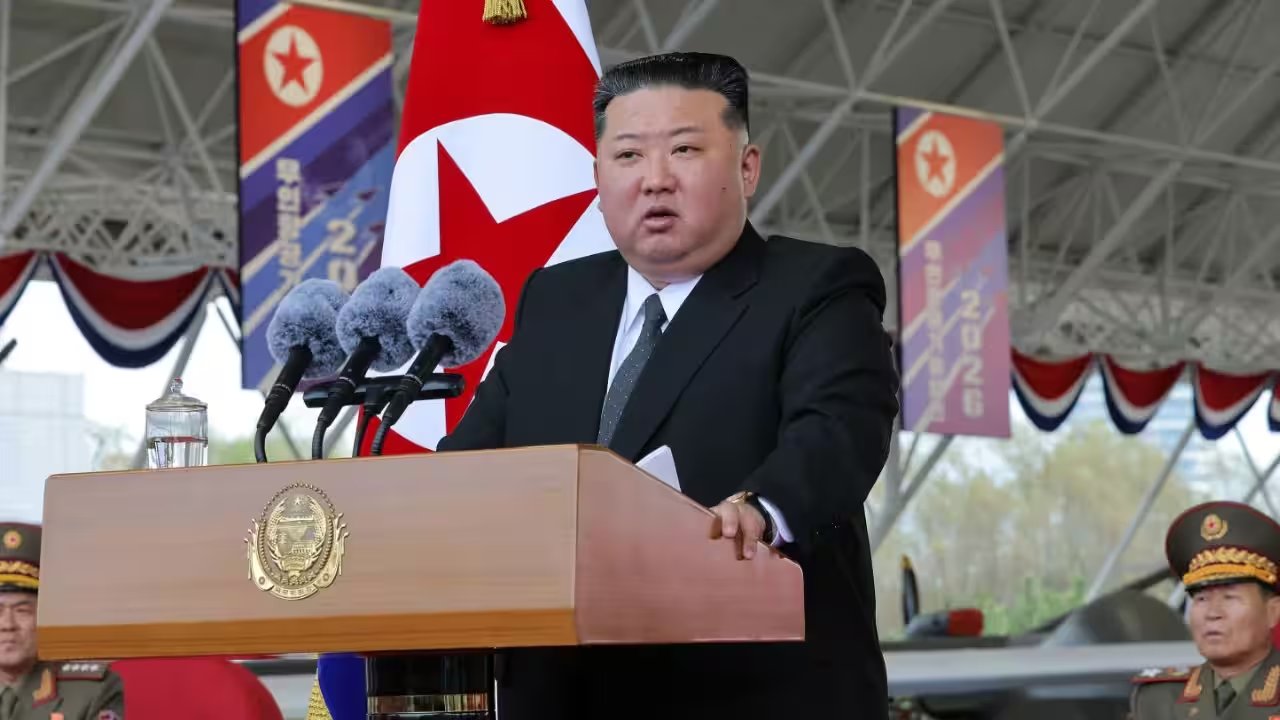
North Korea has published its overhauled socialist constitution, formally striking down decades of reunification doctrine and classifying South Korea as an alien, hostile neighbouring country.
The shift ends an era.
Published Wednesday on state propaganda portal Naenara following a two-and-a-half-year digital blackout, the charter codifies leader Kim Jong-un's hardline mandate to dismantle historical ties with Seoul and realign borders across the peninsula. The constitutional overhaul stems from the first session of the 15th Supreme People's Assembly convened on March 23, where delegates passed sweeping statutory revisions behind closed doors.
Article 2 delivers the sharpest geopolitical break. For generations, Pyongyang claimed the entirety of the Korean Peninsula under its sovereign mantle. Not anymore.
The revised clause explicitly defines North Korean territory as the land flanked by China and Russia to the north and bounded by the "Republic of Korea" to the south, alongside affiliated territorial waters and airspace. By inserting South Korea’s formal constitutional name into the document, the North legally recognises the South as an external, separate country.
Yet the text stops short of defining precise cartographic limits. It lists no coordinates, latitude markers, or maritime boundaries, leaving unresolved border tensions along the demilitarised zone and disputed naval lines.
Every prior statutory reference to peaceful reunification or common national destiny has been purged from the text.
Pyongyang did not stop at redrawing borders. The revised basic law dramatically expands the constitutional remit of the chairman of the State Affairs Commission—the supreme state executive office occupied by Kim.
The text places the nation's nuclear arsenal squarely under the chairman's operational command. More critically, the language establishes a legal basis for Kim to delegate the power to deploy and fire nuclear weapons to a specialised state nuclear command organisation.
The clause signals operational readiness.
By codifying delegated launch authority, Pyongyang creates an institutional fail-safe mechanism against targeted attacks on its core leadership, ensuring retaliatory launch protocols can execute even if communication lines to the supreme leadership shatter.
| Constitutional Parameter | Previous Framework | Revised 15th Assembly Charter |
|---|---|---|
| Status of South Korea | Part of unified Korean nation | Separate border country ("Republic of Korea") |
| National Reunification | Core constitutional mandate | Stripped entirely from all articles |
| Nuclear Command Structure | Implicit supreme authority | Direct command with statutory strike delegation power |
| Territorial Definition | Peninsula-wide sovereign claim | Bounded explicitly by China, Russia, and South Korea |
Curiously, the document released on Naenara conceals key administrative passages.
Portions of two specific articles remain missing from the public text. One omitted passage governs the Cabinet's statutory authority to adopt resolutions during plenary meetings. The other suppresses procedures governing the election of lay judges assigned to special courts.
State officials have not clarified whether assembly delegates struck those specific mechanisms during the March 23 legislative session or whether state censors blacked them out immediately before uploading the document.
Diplomatic and security planners in Seoul and Washington now face a solidified legal landscape in Pyongyang—one where inter-Korean diplomacy has been systematically replaced by the mechanics of mutual deterrence.