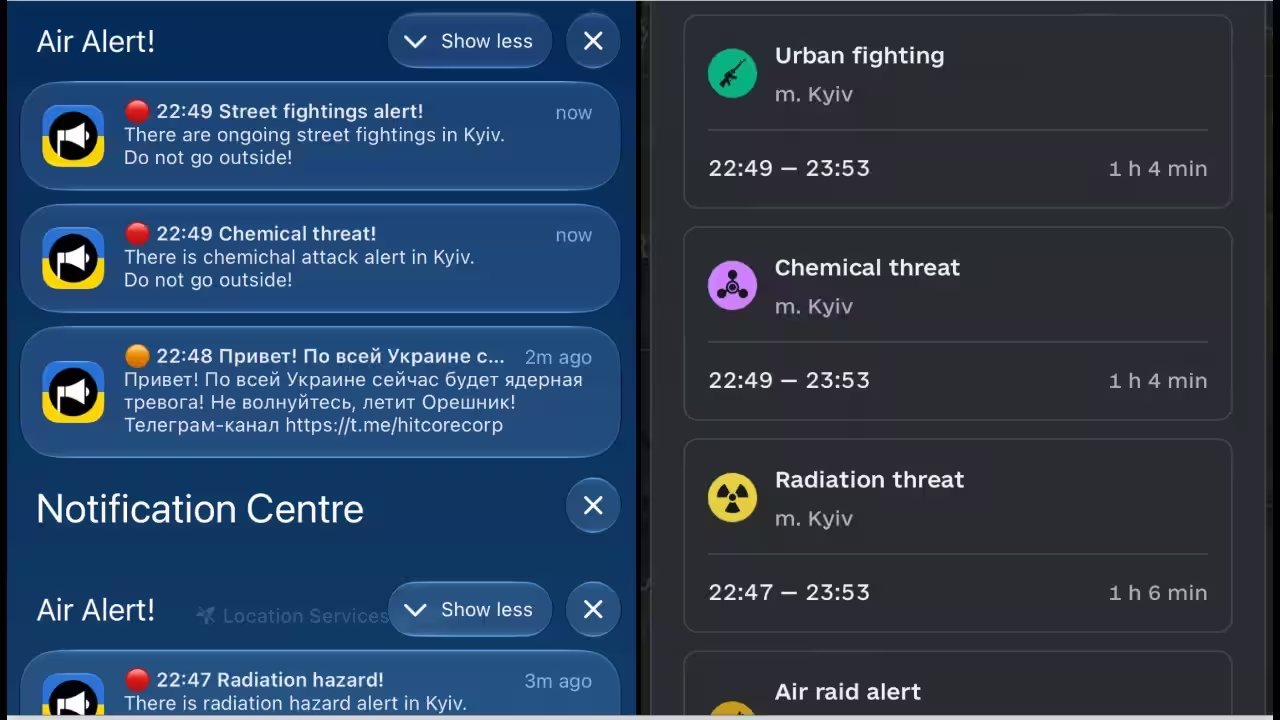
Ukrainian residents woke up to a digital nightmare late Sunday when the government's emergency alert app was hijacked to broadcast false warnings of a nuclear threat. The messages, appearing in English, Russian, and Ukrainian, claimed an "Oreshnik" ballistic missile was incoming and that radiation levels were critical. These fabricated alerts contained glaring spelling and grammatical errors in the English text, a tell-tale sign of the hack that Ukrainian authorities quickly identified. The app, a lifeline for tracking Russian drone strikes, was temporarily suspended but is now back online.
A Telegram channel linked to Russian security services claimed the hacking group Hitcore was responsible for the breach, though this claim remains independently unverified. The attack wasn't isolated to Kyiv. In Russia, the Emergency Situations Ministry confirmed that false alerts blasted through the official app at 2:45 a.m. Monday, affecting 33 of the country's 89 regions. While it is unclear if the two incidents are directly connected, the timing suggests a coordinated effort to destabilize digital infrastructure in both nations.
Panic did not set in. Instead of fleeing to bunkers, Ukrainians took to social media to mock the hackers, sharing memes of pets and AI-generated apocalypse scenes. Air Force Spokesman Yurii Ihnat stated on television that the cyberattack had zero impact on actual air defense operations. The Ukrainian Center for Countering Disinformation advised citizens to ignore the hacked app and rely on traditional sirens and other verified channels.
The breach lands at a precarious moment. A limited ceasefire in the southern Kherson region expired on Monday, ending a brief window for humanitarian aid into occupied areas like Oleshky. In Moscow, Kremlin spokesman Dmitry Peskov acknowledged the threat, noting that government agencies face constant cyberattacks increasingly powered by artificial intelligence. He ordered all state bodies to urgently fortify their digital defenses against future intrusions.