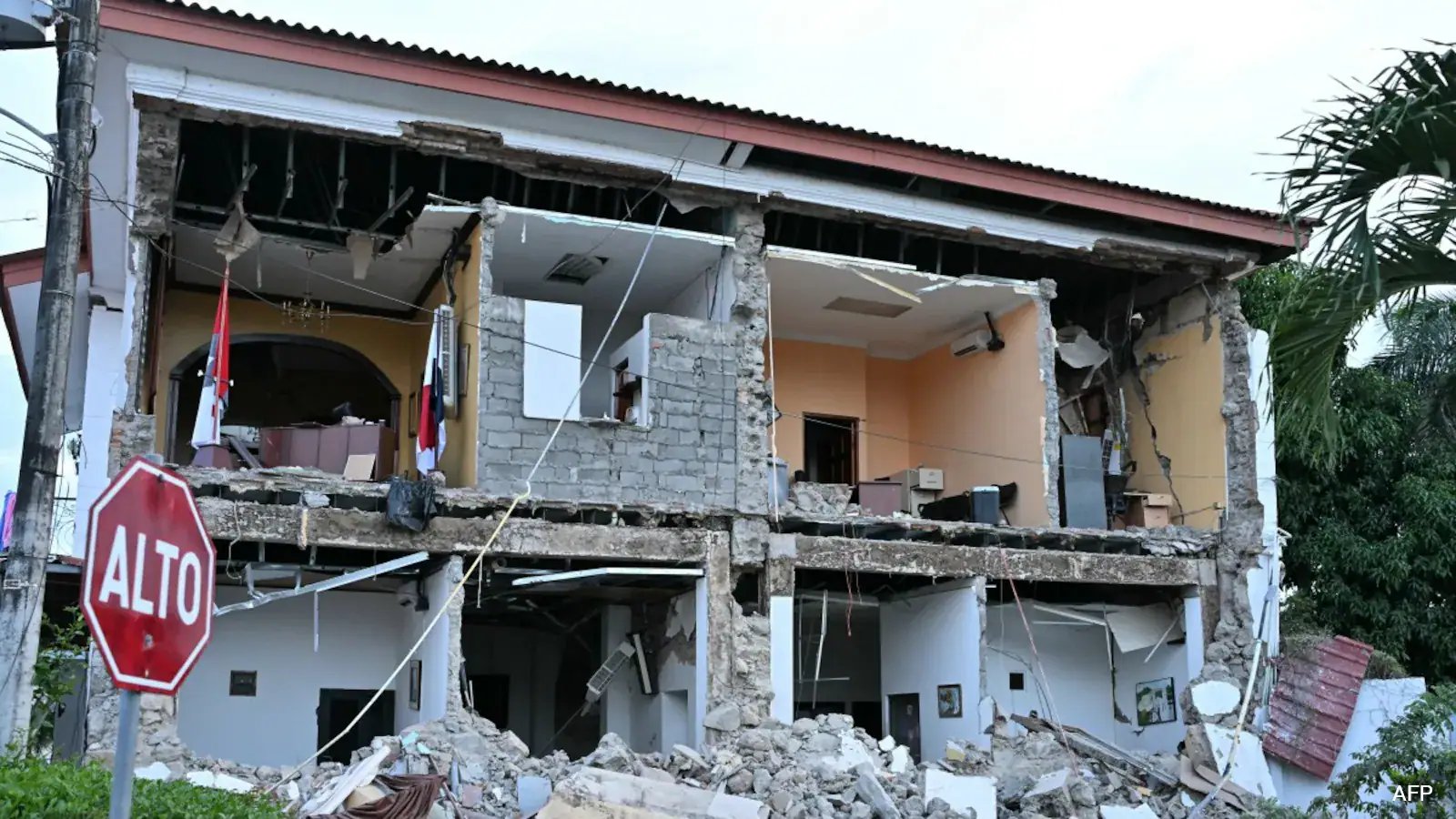
President Jose Raul Mulino stood in the rubble of central Panama on Friday and declared a "major disaster," acknowledging that roads in the worst-hit zones had "completely collapsed." The 7.7-magnitude tremor struck at 17:56 GMT, its epicenter just 10 kilometers from the small town of Pitaloza Arriba in Herrera province. Though the US Geological Survey initially flagged the quake as a magnitude 8.0 before revising it down, the shallow depth turned the event into a violent, minute-long shudder felt by all 4.5 million residents of the nation.
In Panama City, 200 kilometers from the epicenter, the panic was immediate and visceral. Salomon Andion, 46, described the scene inside his 15-story building: "I was scared because the shaking was very strong and prolonged. Heavy objects like dressers, the bed, and all the kitchen items were shaking." He evacuated twice as aftershocks rolled in. Videos circulating on social media showed water cascading from the rooftop pool of a 20-story tower, while another captured the Panama Canal bridge shuddering violently yet holding firm as traffic continued to cross it.
The human cost is emerging slowly but grimly. Juana Alveo, a 38-year-old cashier in Penonome, central Coclé province, told AFP, "It was horrible, like nothing we ever experienced. My daughter was trapped in school." Health Minister Fernando Boyd identified Herrera, Coclé, and Los Santos as the hardest-hit provinces. Tonosi, a town in Los Santos, is completely isolated; land access is impossible, and the government is racing to establish an air bridge to deliver supplies.
Infrastructure damage extends beyond the coastal hub. Panama City’s international airport, a critical regional node, temporarily closed its gates, forcing the diversion of multiple flights. Former president Ricardo Martinelli posted images on Instagram of his home in Sona, Veraguas province, which had collapsed. A church and a hotel in Penonome also suffered extensive structural failure. The Panama Canal Authority confirmed that shipping operations remained "as normal," a critical economic lifeline for the global trade route.
The aftershocks show no sign of ceasing. The local geosciences institute recorded over 80 tremors, including one exceeding magnitude 6.0. Mulino, writing on X, urged citizens not to succumb to "alarms and disorder," while the education ministry suspended classes nationwide. This is the fourth 7.0+ magnitude quake in Latin America this year, following devastating strikes in Venezuela and Colombia. Leaders from Colombia, Ecuador, and Guatemala have already offered aid, but for now, the focus is on the air corridor to Tonosi and the structural integrity of the capital’s skyline.