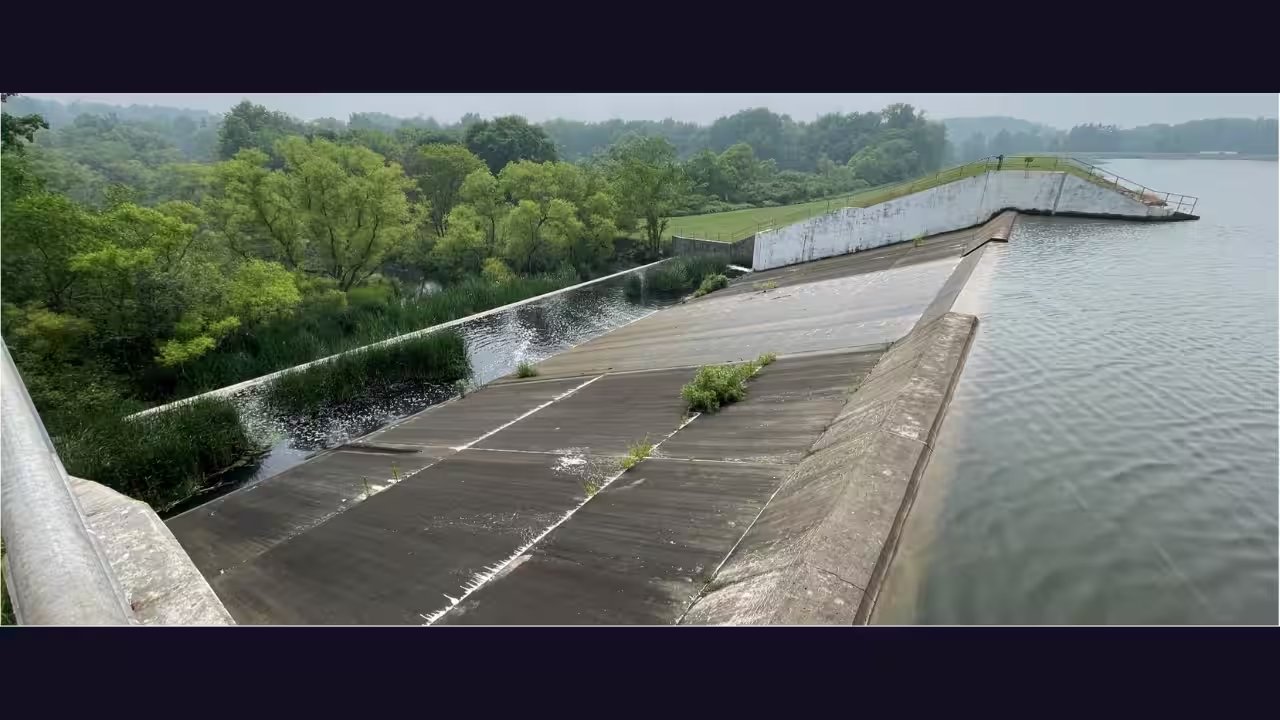
Water is gone from 20 feet of Guilford Lake’s basin. The Ohio Department of Natural Resources (ODNR) executed a full drawdown to replace a crumbling spillway and stabilize the dam’s embankment. This isn’t cosmetic maintenance; engineers found the concrete joints separating and the internal drainage system past its design life. Without this intervention, the structure couldn’t safely handle the Probable Maximum Flood (PMF).
The stakes are concrete. The old spillway lacked the capacity to pass the PMF without overtopping the embankment, a scenario that threatens downstream communities. The Ruhlin Company, approved as the contractor in October 2025 after the state’s Controlling Board released the funds, is now pouring the cutoff walls for a new labyrinth spillway. As of the June 2026 update, the old spillway is demolished, and installation of a new toe drain has begun on the eastern side. The stilling basin is next in the concrete queue. This $14 million project aims to restore the dam to modern safety standards, ensuring it can manage major flood events without putting lives at risk.
For local residents, the landscape has shifted dramatically. The exposed lakebed is off-limits to vehicles, and ODNR has issued a stark warning: do not touch the ice. Water levels are fluctuating, making the surface unpredictable and dangerous. While the state park campground remains open and fishing is permitted outside the construction zone, swimming is banned across the entire lake. Public access to the active work site is strictly prohibited, with the project monitored remotely. Progress photos are posted on the Guilford Lake State Park Facebook page, offering a digital window into the physical transformation. Most work accesses the site through the southeastern entrance, keeping major road closures to a minimum.ODNR projects substantial completion for winter 2026–27. That is when the lake will begin to refill. The target for normal operating levels is spring 2027, weather permitting. The dam, originally built in 1933 and modified in 1957, 1968, and 1983, finally gets the structural overhaul it needs to serve another few decades.